Advertisements
Online Mock Tests
Chapters
1: Forces: Turning Forces and Uniform Circular Motion
2: Work, Power and Energy
3: Machines
(B) Light
▶ 4: Refraction of Light
5: Electromagnetic Waves and Spectrum
(C) Sound
6: Sound
(D) Electricity and Magnetism
7: Electric Circuits, Resistance and Ohm's Law
8: Electric Energy, Power and Household Circuits
9: 1. Electromagnetism 2. Magnetic Effects of Electric Current 3. Electromagnetic Induction
(E) Heat
10: Calorimetry
(F) Modern Physics
11: Radioactivity
Advertisements
Solutions for Chapter 4: Refraction of Light
Below listed, you can find solutions for Chapter 4 of CISCE Goyal Brothers Prakashan for A New Approach to ICSE Physics [English] Class 10.
Goyal Brothers Prakashan solutions for A New Approach to ICSE Physics [English] Class 10 4 Refraction of Light NUMERICAL PROBLEMS [Page 69]
The refractive index of glass, when a ray of light travels from air to glass is 1.5. Calculate the refractive index when light travels from glass to air.
Practice Problem 1:
The ratio between the sine of angle of incidence in water to the sine of angle of incidence in air is 0.75 . Calculate \({}^{a}\mu_{w}.\)
Goyal Brothers Prakashan solutions for A New Approach to ICSE Physics [English] Class 10 4 Refraction of Light EXERCISE-1 [Pages 71 - 75]
What do you understand by the optical medium?
Give two examples of optical medium.
What do you understand by the term refractive index of an optical medium?
How is refractive index related to velocity of light in vacuum to the velocity of light in a given medium?
What do you understand by the statement that refractive index of ordinary glass is 1.5?
With reference to refraction of light, define the following:
Incident ray
With reference to refraction of light, define the following:
Refracted ray
With reference to refraction of light, define the following:
Angle of incidence
With reference to refraction of light, define the following:
Angle of refraction
A ray of light is incident on a glass slab. Which is greater the angle of incidence or the angle of refraction.
- When the ray travels from air to glass?
- When the ray travels from glass to air?
- State two laws of refraction of light.
What is lateral displacement?
State two factors which determine lateral displacement of a medium.
A coin placed at a depth of 16 cm in a water tub, appears at a depth of 12 cm. What is the refractive index of water?
A postage stamp placed under a glass slab of refractive index 1.5, appears raised by 0.8 mm. What is the thickness of glass slab.
Explain the following:
A stick immersed in water obliquely, appears bent and short?
Explain the following:
A stamp placed under glass slab appears raised.
Explain the following:
Why is twilight formed before sunrise and after sunset?
Explain why the planets do not twinkle but the stars twinkle.
Write a relationship between the angle of incidence and angle of refractions for a given pair of media.
How is the refractive index of a material related to real and apparent depth?
How is refractive index related to velocity of light in vacuum to the velocity of light in a given medium?
Why do the faces of persons sitting around campfire appear to shimmer?
Explain the following:
Why does a water tank completely filled with water, when seen obliquely from above appear shallow?
Why does a fisherman aim at the tail of fish during spearfishing?
Explain the following:
Why are more than one image formed in a thick glass mirror?
Why does the sun appear bigger during sunset or sunrise?
Draw a ray diagram to show that apparent depth of a pond filled with water is less than the real depth of pond.
A ray of light travelling in medium I, strikes medium II at angle (not zero or more than 90°) and passes out of it without any change of direction. What can you say about the refractive indices of the medium I and II? Explain.
State two differences between reflection and refraction of light.
A ray of light strikes a glass prism at angle of 90° to the surface of prism.
- What is the angle of incidence?
- What is the angle of refraction?
- Will the ray suffer refraction?
The refractive index of diamond is 2.42. What is the meaning of this statement?
A ray of light is incident obliquely from air to glass slab.
- Draw a labelled diagram showing the change in the path of ray, when it emerges out of glass slab.
- Name two rays of light which are parallel to each other.
- Mark the lateral displacement in the above diagram.
- How are the angle of incidence and angle of emergence related to each other?
A ray of monochromatic light enters a liquid from the air as shown in the diagram given below:
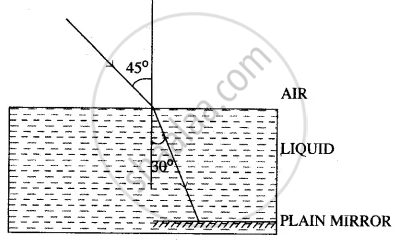
Copy the diagram and show in the diagram the path of the ray of light after it strikes the mirror and re-enters the medium of air.
A ray of monochromatic light enters a liquid from the air as shown in the diagram given below:
Mark in your diagram the two angles on the surface of separation when the ray of light moves out from the liquid to air.
\({ }^{\mathrm{Air}} \mu_{\text {Liq }}\) is 1.4 what is the value of \({ }^{\mathrm{Liq}} \mu_{\text {Air }}\)?
A ray of light moves from a rarer medium to a denser medium as shown in diagram alongside.
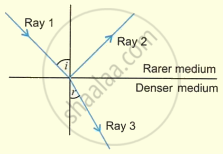
- Write down the number of ray which is reflected partially.
- Write down the number of ray which is refracted from its path.
- What is the ratio between \(\sin \text{‘}i\text{’}\) and \(\sin \text{‘}r\text{’}\) is called?
- Is this ratio constant as long as the nature of media involved is constant?
A ray of light is moving from a rarer medium to a denser medium and strikes a plane mirror placed at 90° to the direction of the ray as shown in the diagram.
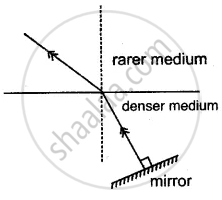
(i) Copy the diagram and mark arrows to show the path of the ray of light after it is reflected from the mirror.
(ii) Name the principle you have used to mark the arrows to show the direction of the ray.
A ray of light is incident as a normal ray on the surface of separation of two different media. What is the value of the angle of incidence in this case?
Refractive index of diamond with respect to air is 2.5. What will be refractive index of air with respect to diamond?
A coin placed at the bottom of a 2 litre beaker filled with water appears raised by 6 cm. If the refractive index of water is `4/3`, find the depth of water in the beaker.
A ray of light passes from water to air. How does the speed of light change?
Which colour of light travels fastest in any medium except air?
Name one factor that affects the lateral displacement of light as it passes through a rectangular glass slab.
Speed of light in glass is 2 ×10⁸ ms−1. What is refractive index of glass?
Jatin puts a pencil into a glass container having water and is surprised to see the pencil in a different state.
- What change is observed in the appearance of the pencil?
- Name the phenomenon responsible for the change.
- Draw a ray diagram showing how the eye sees the pencil.
MULTIPLE CHOICE QUESTIONS Choose the most appropriate option.
When a beam of light strikes a glass slab a part of it is:
reflected
absorbed
transmitted
all of these
The phenomenon due to which a ray of light deviates from its path while travelling from one optical medium to another optical medium is called ______.
dispersion
refraction
reflection
diffraction
When a ray of light travelling in an optically denser medium, emerges into an optically less denser medium, it ______.
deviates towards the normal
deviates away from normal
does not deviate
gets reflected
A ray of light strikes a glass slab at 90∘. The angle of incidence is:
90°
zero
less than 90°, but not zero
none of these
Two media 'a' and 'b' have same refractive index. A ray of light travelling from medium 'a' to medium 'b' will suffer:
refraction at the interfaces
partly suffer reflection at the interfaces
partly gets absorbed in medium 'b'
both partly suffer reflection at the interfaces and partly gets absorbed in medium 'b'
A ray of light on entering from medium 'a' to medium 'b' does not suffer refraction. The angle of incidence in medium 'a' is:
90°
zero
45°
60°
During sunrise or sunset, the sun appears bigger because the rays of light coming from it pass through ______.
larger length of atmosphere
smaller length of atmosphere
the earth gets closer to sun
none of these
The highest refractive index is of ______.
Glass
Water
Diamond
Ruby
cold air
During spear fishing a fisherman aims at the:
tail of fish
head of fish
slightly ahead of the head of fish
none of these
When a ray of light enters into another optical medium, its wavelength and velocity change. The material in which wavelength and velocity decrease maximum, when the ray is travelling through air is:
alcohol
diamond
glass
water
A thick glass slab with a silvered side forms multiple images on account of:
reflection of light
total internal reflection of light
refraction of light
all of these
A ray of light is incident on a glass prism at an angle of 60°, while travelling from air to glass. The angle of refraction in glass is:
more than 60°
less than 60°
equal to 60°
none of these
A ray of light travelling from glass to air, strikes the surface of separation at an angle of x°, such that angle of refraction is y°. In such a case the ratio of sin x to the sin y is:
refractive index of glass with respect to air
refractive index of air with respect to glass.
either (a) or (b)
neither (a) nor (b)
A rays of light AB enters into a glass slab at an angle of 45°. It emerges out from the opposite face of glass to form emergent ray CD. The ratio between the angle of incidence and angle of emergence is:
2 : 1
1 : 2
1 : 1
none of these
In a ray of light travels from air to water, the ratio between $$\sin i$$ and $$\sin r$$ is denoted by $${}^{a}\mu_{w}$$. However, when the ray of light emerges from water to air the ratio of $$\sin i$$ and $$\sin r$$ is denoted by $${}^{w}\mu_{a}$$. The relation between $${}^{a}\mu_{w}$$ and $${}^{w}\mu_{a}$$ is:
$$^{a}\mu_{w} = \dfrac{1}{{}^{w}\mu_{a}}$$
$$\dfrac{{}^{a}\mu_{w}}{{}^{w}\mu_{a}} = 1$$
$$^{a}\mu_{w} \times {}^{w}\mu_{a} = 1$$
both $$^{a}\mu_{w} = \dfrac{1}{{}^{w}\mu_{a}}$$ and $$^{a}\mu_{w} \times {}^{w}\mu_{a} = 1$$
For a rectangular glass slab the incident ray and emergent ray are:
convergent and meet at some distance away from the glass slab
divergent and do not meet at some distance away from glass slab.
parallel to each other and hence do not meet.
all of these.
When a ray of light emerges out of a glass slab, then:
∠i = ∠e
∠i > ∠e
∠i < ∠e
none of these
The speed of light in a medium M is $$2.5 \times 10^{8} \mathrm{~ms}^{-1}$$. If the speed of light in air is $$3 \times 10^{8} \mathrm{~ms}^{-1}$$, the refractive index of the medium is:
1.20
1.15
1.25
1.18
The speed of light in diamond of refractive index 2.5 is:
[vAir = 3 × 10⁸ ms−1]
1.25 × 10⁸ ms−1
1.20 × 10⁸ ms−1
1.18 × 10⁸ ms−1
1.22 × 10⁸ ms−1
The refractive index of chlorobenzene with respect to air is 1.52. If the ray of light travels from chlorobenzene to air, the refractive index of air with respect to chlorobenzene is:
0.60
0.67
0.65
0.62
The ratio of sine of angle of incidence in water to the sine of angle of incidence in air is 0.75. The \({}^{a}\mu_{w}\) is:
1.30
1.31
1.28
1.33
When objects are viewed through the rising heat of a campfire, they appear to shimmer. The optical phenomenon responsible for this effect is ______.
refraction
reflection
scattering
total internal reflection
When a ray of light travelling in air, strike obliquely a rectangular glass slab emerges out of it, it suffers lateral displacement. The magnitude of lateral displacement is directly proportional to the:
thickness of glass slab
angle of incidence
refractive index of glass slab
all of these
The sun appears bigger during sunrise or sunset because:
During this time the rays of sun travel through maximum distance in atmosphere.
In doing so the rays get maximum displaced laterally.
The image of sun is formed closer to the eye due to refraction
All of these
A stone placed at the bottom of a swimming tank appears raised by 1.5 m. If the refractive index of water is 1.33, the actual depth of swimming tank is:
5.90 m
5.95 m
6.00 m
6.10 m
Direction for Q. Numbers 26 to 28: The questions given below are Assertion (A) and Reason (R) type questions. Choose the correct answer from options given below:
Assertion (A): At the boundary separating the two media, light suffers partial reflection and partial refraction.
Reason (R): The intensity of refracted light will be less than that of the incident light.
Both Assertion (A) and Reason (R) are true and Reason (R) is the correct explanation of Assertion (A).
Both Assertion (A) and Reason (R) are true but Reason (R) is not the correct explanation of Assertion (A).
Assertion (A) is false, but Reason (R) is true.
Assertion (A) is true, but Reason (R) is false.
Assertion (A): When a ray of light passes from one medium to another medium, its frequency changes.
Reason (R): The frequency of light depends on the source of light.
Both Assertion (A) and Reason (R) are true and Reason (R) is the correct explanation of Assertion (A).
Both Assertion (A) and Reason (R) are true but Reason (R) is not the correct explanation of Assertion (A).
Assertion (A) is false, but Reason (R) is true.
Assertion (A) is true, but Reason (R) is false.
Assertion (A): Light of a single colour is passed through a liquid having a piece of glass suspended in it. On changing the temperature of liquid, at a particular temperature the glass piece is not seen.
Reason (R): The glass piece is not seen on changing the temperature of liquid, when the refractive index of liquid becomes equal to the refractive index of glass.
Both Assertion (A) and Reason (R) are true and Reason (R) is the correct explanation of Assertion (A).
Both Assertion (A) and Reason (R) are true but Reason (R) is not the correct explanation of Assertion (A).
Assertion (A) is false, but Reason (R) is true.
Assertion (A) is true, but Reason (R) is false.
Complete the following by choosing correct answers from the brackets.
A ray of light while travelling from optically denser medium to optically rarer medium bends ______ normal.
away from
towards
A ray of light while travelling from rarer to denser medium on striking the surface of separation at ______ does not suffer any refraction.
90°
45°
0°
The magnitude of lateral displacement ______ with the increase in the thickness of optical material.
decreases
increases
The twinkling of stars is due to ______ of light by atmosphere.
reflection
refraction
More is refractive index of a medium, less in the of ______.
reflection
refraction
Match the statements in Column A with those in Column B.
| Column A | Column B |
|---|---|
| (a) Lateral displacement | (i) Principle of reversibility of light. |
| (b) Twinkling of stars | (ii) The phenomenon due to which a ray of light changes its path while moving from one medium to other medium. |
| (c) $$ {}^{a}\mu_{b} = \dfrac{1}{{}^{b}\mu_{a}} $$ | (iii) Ratio between velocity of a light in vacuum to velocity of light in a given medium. |
| (d) Refractive index | (iv) Perpendicular shift in the path of incident ray during refraction in a glass. |
| (e) Refraction | (v) Refraction of star light due to atmosphere. |
Goyal Brothers Prakashan solutions for A New Approach to ICSE Physics [English] Class 10 4 Refraction of Light NUMERICAL PROBLEMS ON REFRACTION OF LIGHT THROUGH OPTICAL SLABS [Pages 75 - 76]
The refractive index of a material is 1.33. If the velocity of light in vacuum is 3 × 10⁸ ms−1, find the velocity of light in the material.
Practice Problems 1:
The velocity of light in air is \(3 \times 10^{8} \mathrm{~ms}^{-1}\) and in glass is \(2 \times 10^{8} \mathrm{~ms}^{-1}\). Find the refractive index of glass.
The velocity of light in air is \(3 \times 10^{8} \mathrm{~ms}^{-1}\). Calculate the velocity of light in diamond of refractive index 2.5.
The angle of incidence in air for a ray of light is 40°. If the ray travels through water of refractive index `4/3`, find the angle of refraction.
Practice Problems 2:
The angle of refraction in a glass block of refractive index 1.5 is 19°. Calculate the angle of incidence.
Calculate the refractive index of a material, when angle of incidence in air is 50° and angle of refraction in the material is 36°.
A glass block 3.0 cm thick is placed over a stamp. Calculate the height through which the image of the stamp is raised. Refractive index of glass is 1.54.
Practice Problems 3:
A coin is placed at a depth of 15 cm in a beaker containing water. The refractive index of water is `4/3`, calculate height through which the image of the coin is raised.
The floor of a water tank appears at a depth of 2.5 m. If the refractive index of water is 1.33, find the actual depth of water.
A postage stamp placed under a glass, appears raised by 8 mm. If refractive index of glass is 1.5, calculate the actual thickness of the glass slab.
Practice Problem 4:
A stone placed at the bottom of a water tank appears raised by 80 cm. If the refractive index of water is `4/3`, find the actual depth of water in the tank.
A scientist lowers a metallic ruler vertically into a transparent oil tank. The ruler touches an object placed at the bottom of the tank and gets wet up to the 25 cm mark. The refractive index of the glycerin is 1.25.
- Up to which mark will the ruler get wet if the scientist lowers it up to the image of the object?
- How will this length in (a) change if another liquid of μ > 1.25 is used?
Goyal Brothers Prakashan solutions for A New Approach to ICSE Physics [English] Class 10 4 Refraction of Light EXERCISE-2 [Pages 82 - 86]
Define or explain the term total internal reflection.
Critical angle of water is 48°. What do you understand by the statement?
State two conditions necessary for total internal reflection to occur.
What is a total reflecting prism?
State two uses of totally reflecting prism.
Diagram alongside shows an equilateral prism and a ray PQ, incident on the face AB. Copy the diagram and on it show
- refracted ray
- emergent ray
- angle of incidence
- angle of refraction face AB
- angle of emergence
- angle of deviation
- Relation between angle of incidence, angle of emergence, angle of prism and angle of deviation.
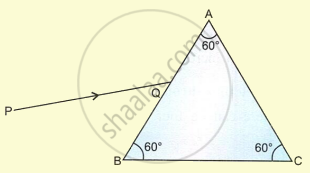
State three factors on which the angle of deviation depends.
State four differences between refraction of light and total internal reflection of light.
Diagram alongside shows a glass slab, such that a ray of light AB is incident on it at an angle of near 90°. If the critical angle for glass is 42°, trace the course of ray AB, through glass, till it emerges out in air. Copy the diagram.
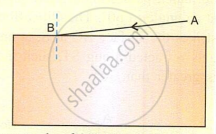
Draw an isosceles right angled prism and show how a ray of light can be turned through an angle of 90°. Assume prism is of glass and critical angle for glass is 42°.
Draw an isosceles right angled prism and show how a ray of light can be turned through an angle of 180°. Assume prism is of glass and critical angle for glass is 42°.
- Copy the Figs. I and II. By using a suitable apparatus show rays of light in Fig. I and Fig. II can be turned through 90° by two different ways.
- Also, state in which of the two cases light is not absorbed and why?
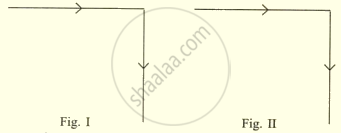
Copy the Fig. I and Fig. II. Both Figures show isosceles right angled glass prisms.
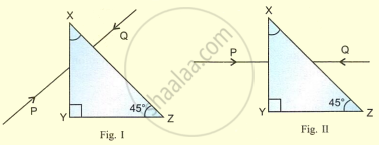
- Trace the course of rays P and Q till the rays emerge out in (i) Fig. I, (ii) Fig. II.
- Which ray gets only refracted in (i) Fig. I and (ii) Fig. II?
- Which ray gets totally internally reflected in (i) Fig. I and (ii) Fig. II?
- Which surface appears silvery in (i) Fig. I and (ii) Fig. II?
Why do diamonds sparkle?
Explain the following:
Why does a crack in window pane, sometimes appear silvery?
Diagram alongside shows the paths of three rays A, B and C in water.
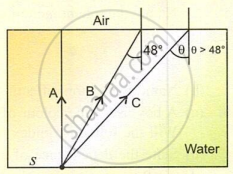
- Copy the diagram and show the paths of rays when they strike the surface of water-air interface.
- Does ray undergo refraction?
- Name the phenomenon exhibited by C.
- State the conditions necessary for phenomenon in С.
- Diagram alongside shows a glass prism of refractive index 1.5 and an object PQ is placed in front of face AC. Copy the diagram and complete it showing how the image is produced by the prism.
- Name an instrument in which such prism is used.
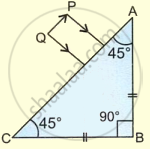
Diagram alongside, shows a ray PQ incident normally on the equilateral prism ABC. Copy the diagram.
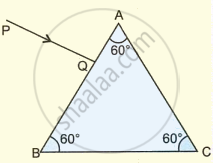
- Complete the ray diagram, showing the emergence of ray in air.
- What is the angles of incidence on (i) face AB, (ii) face АС.
A monochromatic point source of light O is seen through a rectangular glass block ABCD. The paths of two rays, in and outside, the blocks are as shown in the diagram.
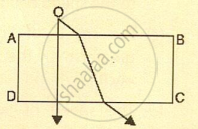
- Does the source appear to be nearer or farther with respect to surface AB?
- How does the shift depend upon the thickness AD or BC of the block?
- Justify your answer in (ii) with the help of a ray diagram.
- For the same rectangular block, which colour from the visible spectra will produce the maximum shift?
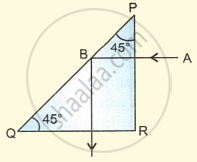
Diagram alongside shows the path of ray AB through an isosceles prism ‘PQR’. What is the magnitude of
- angle of incidence on face PR?
- angle of incidence on face PQ?
- angle of emergence on face QR?
A ray of light incident at an angle of incidence ‘i’ passes through an equilateral glass prism such that the refracted ray inside the prism is parallel to its base and emerges from the prism at an angle of emergence ‘e’.
How is the angle of emergence ‘e’ related to the angle of incidence ‘i’?
A ray of light incident at an angle of incidence ‘i’ passes through an equilateral glass prism such that the refracted ray inside the prism is parallel to its base and emerges from the prism at an angle of emergence ‘e’.
What can you say about the value of the angle of deviation in such a situation?
What is meant by the term ‘critical angle’?
How is the critical angle related to the refractive index of a medium?
Does the depth of a tank of water appear to change or remain the same when viewed normally from above?
The diagram below shows a fish in the tank and its image seen on the surface of the water.
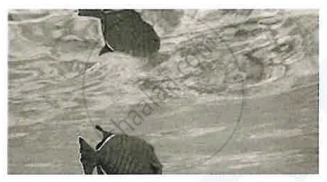
Name the phenomenon responsible for the formation of this image.
A boy uses the blue colour of light to find the refractive index of glass. He then repeats the experiment using the red colour of light. Will the refractive index be the same or different in the two cases? Give a reason to support your answer.
State the dependence of angle of deviation on the refractive index of the material of the prism.
State the dependence of angle of deviation on the wavelength of light
Advanced optical sensors in air-to-air missiles use fiber optic cables to transmit light signals with minimal loss. This relies on a physical phenomenon that confines light within the fibers, making the system very dependable for guiding the missile precisely.
- Name the optical phenomenon that allows light signals to remain confined within the fiber optic cables during transmission.
- Explain the two main conditions necessary for this phenomenon to occur.
MULTIPLE CHOICE QUESTIONS Choose the most appropriate option.
For total internal reflection to take place a ray of light must ______.
travel from denser to rarer medium.
travel from rarer to denser medium.
medium does not play any role
none of these
The critical angle for glass is 42°. The corresponding angle of refraction is:
0°
90°
lesser than 90° but more than 42°.
no angle of refraction.
The critical angle for a material X is 45°. The total internal reflection will take place, if the angle of incidence in the denser medium is:
less than 45°
90°
more than 45°, but not 90°.
less than 45°, but not zero degree
Diamonds sparkle more than the glass, because they have ______.
smaller critical angle than the glass
larger critical angle than the glass
critical angle plays no role
none of these
Small air bubbles rising up a fish tank appear silvery when viewed from some particular angle because of the phenomenon of ______.
reflection
refraction
total internal reflection
dispersion
An isosceles totally reflecting prism can reflect rays through an angle of :
60°
90°
180°
both 90° and 180°
A ray of light is incident on the face of an equilateral prism at angle of 90°. The ray gets totally reflected on the second refracting face. The total deviation produced in the path of ray is:
60°
90°
120°
180°
A crack in the window pane appears silvery when viewed from some particular angle. This phenomenon is due to:
reflection of light
refraction of light
total internal reflection of light
dispersion of light
When an equilateral prism is in minimum deviation position the angle of incidence is ______.
greater than the angle of emergence
smaller than the angle of emergence
equal to the angle of emergence
none of these
A prism has ______.
two rectangular and three triangular surfaces
two triangular and three rectangular surfaces
three rectangular and three triangular surfaces
none of these
When a ray of light passes through an equilateral glass prism:
it suffers refraction on the first refracting surface.
it suffers refraction on both the refracting surfaces.
it bends towards the base on both refracting surfaces
- it suffers refraction on both the refracting surfaces and it bends towards the base on both refracting surfaces
From total internal reflection to take place the rays of light must travel:
from rarer to the denser medium
from denser to the rarer medium
The angle of incidence in denser medium should be greater than critical angle
the rays of light must travel from a denser to a rarer medium and the angle of incidence in the denser medium should be greater than the critical angle
A beaker half filled with water is held above the eye level in bright sunlight. The top surface of water appears silvery, because of:
reflection of light
refraction of light
total internal reflection of light
dispersion of light
A prismatic periscope uses isosceles right angled glass prism. These prisms are based on the phenomenon of:
reflection of light
refraction of light
dispersion of light
total internal reflection of light
In prism the binoculars, the totally internally reflecting prisms, turns the incident beam of light through:
180°
120°
90°
none of these
A prismatic periscope is preferred to reflecting periscope because:
image formed by prismatic periscope is sharper than reflecting periscope.
no rays of light are absorbed by prismatic periscope, but reflecting periscope absorbs some amount of light.
deposition of dust or moisture does not affect prismatic periscope, but reduces visibility in case of reflecting periscope.
all of these
The angle of deviation in case of equilateral glass prism depends upon:
angle of incidence
refractive index of material of prism
colour or wavelength of incident ray
all of these
When a prism is in minimum deviation position, the value of angle of incidence is equal to:
\(\dfrac{\angle \mathrm{A} + \angle \delta}{2}\)
\((\angle \mathrm{A}+\angle \delta) \times 2\)
\(\dfrac{2}{\angle \mathrm{A} + \angle \delta}\)
none of these
Select the incorrect option for total internal reflection in a medium.
It takes place in an optically denser medium as compared to an optically less denser medium.
It takes place at an angle greater than critical angle.
It does not obey laws of reflection.
It takes place, if angle of incidence in denser medium is greater than critical angle.
The wavelength of light in a medium ‘M’ is 900 nm. If the wave enters a medium ‘N’ of refractive index `4/3`, then its wavelength is:
675 nm
650 nm
695 nm
700 nm.
Direction for Q. Numbers 21 to 24: The questions given below are Assertion (A) and Reason (R) type questions. Choose the correct answer from options given below:
Assertion (A): In a prism, the refraction of light occurs at two inclined faces, so the emergent ray is parallel to the incident ray.
Reason (R): In a parallel sided glass slab, the refraction of light occurs at two parallel faces, so the emergent ray is parallel to the incident ray.
Both Assertion (A) and Reason (R) are true and Reason (R) is the correct explanation of Assertion (A).
Both Assertion (A) and Reason (R) are true but Reason (R) is not the correct explanation of Assertion (A).
Assertion (A) is false, but Reason (R) is true.
Assertion (A) is true, but Reason (R) is false.
Assertion (A): Total internal reflection occurs only when a ray of light passes from a denser medium to a rarer medium.
Reason (R): Critical angle is the angle of incidence in denser medium for which the angle of refraction in rarer medium is 90°.
Both Assertion (A) and Reason (R) are true and Reason (R) is the correct explanation of Assertion (A).
Both Assertion (A) and Reason (R) are true but Reason (R) is not the correct explanation of Assertion (A).
Assertion (A) is false, but Reason (R) is true.
Assertion (A) is true, but Reason (R) is false.
Assertion (A): A thick glass mirror forms multiple number of images.
Reason (R): Multiple images are formed due to the total internal reflection of light.
Both Assertion (A) and Reason (R) are true and Reason (R) is the correct explanation of Assertion (A).
Both Assertion (A) and Reason (R) are true but Reason (R) is not the correct explanation of Assertion (A).
Assertion (A) is false, but Reason (R) is true.
Assertion (A) is true, but Reason (R) is false.
Assertion (A): When prism is in minimum deviation position, the angle of incidence is equal to angle of emergence.
Reason (R): For a prism ∠i + ∠e = ∠A + ∠δ.
Both Assertion (A) and Reason (R) are true and Reason (R) is the correct explanation of Assertion (A).
Both Assertion (A) and Reason (R) are true but Reason (R) is not the correct explanation of Assertion (A).
Assertion (A) is false, but Reason (R) is true.
Assertion (A) is true, but Reason (R) is false.
Complete the following by choosing correct answers from brackets.
Total internal reflection occurs only in the medium having ______ denser than air.
less
more
In minimum deviation position for an equilateral prism, the angle of ______ is equal to half of the sum of angles of prism and deviation.
refraction
incidence
A coloured light X, has a greater angle of emergence than another coloured light Y. From this it implies that X has ______ wavelength than Y.
smaller
longer
The air bubbles rising up a water tank appears silvery due to ______ of light.
refraction
reflection
total internal reflection
The total internal reflection will take place only when an incident ray travelling in some denser medium strikes surface of separation at an angle which is ______ than critical angle.
greater
smaller
Match the statements in column A with those in column B.
| Column A | Column B |
|---|---|
| (a) Angle of deviation of a prism depends on | (i) Used in Prismatic periscope. |
| (b) In minimum deviation for a prism. | (ii) Smaller wavelength of light incident on medium. |
| (c) Totally reflecting prisms | (iii) Refractive index of the prism. |
| (d) Decrease of velocity of light in a medium | (iv) Refraction and total internal reflection |
| (e) Sparkling of diamond | (v) Angle of incidence is always equal to the angle of emergence. |
Goyal Brothers Prakashan solutions for A New Approach to ICSE Physics [English] Class 10 4 Refraction of Light NUMERICAL PROBLEMS ON LENSES [Pages 95 - 98]
An object is placed at a distance of X from a convex lens, when a real image is formed at a distance of 15 cm from the lens. If the focal length of the lens is 10 cm, calculate (a) value of X (b) the magnification produced. State the characteristics of the image.
Practice Problems 1:
A convex lens of focal length 10 cm is placed at a distance of 60 cm from a screen. How far from the lens should be placed an object so as to obtain a real image on the screen? Calculate the magnification of the image and its characteristics.
An object is placed at a distance of 24 cm in front of a convex lens of focal length 8 cm.
- What is the nature of the image so formed?
- Calculate the distance of the image from the lens.
A convex lens produces a real and inverted image 2.5 times magnified at a distance of 25 cm from the lens. Calculate focal length of the lens.
Practice Problems 2:
An object when placed in front of a convex lens forms a real image of 0.5 magnification. If the distance of the image from the lens is 24 cm, calculate focal length of the lens.
A convex lens forms a real image 4 times magnified when placed at a distance of 6 cm from the lens. Calculate the focal length of the lens.
An object of height 2 cm is placed at a distance of 8 cm from a convex lens of focal length 10 cm. Calculate (a) position of the image (b) the size of the image. State the characteristics of the image.
Practice Problems 3:
An object 1.4 cm high when placed in front of a convex lens at a distance of 6 cm, forms a virtual image at a distance of 24 cm from the lens. Calculate (a) the focal length of the lens (b) the size of the image.
A convex lens forms a 2.5 times magnified virtual image when an object is placed at a distance of 8 cm from the lens. Calculate (a) the distance of the image from the lens (b) the focal length of lens.
An object 1 cm high is placed at a distance of 4 cm from a convex lens of focal length 6cm. Calculate (a) the position of the image (b) size of a image. State the characteristics of the image.
An object 4 cm high is placed at a distance of 40 cm from the optical centre of a concave lens of focal length 20 cm. Calculate (a) the position of the image (b) the size of the image. Also state the characteristics of the image.
Practice Problems 4:
An object 2 cm high is placed at a distance of 25 cm from the optical centre of a concave lens of focal length 15 cm. Calculate (a) the position of the image (b) the size of the image.
A concave lens forms 4 times diminished and virtual image when an object is placed at a distance of 80 cm. Calculate (a) the position of the image (b) the focal length of the lens.
A concave lens has focal length 15 cm. At what distance should the object from the lens be placed so that it forms an image at 10 cm from the lens? Also find the magnification produced by the lens.
Calculate the power of a convex lens of focal length 12.5 cm.
Practice Problems 5:
A converging lens has a focal length 40 cm. Calculate its power.
A lens which forms a real image has a focal length 8 cm. Calculate its power.
An eye specialist prescribes a number +4.5 D to a person for his glasses. What is the nature of the lens? What is the focal length of the lens?
Practice Problems 6:
State the nature of the lens and the focal length if its power is +4D.
The number of the glasses of a person is +0.75 D. What is the nature of the lens and what is its focal length?
The focal length of the glasses of a short sighted person is 37.5 cm. Calculate the power of the glasses and their nature.
Practice Problems 7:
The focal length of a concave lens is 10 cm. Calculate its power.
The focal length of the lens of a myopic person is 40 cm. What is the power of the lens?
The power of the lens of a myopic person is −3.75 D. Calculate the focal length of the lens.
Practice Problems 8:
Calculate the focal length of a lens of power –2.75 D.
The power of a concave lens is −12.5 D. What is the focal length of the lens?
Goyal Brothers Prakashan solutions for A New Approach to ICSE Physics [English] Class 10 4 Refraction of Light EXERCISE-3 [Pages 98 - 103]
Define:
Convex lens
Define:
Concave lens
With reference of convex lens define the following:
Optical centre of convex lens.
Define the principal focus of a convex lens.
With reference of convex lens define the following:
First principal focus of convex lens.
With reference of convex lens define the following:
Second principal focus of convex lens.
With reference of convex lens define the following:
First focal plane of convex lens.
With reference of convex lens define the following:
Second focal plane of convex lens.
Refer to the diagram given below. A lens with two different refractive indices is shown. If the rays are coming from a distant object, then how many images will be seen?

A glass lens always forms a virtual, erect and diminished image of an object kept in front of it. Identify the lens.
Where is an image of an object is formed and what is its nature in case of convex lens when:
- Object is at infinity with respect to focal length of lens?
- Object is beyond 2F of the lens?
- Object is at 2F of the lens?
- Object is in between the F and 2F of the lens?
- Object is at principal focus of lens?
- Object is in between the principal focus and optical centre of lens?
- An object 2 cm high is placed in front of a concave lens of focal length 3 cm, at a distance of 5 cm from the optical centre of lens. Draw a neat ray diagram using above dimensions and locate the position of image.
- From the diagram state four characteristics of image.
A double convex lens with refractive index μ1 inside two liquids of refractive indices μ2 and μ3 are shown in the diagrams below. The refractive indices are such that μ2 > μ1 and μ1 > μ3.
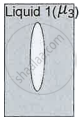 |
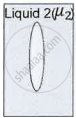 |
| Figure a | Figure b |
How would a parallel incident beam of light refract when it comes out of the lens in each of the cases shown above?
- in Fig a.
- in Figure b.
A convex lens is used as simple microscope. Answer the following questions.
- Where is object with respect to lens and principal focus?
- Where is image formed by the lens?
An object AB is placed on the principal axis of a convex lens as shown in the diagram.
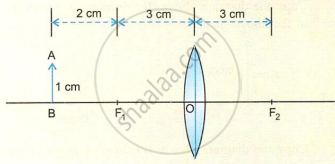
Copy the diagram according to dimensions.
- From point A draw a ray passing through optical centre and then to the other side of lens.
- From point A draw a ray parallel to principal axis and then its passage through convex lens after refraction.
- From point A draw another ray passing through F₁ and then through lens after refraction.
- Locate the position of image.
- State two characteristics of image.
With respect to infinity, 2F, F and optical centre of a convex lens, when it is used as:
- Objective lens of a telescope.
- For erecting an image formed by a telescope.
- Objective lens of photographic camera.
- Object lens of a slide projector.
- Objective lens of a search light.
- Objective lens of a simple microscope.
Define the power of a lens.
When is the power of a lens is positive?
When is the power of a lens negative?
A convex lens is of focal length 20 cm. Find its power.
Power of a lens is −4D. Answer the following questions:
- Is the lens convex or concave?
- What is the focal length of lens?
A convex lens of power +5D is placed in contact with concave lens of power −1.5D. Answer the following questions:
- What is combined power of lens system?
- What is the focal length of this system?
- Can this combination can be used as a simple microscope?
A convex lens of focal length 10 cm is placed at a distance of 60 cm from a screen. How far from the lens should be placed an object so as to obtain a real image on the screen? Calculate the magnification of the image and its characteristics.
A convex lens forms a real image 3 times magnified when placed at a distance of 9 cm from the lens. Calculate.
- Focal length of convex lens.
- Power of convex lens.
A concave lens has focal length 15 cm. At what distance should the object from the lens be placed so that it forms an image at 10 cm from the lens? Also find the magnification produced by the lens.
A virtual diminished image is formed when an object is placed between the optical centre and the principal focus of a lens.
- Name the type of lens which forms the above image.
- Draw a ray diagram to show the formation of the image with the above stated characteristics.
Draw accurate diagram in the following case:
A ray of light after refraction through a concave lens emerges parallel to the principal axis of the lens.
Draw accurate diagram in the following case:
A ray of light after refraction through a convex lens emerges parallel to the principle axis of the lens.
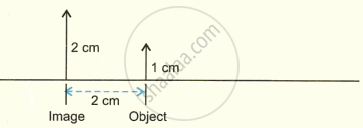
Copy the diagram above. By drawing two rays, locate the position of (a) lens, (b) its principal focus and (c) the kind of lens in the above diagram.
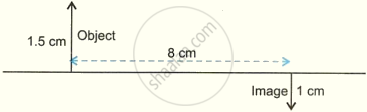
Copy the diagram above. By drawing two rays, locate the position of (a) lens, (b) its principal focus and (c) the kind of lens in the above diagram.
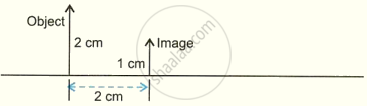
Copy the diagram above. By drawing two rays, locate the position of (a) lens, (b) its principal focus and (c) the kind of lens in the diagram.
The ray diagram below illustrates the experimental set up for the determination of the focal length of a converging lens using a plane mirror.
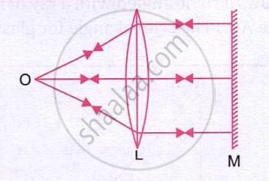
- State the magnification of the image formed.
- Write two characteristics of the image formed.
- What name is given to the distance between the object and the optical centre in the diagram above?
A linear object is placed on the axis of a lens. An image is formed by refraction in the lens. For all positions of the object on the axis of the lens, the positions of the image are always between the lens and the object.
- Name the lens.
- Draw a ray diagram to show the formation of the image of an object placed in front of the lens at any position of your choice except infinity.
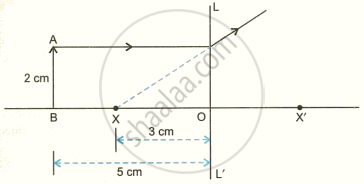
- Copy the diagram and show the formation of the image of the object AB.
- What is the name given to Х?
- What is the kind of lens?
- State characteristics of the image.
We can burn a piece of paper by focussing the sun rays by using a particular type of lens. Name the type of lens used for the above purpose. Draw a ray diagram to support your answer.
Define the power of a lens.
A lens mentioned in convex lens has a focal length of 25 cm. Calculate the power of the lens.
Ranbir claims to have obtained an image twice the size of the object with a concave lens. Is he correct? Give a reason for your answer.
Where should an object be placed so that a real and inverted image of the same size as the object is obtained using a convex lens?
Draw a ray diagram to show the formation of the image of the same size as the object is obtained using a convex lens?
MULTIPLE CHOICE QUESTIONS Choose the most appropriate option.
The point on the principal axis of a convex lens, such that rays of light starting from it on passing through the lens, move parallel to the principal axis is called ______.
first focal point
second focal point
optical centre
aperture of lens
A convex lens can be regarded as a set of prisms and a glass slab, such that refracting angle of the prisms:
continuously decreases in outward direction
continuously increases in outward direction
remains same in outward direction
none of these
A lens forms an inverted image of an object equal to its own size. The object is:
beyond infinity and 2F1
at 2F1
between 2F1 and F1
in between F1 and optical centre
A convex lens will form a virtual, erect and enlarged image, when the object is ______.
between 2F1 and F1
2F1
2F1 and infinity
F1 and optical centre
A concave lens always forms ______.
real, inverted and enlarged image
virtual, inverted and enlarged image
virtual, erect and diminished image
virtual, erect and enlarged image
Which is the incorrect statement regarding the characteristics of image, when an object is placed beyond 2F1 of a convex lens, but not at infinity?
Image is real.
Image is enlarged.
Image is inverted.
Image is formed between F2 and 2F2 on the other side of lens.
Which is the incorrect statement regarding the characteristics of an image formed by a convex lens, when the object is placed at twice the distance of the focal length of lens?
Image is real.
Image is inverted.
Image is diminished.
Image is formed at 2 F on the other side of lens.
Which is the incorrect statement regarding the characteristics of an image formed in a convex lens, when the object is placed between F and 2F of the lens?
Image is real.
Image is inverted.
Image is enlarged.
Image is formed at infinity on the other side of lens.
Which is the incorrect statement regarding the characteristics of an image formed by a convex lens, when the object is placed at the focal point of lens?
Image is real.
Image is erect.
Image is formed at infinity.
Image is highly enlarged.
Which is the incorrect statement regarding characteristics of an image formed by a convex lens, when the object is placed between focal point and optical centre of lens?
Image is virtual.
Image is enlarged.
Image is erect.
Image is real.
An object is situated anywhere between the optical centre and infinity in case of a concave lens which of the following statements is incorrect?
Image is virtual.
Image is diminished.
Image is inverted.
Image is always formed between ‘O’ and ‘F’.
From the diagram given alongside, identify the characteristic which is incorrect for the image formed by the convex lens.
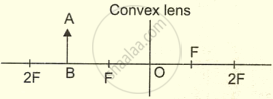
Image is enlarged.
Image is virtual.
Image is inverted.
Image is formed beyond 2F on right hand side.
From the diagram given alongside identify the characteristic which is incorrect for the image formed in a concave lens.
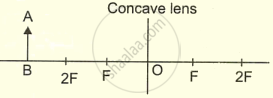
Image is virtual.
Image is diminished.
Image is formed on the right hand side of the lens.
Image is erect.
If f (in cm) is the focal length of a lens in centimetres, the expression for the power of lens (P) is:
$$\text{P} = \frac{1 \ \text{cm}}{f \text{ in cm}}$$
$$\text{P} = \frac{100 \ \text{cm}}{f \text{ in (cm)}}$$
f in cm × 100 cm
none of the these.
The power of lens is measured in ______.
dioptre
cm−
m−1
none of these
The power of a lens is ______.
directly proportional to its focal length in centimetres
inversely proportional to its focal length in centimetres
inversely proportional to its focal length in metres
directly proportional to its focal length in metres.
A converging lens of focal length 40 cm has a power of ______.
+2.50 D
+2.00 D
+2.40 D
+2.60 D
A lens which forms a real image has a power of +12.5 D. The focal length of the lens is:
16 cm
12 cm
8 cm
20 cm
An eye specialist prescribes a number + 4.5 D to person for his glasses. The nature of lens and its focal length is:
Convex, 22.22 cm
Concave, 22.22 cm
Convex, 21.22 cm
Concave, 21.22 cm
The focal length of the glasses of a shortsighted person is 40 cm. What is the nature of lens and its power?
Convex, 2.5 D
Concave, −2.5 D
Convex, 2.0 D
Concave, −2.0 D
A convex lens with a focal length of 12 cm has an object at a distance of 20 cm in front of the lens. A blurred image is obtained on the screen placed at a distance of 23 cm in front of the lens. In order to obtain a clear image, the screen has to be moved ______.
towards the lens.
away from the lens.
to a position very far from the lens.
either towards or away from the lens.
Direction for Q. Numbers 22 to 25: The questions given below are Assertion (A) and Reason (R) type questions. Choose the correct answer from options given below:
Assertion (A): A convex lens is used as an objective lens of a telescope.
Reason (R): Convex lens, converges parallel rays coming from stars.
Both Assertion (A) and Reason (R) are true and Reason (R) is the correct explanation of Assertion (A).
Both Assertion (A) and Reason (R) are true but Reason (R) is not the correct explanation of Assertion (A).
Assertion (A) is false, but Reason (R) is true.
Assertion (A) is true, but Reason (R) is false.
Assertion (A): Greater the focal length of a lens, less is its power.
Reason (R): Power of a lens is inversely proportional to its focal length.
Both Assertion (A) and Reason (R) are true and Reason (R) is the correct explanation of Assertion (A).
Both Assertion (A) and Reason (R) are true but Reason (R) is not the correct explanation of Assertion (A).
Assertion (A) is false, but Reason (R) is true.
Assertion (A) is true, but Reason (R) is false.
Assertion (A): A convex lens always forms real images.
Reason (R): A convex lens converges the parallel rays to a point.
Both Assertion (A) and Reason (R) are true and Reason (R) is the correct explanation of Assertion (A).
Both Assertion (A) and Reason (R) are true but Reason (R) is not the correct explanation of Assertion (A).
Assertion (A) is false, but Reason (R) is true.
Assertion (A) is true, but Reason (R) is false.
Assertion (A): Concave lens is called a diverging lens.
Reason (R): Concave lens always forms virtual and diminished image.
Both Assertion (A) and Reason (R) are true and Reason (R) is the correct explanation of Assertion (A).
Both Assertion (A) and Reason (R) are true but Reason (R) is not the correct explanation of Assertion (A).
Assertion (A) is false, but Reason (R) is true.
Assertion (A) is true, but Reason (R) is false.
Complete the following by choosing correct answers from brackets.
A piece of glass which is ______ in the middle and thicker at its edges is called diverging lens.
thicker
tapering
The point on the principal axis of a convex lens, such that rays start from it after refraction, travel parallel to principal axis is called ______ principal focus.
second
first
When an object is between first principal focus and ______ it forms a virtual and enlarged image in case of a convex lens.
infinity
optical centre
A prismatic periscope uses ______ right angled isosceles prisms.
one
two
If a person can see near objects clearly, but not the far off objects, his eye sight can be corrected by using a ______ lens of appropriate focal length.
convex
concave
Match the statements in Column A with those in Column B.
| Column A | Column B |
|---|---|
| (a) Power of a lens | (i) A lens used in photographic camera. |
| (b) Optical centre | (ii) A lens used for correcting shortsightedness use in eye. |
| (c) Second principal focus of lens | (iii) A point within a lens, such that any ray passing through it does not suffer refraction. |
| (d) Convex lens | (iv) Reciprocal of focal length in metres. |
| (e) Concave lens | (v) Parallel rays after refraction through a convex lens meet at a point on principal axis. |
Goyal Brothers Prakashan solutions for A New Approach to ICSE Physics [English] Class 10 4 Refraction of Light COMPETENCY-FOCUSED PRACTICE QUESTIONS RELEASED BY CISCE [Pages 103 - 106]
When light enters from air to glass, it bends toward the normal. If red, blue, and yellow colours are allowed to enter the same glass block at the same angle of incidence, then for which colour, the value of ∠i − ∠r, be greater?
green
red
blue
yellow
Assertion (A): When light passes through a triangular prism, it is observed that for two angles of incidence, the angle of deviation is the same.
Reason (R): According to the principle of reversibility, the light retraces the path in reversing the direction.
A and R are true, and R is the reason for A.
A and R are true, and R is not the reason for A.
A is true, but R is false.
A is false, but R is true.
Which of the following diagrams shows the correct path of light through the lens?
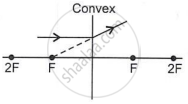
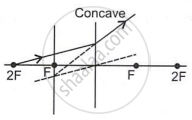
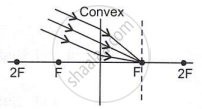
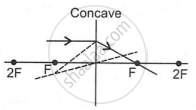
Assertion: For a glass block, the i vs. r graph is a straight line.
Reason: When a ray of light undergoes refraction, it follows Snell’s law.
Both Assertion and Reason are true, and the Reason is the correct explanation of the Assertion.
Both Assertion and Reason are true, but Reason is not the correct explanation of the Assertion.
Assertion is true, but the Reason is false.
Assertion is false, but the Reason is true.
A student traces the path of a ray of light through a glass prism for different angles of incidence. He analyses each diagram and draws the following conclusion:
- On entering the prism, the light ray bends towards its base.
- Light ray suffers refraction at the point of incidence and at the point of emergence while passing through the prism.
- An emergent ray bends at a certain angle to the direction of the incident ray.
- While emerging from the prism at the second surface, the angle of refraction is less than the angle of incidence at that surface.
I, II and III
I, III and IV
II, III and IV
All of these.
A ray of light passes obliquely from an optical medium of refractive index 1.33 to another medium of refractive index 1.5. While passing from the first medium to the second, the light ray will:
bend towards the normal.
bend away from the normal.
move along the normal.
suffer total internal reflection.
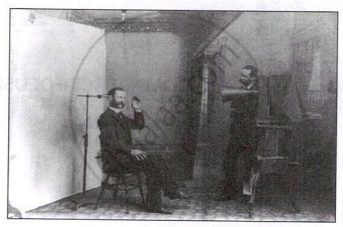
You want to register your name for an examination. For registration purposes, you need a passport-size photograph of yourself. When you went to a studio, the photographer told you to sit on a chair in front of a white screen in the room.
Assertion (A): This is purposefully done so that you as an object should stand beyond the centre of curvature of the camera lens, but surely not at an infinite distance.
Reason (R): The characteristics of the image formed are that it can be taken on a screen and is also diminished in size.
Both A and R are true, and R is the correct explanation of A.
Both A and R are true, and R is not the correct explanation of A.
A is true, but R is false.
Both A and R are false.
AB is an object and PQ is its real, inverted image. The lengths of AB and PQ are equal. This is possible when a lens is present between the object and its image.
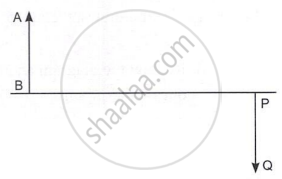
- What kind of lens is used here? Also, state the position of the lens and where it is to be placed.
- Name a device where this lens action is used.
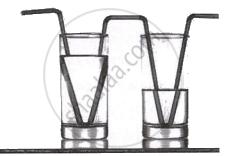
The diagram shows straw partially immersed in water in the glasses.
- Why does the straw in water appear thicker as compared to the straw outside water?
- Why does the straw appear discontinuous in water?
The diagram shows a triangular prism used for tracing the path of ray AB due to the refraction through the prism. Observe the diagram and answer the following:
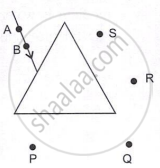
- State the correct eye position from the points P, Q, R and S to see the images of the points A and B in the same line through the prism.
- If the ray, after entering the prism, suffers total internal reflection, then which would be the appropriate position out of P, Q, R, and S to see the image due to TIR?
A convex lens of power +5 D has an object placed at a distance of 50 cm in front of the lens.
- State the nature of the image formed.
- What is the definite distance, towards or away from the lens, the object should move so that the image is not seen?
In a science exhibition, boys of a Secondary school made two types of periscopes. In one of the periscopes, ordinary glass was used as the reflecting material, while in the other, a prism was used. When Anushka put her eyes on the eyepiece of the periscope, she saw that the image formed in one of the periscopes was quite bright, while in the other, it was a little blurred.
- In which of the two periscopes, mirror or prism, Anushka saw the image brighter?
- Why is one of the images brighter than the other?
ABC is a glass block whose two sides, AB and BC, are at right angles to each other. A ray of light is incident on the surface AB, as shown in the diagram, and suffers total internal reflection before falling on the surface BC. Finally, the light ray emerges out along the surface BC.
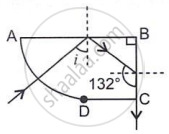
- What is the angle of incidence at the surface AB?
- What is the critical angle for the glass block BC?
- What would happen to the critical angle if the temperature of the glass block is increased?
The diagram shows a glass prism of a critical angle 42°.
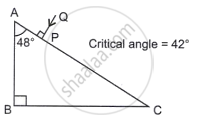
- Redraw the diagram and complete the path of the light ray PQ till it emerges out of the prism.
- Also, calculate the net angle of deviation of the ray PQ when it emerges from the prism.
You are doing an experiment on the refraction of light in your Physics laboratory. ABCD is a rectangular block. A ray of light is incident obliquely on the surface AB.
- Draw the path of the ray of light through the glass block and also show how it emerges from the block. [The diagram should show the lateral displacement suffered by the ray.]
- Which two pairs of angles remain the same during the experiment?
- If the same experiment is performed first with red and then with blue light, which colour will suffer greater lateral displacement?
In the given diagram, two transparent optical media are shown. The rarer medium is air, while the denser medium is water. Redraw the diagram by showing the paths of the rays after striking the surface of separation AD for the incident rays OA, OB, OC and OD, respectively. (Critical angle for the denser medium = 48°)
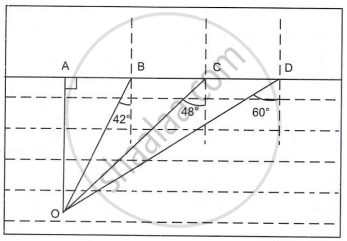
Solutions for 4: Refraction of Light
Goyal Brothers Prakashan solutions for A New Approach to ICSE Physics [English] Class 10 chapter 4 - Refraction of Light
Shaalaa.com has the CISCE Mathematics A New Approach to ICSE Physics [English] Class 10 CISCE solutions in a manner that help students grasp basic concepts better and faster. The detailed, step-by-step solutions will help you understand the concepts better and clarify any confusion. Goyal Brothers Prakashan solutions for Mathematics A New Approach to ICSE Physics [English] Class 10 CISCE 4 (Refraction of Light) include all questions with answers and detailed explanations. This will clear students' doubts about questions and improve their application skills while preparing for board exams.
Further, we at Shaalaa.com provide such solutions so students can prepare for written exams. Goyal Brothers Prakashan textbook solutions can be a core help for self-study and provide excellent self-help guidance for students.
Concepts covered in A New Approach to ICSE Physics [English] Class 10 chapter 4 Refraction of Light are Refraction of Light, Light: Reflection and Refraction, Laws of Refraction, Principle of Reversibility of Light, Refractive Index of a Glass Slab, Examples Showing Effects of Refraction, Critical Angle, Total Internal Reflection, Factors Affecting The Critical Angle, Essential Connditions for Total Internal Reflection, Relation Between Refractive Index and Critical Angle, Consequences of Total Internal Reflection, Mutliple Images in a Thick Mirror, Refraction of Light Through a Glass Prism, Factors Affecting the Angle of Deviation, Total Internal Reflection in a Prism, Causes of Refraction, Velocity of Light and Refractive Index, Total Internal Reflection vs. Plane Mirror Reflection, Lateral Displacement, Factors Affecting Refractive Index of a Medium, Verification of Laws of Refraction, Refraction and Reflection in a Glass Slab, Real and Apparent Depth, Simple Effects of Refraction, Application of Total Internal Reflection, Prism, Apparent Bending of a Stick Under Water, Consequences of Refraction of Light, Concept of Lenses, Lens - Slab and Prism, Some Definitions Related to Lens, Image Formation by Lenses, Power of a Lens, Magnifying Glass Or Simple Microscope, Application of Lenses, First Focal Point and First Focal Length, Second Focal point and Second Focal Length, Rules for Geometric Construction of Images for Lenses, Geometric Construction of Images in Convex Lens, Geometric Construction of Images in Concave Lens, Convex Lens vs Concave Lens, Sign Convention for Lenses, Lens Formula and Magnification, Determination of the Focal Length of a Convex Lens by a Plane Mirror Method, Refraction of Light Through an Equi-Convex Lens and an Equi-Concave Lens.
Using Goyal Brothers Prakashan A New Approach to ICSE Physics [English] Class 10 solutions Refraction of Light exercise by students is an easy way to prepare for the exams, as they involve solutions arranged chapter-wise and also page-wise. The questions involved in Goyal Brothers Prakashan Solutions are essential questions that can be asked in the final exam. Maximum CISCE A New Approach to ICSE Physics [English] Class 10 students prefer Goyal Brothers Prakashan Textbook Solutions to score more in exams.
Get the free view of Chapter 4, Refraction of Light A New Approach to ICSE Physics [English] Class 10 additional questions for Mathematics A New Approach to ICSE Physics [English] Class 10 CISCE, and you can use Shaalaa.com to keep it handy for your exam preparation.
