Advertisements
Advertisements
Question
ABC is a glass block whose two sides, AB and BC, are at right angles to each other. A ray of light is incident on the surface AB, as shown in the diagram, and suffers total internal reflection before falling on the surface BC. Finally, the light ray emerges out along the surface BC.
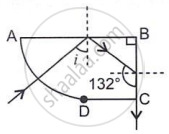
- What is the angle of incidence at the surface AB?
- What is the critical angle for the glass block BC?
- What would happen to the critical angle if the temperature of the glass block is increased?
Long Answer
Advertisements
Solution
- The angle of incidence at surface AB is 48°.
- The ray emerges along BC, so its angle of incidence at BC is the critical angle. Using the angles in the diagram and the fact that AB and BC are perpendicular, the critical angle is 42°.
- The critical angle increases when the temperature of the glass increases. Heating reduces the refractive index of glass, and since C = `1/mu`, a lower refractive index gives a larger critical angle.
shaalaa.com
Is there an error in this question or solution?
