Advertisements
Advertisements
Question
You are doing an experiment on the refraction of light in your Physics laboratory. ABCD is a rectangular block. A ray of light is incident obliquely on the surface AB.
- Draw the path of the ray of light through the glass block and also show how it emerges from the block. [The diagram should show the lateral displacement suffered by the ray.]
- Which two pairs of angles remain the same during the experiment?
- If the same experiment is performed first with red and then with blue light, which colour will suffer greater lateral displacement?
Diagram
Very Long Answer
Advertisements
Solution
(a)
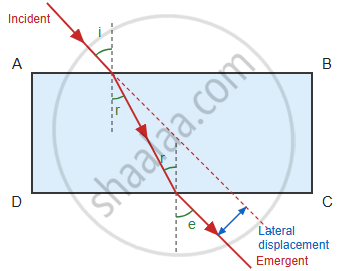
The ray enters face AB, bends towards the normal inside the glass, and leaves through face DC bending away from the normal. The emergent ray is parallel to the incident ray but shifted sideways. This sideways shift is the lateral displacement, shown by the blue double-headed arrow between the dashed extension of the incident ray and the emergent ray.
(b) Two pairs of angles stay equal:
- Angle of incidence at AB = angle of emergence at DC (i = e).
- Angle of refraction at AB = angle of incidence at DC (both are r).
(c) Blue light suffers greater lateral displacement. Glass has a higher refractive index for blue light than for red, so blue bends more inside the block.
shaalaa.com
Is there an error in this question or solution?
