Advertisements
Advertisements
Question
Diagram alongside shows the paths of three rays A, B and C in water.
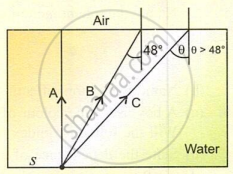
- Copy the diagram and show the paths of rays when they strike the surface of water-air interface.
- Does ray undergo refraction?
- Name the phenomenon exhibited by C.
- State the conditions necessary for phenomenon in С.
Diagram
Very Long Answer
Advertisements
Solution
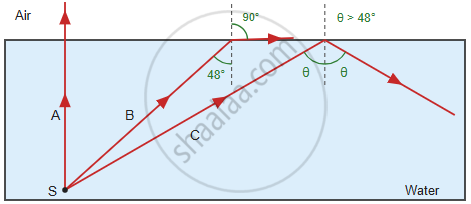
(a)
- Ray A strikes the surface along the normal, so it passes into air without bending.
- Ray B strikes the surface at 48°, which is the critical angle. It refracts at 90° and grazes along the water surface.
- Ray C strikes the surface at θ > 48°, which is more than the critical angle. It is totally reflected back into the water, with angle of reflection = θ.
(b) No, ray A does not bend. It strikes along the normal (angle of incidence = 0°), so it passes into air without deviation.
(c) Total internal reflection.
(d) Conditions for total internal reflection:
- Light must travel from a denser medium (water) to a rarer medium (air).
- The angle of incidence must be greater than the critical angle (48° for water).
shaalaa.com
Is there an error in this question or solution?
