Advertisements
Advertisements
Questions
A monochromatic point source of light O is seen through a rectangular glass block ABCD. The paths of two rays, in and outside, the blocks are as shown in the diagram.
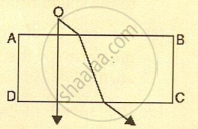
- Does the source appear to be nearer or farther with respect to surface AB?
- How does the shift depend upon the thickness AD or BC of the block?
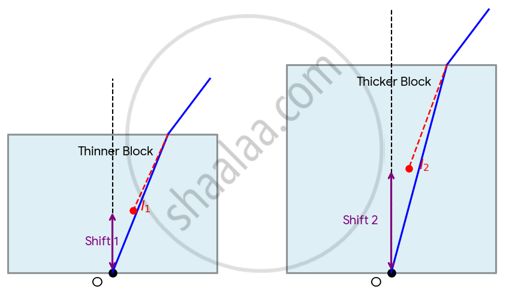
- Justify your answer in (ii) with the help of a ray diagram.
- For the same rectangular block, which colour from the visible spectra will produce the maximum shift?
A monochromatic point source of light 'O' is seen through a rectangular block ABCD. Paths of rays inside and outside the block are shown in diagram alongside.
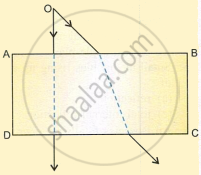
- Does monochromatic source appear nearer or farther with respect to AB.
- How does the shift depend on the thickness of glass block?
- For same rectangular block, which colour from visible light will produce maximum shift?
Advertisements
Solution
(ii) The shift is directly proportional to the thickness. As the thickness of the block increases, the apparent shift also increases.
(iii) This diagram clearly shows that a thicker glass block creates a much larger apparent shift (S2 > S1) for the same object O.
(iv) Violet color from the visible spectra will produce the maximum shift because glass has the maximum refractive index for violet light.
Notes
Students should refer to the answer according to their questions.
