Advertisements
Online Mock Tests
Chapters
▶ 1: Forces: Turning Forces and Uniform Circular Motion
2: Work, Power and Energy
Chapter 3: Machines
(B) Light
Chapter 4: Refraction of Light
Chapter 5: Electromagnetic Waves and Spectrum
(C) Sound
Chapter 6: Sound
(D) Electricity and Magnetism
Chapter 7: Electric Circuits, Resistance and Ohm's Law
Chapter 8: Electric Energy, Power and Household Circuits
Chapter 9: 1. Electromagnetism 2. Magnetic Effects of Electric Current 3. Electromagnetic Induction
(E) Heat
Chapter 10: Calorimetry
(F) Modern Physics
Chapter 11: Radioactivity
![Goyal Brothers Prakashan solutions for A New Approach to ICSE Physics [English] Class 10 chapter 1 - Forces: Turning Forces and Uniform Circular Motion - Shaalaa.com](/images/a-new-approach-to-icse-physics-english-class-10_6:7f30c0b5c38149fc86326989580f7d2b.jpg "Goyal Brothers Prakashan solutions for A New Approach to ICSE Physics [English] Class 10 chapter 1 - Forces: Turning Forces and Uniform Circular Motion")
Advertisements
Solutions for Chapter 1: Forces: Turning Forces and Uniform Circular Motion
Below listed, you can find solutions for Chapter 1 of CISCE Goyal Brothers Prakashan for A New Approach to ICSE Physics [English] Class 10.
Goyal Brothers Prakashan solutions for A New Approach to ICSE Physics [English] Class 10 1 Forces: Turning Forces and Uniform Circular Motion EXERCISE [Pages 10 - 14]
Define rigid body and support your answer by a practical example.
By drawing diagram define or explain:
- Point of action of force.
- Line of action of force.
- Principle of transmissibility of force.
What do you understand by the term moment of force?
State the mathematical expression for moment of force.
Its moment of a force scalar or a vector quantity?
State the unit of moment of force in C.G.S. system.
State the S.I. unit of moment of force.
State when the moment of force is positive and when it is negative.
What force will produce a moment of force of 9 Nm of the perpendicular distance between the point of action of force and turning point is 40 cm?
Why are spanners with long handles easier to open nuts of a truck wheel as compared to spanners with short handles?
Why is it easier to tear a branch of tree by pulling it from its far end, rather than close to the trunk of tree?
Why is digging of a field is more easier with a spade of long handle than a spade with short handle?
Why is it easier to draw water from a hand pump with long handle as compared to pump with short handle?
A jack screw is provided with a long arm. Explain why?
Why is it easier to open a door by applying the force at the free end of it?
Explain the following:
A small boy balances a grown up man on see-saw.
The hand flour grinder is provided with a handle near the rim.
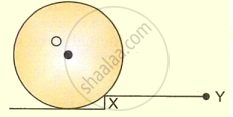
Diagram alongside shows a heavy roller with its axle at point O. It is to be pulled on the pavement XY by applying minimum possible force. Copy the diagram and mark on it the point P and the direction in which the minimum possible force is applied.
What is meant by equilibrium?
What do you mean by static equilibrium? Give one example.
What do you mean by dynamic equilibrium? Give one example.
A labourer is pushing a heavy stone with maximum force, but is unable to move it.
- What is kind of equilibrium shown by the stone?
- Name two sets of opposing forces acting on the stone.
- Are the forces mentioned by you in equilibrium?
An aeroplane is flying high in sky at a constant speed.
- What kind of equilibrium is shown by the aeroplane?
- Name two sets of opposing forces acting on the aeroplane.
- Are forces mentioned by you in equilibrium?
Define couple.
Define the following:
Arm of couple
Define the moment of a couple.
State the mathematical expression of couple.
When a couple is (i) positive (ii) negative?
State absolute unit of couples in S.I. system.
Give two examples of a couple's actions in our daily life.
- Mass of a body is 103 kgf. Is this statement true?
- If the answer in above question is No, then give a reason.
- What is the mass of body?
Define centre of gravity.
State position of centre of gravity in the following bodies.
A square lamina
What is the position of the centre of gravity of a rectangular lamina?
At which point is the centre of gravity situated in a triangular lamina?
At which point is the centre of gravity situated in a circular lamina?
What is the position of the centre of gravity of a cylinder?
State position of centre of gravity in the following bodies.
A cone made of brass
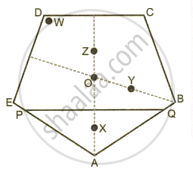
ABCDE is a regular pentagon with its center of gravity at O. What will be the most probable position (W, X, Y, Z or O) of the new center of gravity:
- if a piece of clay is attached at point A?
- if the pentagon is cut along the line PQ? (Of the remaining part DCBQPE)
- Can centre of gravity of a body be outside the body? If so give an example.
- Draw the diagram for example in (a) clearly showing centre of gravity.
Define the following:
Circular motion
Define Centripetal force.
Define the term centrifugal force.
State whether following statement is true or false.
On the deformation of body (such as soft drink can), the position of centre of gravity does not change.
'The centre of gravity of a freely suspended body always lies vertically below the point of suspension'.
True
False
A stone of mass 'm' is rotated in a circular path with a uniform speed by tying a strong string with the help of your hand. Answer the following questions:
- Is the stone moving with a uniform or variable speed?
- Is the stone moving with a uniform or variable velocity?
- Is the stone moving with a uniform or variable acceleration?
- What is the effect of acceleration on the stone?
- In which direction acceleration acts?
- What kind of force is acting on the stone and state its direction?
- What kind of force is acting on hand and state its direction?
Give an example of a body moving with uniform speed, but has an accelerated motion.
Differentiate between uniform linear motion and uniform circular motion.
State two differences between the centripetal and centrifugal force.
Explain movement of earth around the sun.
Explain movement of electrons around the nucleus.
MULTIPLE CHOICE QUESTIONS Choose the most appropriate option.
The point of action of force on a rigid body is:
fixed point on rigid body
fixed point, but can be transferred any where along the line of action of force.
fixed point, but can be transferred any where along the direction of force.
fixed point, but can be transferred any where opposite to the direction of force.
The turning effect produced in a rigid body around a fixed point by the application of force is called ______.
turning force
moment of force
moment of couple
none of these
The unit of moment of force in SI system is ______.
Nm
dyne-cm
dyne-m
N-cm
A moment of couple has a tendency to rotate the body in an anticlockwise direction. Then the moment of the couple is taken as ______.
positive
negative
maximum
zero
The condition for equilibrium is:
the resultant of all the forces acting on the body be zero only.
the resultant of moments of all the forces acting on the body about the turning point should be zero.
the resultant of all the forces acting on the body be zero and the resultant of moments of all the forces acting on the body about the turning point should be zero.
none of the above
A body is acted upon by two equal and opposite forces along different lines of action of force. The body will have:
only rotatory motion
only translatory motion
both rotatory and translatory motion
neither rotatory nor translatory motion
The centre of gravity of a cricket ball is at ______.
its topmost point
any point on its surface
its bottom, touching the ground
its geometric centre
A body is describing a uniform circular motion. Which of the following quantities is/are constant?
speed
acceleration
velocity
both speed and acceleration
In a uniform circular motion ______.
speed of body continuously changes because the direction of motion changes
velocity of body continuously changes because the direction of motion changes
the motion of body is accelerated
- velocity of body continuously changes because the direction of motion changes and the motion of body is accelerated.
Two equal and opposite forces of 20 N are acting along the diameter of a wheel of radius 5 m. The moment of couple due to the forces is:
300 Nm
100 Nm
400 Nm
200 Nm
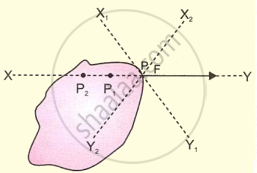
The diagram alongside shows a rigid body, such that force F acts at point P.
The line of action of force in this case is :
XY
X1Y1
X2Y2
all of these
A door is easy to open or close if the force is applied ______.
near its hinge
in the middle of door
at the far end of door
none of these
In non-motorised steering wheels of the automobiles its diameter is kept large to provide ______.
large moment of force
large torque
large moment of couple
none of these
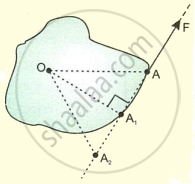
The figure alongside shows a rigid body, capable of turning around point O.
If a force F, acts at point A, the moment of force of F around O is :
F × OA
F × OA1
F × OA2
any of these
In S.I. system, gravitational unit of moment is kilogram force metre, (kgf-m). One kgf-m in C.G.S. system is equal to:
9.8 × 10⁷ dyne-cm
9.8 × 10⁸ dyne-cm
9.8 × 10⁶ dyne-cm
none of these
The spanner used to tighten or loosen a nut of the automobile wheel, has long handle, because long handle ______.
increase the torque
lowers the torque
does not affect the torque
it is convenient to work with long handle.
In order to cause the motion of rotation in rigid pivoted body there must act:
single force on the rigid body
A pair of forces on the rigid body in any direction.
A pair of forces on the rigid body such that forces are unlike parallel forces
none of these
According to principle of moments:
Sum of all the moments of force around a turning point should be zero.
The sum of moments of force in clockwise direction must be equal to sum of moments in anticlockwise direction.
Either sum of all the moments of force around a turning point should be zero or the sum of moments of force in clockwise direction must be equal to sum of moments in anticlockwise direction.
None of these
For a triangular lamina the centre of mass (centre of gravity) is the ______.
intersection of right bisectors
intersection of medians
either intersection of right bisectors or intersection of medians
none of these
The centripetal force and centrifugal force act on the ______.
same body
two different bodies
in opposite directions
two different bodies and in opposite directions
The mud flies off the wheels of a moving vehicle because of ______.
centripetal force
centrifugal force
either (a) or (b)
none of these
A pendulum is made to swing in an evacuated chamber. The pendulum while swinging in the state of:
static equilibrium
dynamic equilibrium
neutral equilibrium
none of these
A brass ball is suspended by a strong cotton thread is not moving. On the brass ball:
its weight (mg) acts vertically downward.
the tension (T) in the thread acts vertically upward.
the weight (mg) is equal to the tension T.
All of these
A boy of mass 30 kg is sitting at distance of 2 m from the middle of see-saw. The moment of force generated by the boy is:
60 kgfm
60 kg-m
6000 g-m
none of these
In the diagram alongside the moment of couple around point R is :
![This diagram shows a pair of equal and opposite parallel forces ((20\text{ N})) separated by a total perpendicular distance of (40\text{ cm}), with an internal point \[R\] located (30\text{ cm}) away from the bottom force line.](/images/_4:cc2e5abe7a7a477f95b56bb997bd7f0c.png)
8 N-m in C.W.D.
8N-m in A.C.W.D.
6 N-m in C.W.D.
6 N-m in A.C.W.D.
In the diagram alongside, F1 = F2 acting on a wheel of radius 2.5 m produce a moment of couple of 100 Nm. The magnitude of each force acting on the wheel is:
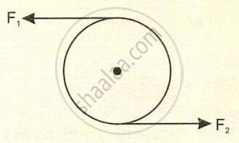
4.0 N
40.0 N
20.0 N
2.0 N
A uniform half metre-scale of weight W is balanced by a weight of 50 gf. The magnitude of weight W is :
![This diagram shows a (50\text{ cm}) rule balanced at the (29\text{ cm}) fulcrum, balancing its own weight ([W]) at (25\text{ cm}) against a (50\text{ gf}) load at (50\text{ cm}).](/images/_4:b6057def22ef48a0b3e3346483d3a52c.png)
22.65 gf
226.5 gf
26.25 gf
262.5 gf
Direction for Q. Numbers 28 to 32: The questions given below are Assertion (A) and Reason (R) type questions. Choose the correct answer from options given below:
Assertion (A): The turning effect on the body about an axis is due to the moment of force (torque) applied on the body.
Reason (R): The moment of a force (torque) is equal to the product of the magnitude of the force and the perpendicular distance of the line of action of the force from the axis of rotation.
Both Assertion (A) and Reason (R) are true and Reason (R) is the correct explanation of Assertion.
Both Assertion (A) and Reason (R) are true but Reason (R) is not the correct explanation of Assertion.
Assertion (A) is false, but Reason (R) is true.
Assertion (A) is true, but Reason (R) is false.
Assertion (A): The direction of anticlockwise moment is along the axis of rotation inwards.
Reason (R): The clockwise moment is along the axis of rotation inwards.
Both Assertion (A) and Reason (R) are true and Reason (R) is the correct explanation of Assertion.
Both Assertion (A) and Reason (R) are true but Reason (R) is not the correct explanation of Assertion.
Assertion (A) is false, but Reason (R) is true.
Assertion (A) is true, but Reason (R) is false.
Assertion (A): Actually, rotation is always produced by a pair of forces.
Reason (R): The pair of forces formed by the external force and the force of reaction is called a couple.
Both Assertion (A) and Reason (R) are true and Reason (R) is the correct explanation of Assertion.
Both Assertion (A) and Reason (R) are true but Reason (R) is not the correct explanation of Assertion.
Assertion (A) is false, but Reason (R) is true.
Assertion (A) is true, but Reason (R) is false.
Assertion (A): A body is acted upon by two unequal forces in opposite directions, but not in the same line.
Reason (R): The effect is that the body will have only translational motion.
Both Assertion (A) and Reason (R) are true and Reason (R) is the correct explanation of Assertion.
Both Assertion (A) and Reason (R) are true but Reason (R) is not the correct explanation of Assertion.
Assertion (A) is false, but Reason (R) is true.
Assertion (A) is true, but Reason (R) is false.
Assertion (A): The position of the centre of gravity of a body remains unchanged even when the body is deformed.
Reason (R): The centre of gravity of a freely suspended body always lies vertically below the point of suspension.
Both Assertion (A) and Reason (R) are true and Reason (R) is the correct explanation of Assertion.
Both Assertion (A) and Reason (R) are true but Reason (R) is not the correct explanation of Assertion.
Assertion (A) is false, but Reason (R) is true.
Assertion (A) is true, but Reason (R) is false.
Complete the following by choosing correct answers from brackets.
A ______ moment of couple rotates a rigid body in clockwise direction.
positive
negative
The turning effect of the applied ______ on a body about the turning point or axis is called moment of force.
power
energy
force
Moment of force is a ______ quantity as it has magnitude and direction.
scalar
vector
When a body remains in its uniform state of motion when two or more forces act on it the body is said to be in _________ equilibrium.
static
dynamic
During uniform circular motion, velocity of a body is ______ quantity.
constant
variable
A force which is directed towards the centre of a circular path and always acts at right angles to the direction of motion, along the circular path is called ______.
centrifugal force
centripetal force
Match the statements in Column A with those in Column B.
| Column A | Column B |
|---|---|
| (a) Rigid body | (i) The product of force and the ⟂ distance between the point of application of force and turning point. |
| (b) Torque | (ii) A force which produces a turning force in anticlockwise direction. |
| (c) Moment of force | (iii) A force which is directed towards the centre along the radius when a body describes uniform circular motion. |
| (d) Positive moment of force | (iv) A body which does not get deformed under the action of multiple forces. |
| (e) Centripetal force | (v) Turning effect of applied force on a rigid body about the turning point or axis of rotation. |
Goyal Brothers Prakashan solutions for A New Approach to ICSE Physics [English] Class 10 1 Forces: Turning Forces and Uniform Circular Motion NUMERICAL PROBLEMS ON MOMENT OF FORCE [Pages 14 - 18]
A force of 1600 dynes acts on a rigid body, such that the perpendicular distance between the force and its turning point is 40 cm. Calculate the moment of force.
Practice Problems 1:
A force of 50 dynes acts on a rigid body, such that the perpendicular distance between the fulcrum and the point of application of force is 75 cm. Calculate the moment of force.
The perpendicular distance between the point of application of force and turning point is 1.75 m when a force of 80 N acts on a rigid body. Calculate the moment of force.
A force of 525 N produces a moment of force of 420 Nm. Calculate the shortest distance between the point of application of force and the turning point.
Practice Problems 2:
A force of 50 N produces a moment of force of 10 Nm in a rigid body. Calculate the perpendicular distance between the point of application of force and the turning point.
Calculate the force which will produce a moment of force of 1575 dyne-cm, when the perpendicular distance between point of application of force and turning point is 45 cm.
Two equal and unlike parallel forces of magnitude 16 N act on a rigid body, such that moment of couple is 12 Nm. Calculate the arm of couple.
Practice Problems 3:
A couple of 15 N force acts on a rigid body, such that arm of couple is 85 cm. Calculate moment of couple in the SI system.
Calculate the length of arm of couple, if a force of 13 N produces a moment of couple of 14.3 Nm.
Two forces each of magnitude 2 N act vertically upward and downward respectively on two ends of a uniform rod of length 1 m, freely pivoted at its centre. Determine the resultant moment of forces about the mid-point of the rod.
The diagram shows a wheel of diameter 4 m, and pivoted at O. Calculate the moment of force about point (a) O, (b) Q, when a force F = 4 N acts at point P or Q.
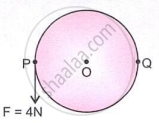
Practice Problems 4:
The diagram alongside shows a force F = 5 N acting at point A produces a moment of force of 6 Nm about point O. What is the diameter of the wheel?
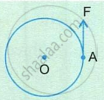
The diagram alongside shows a force F acting at point A, such that it produces a moment of force of 20 Nm in clockwise direction. Calculate the magnitude of force F.

Study the diagram alongside carefully and calculate the resultant moment of force about (a) point P (b) point Q (c) about point R which is exactly in the middle of P and Q.
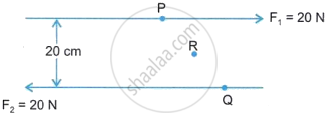
Practice Problems 5:
Study the diagram alongside and calculate the moment of couple.
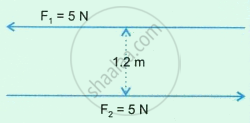
Two forces F1 and F2 are applied on a circular body such that moment of couple is 9 Nm in a CWD. Calculate the radius of circular body.
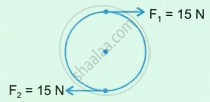
Two forces F1 = F2 are applied on a wheel of radius 1.5 m, such that moment of couple is 30 Nm. Calculate the magnitude of each of the force.
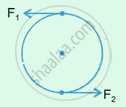
A uniform metre scale is balanced at 40 cm mark, when weights of 25 gf and 10 gf are suspended at 5 cm mark and 75 cm mark respectively. Calculate weight of the metre scale.
Practice Problems 6:
A uniform metre scale is balanced at 60 cm mark, when weights of 5 gf and 40 gf are suspended at 10 cm mark and 80 cm mark respectively. Calculate the weight of the metre scale.
A uniform metre scale is balanced at 20 cm mark, when a weight of 100 gf is suspended from one end. Where must the weight of 100 gf be suspended? Calculate the weight of the metre scale.
A uniform metre scale balances horizontally on a knife edge placed at 55 cm mark, when a mass of 25 g is supported from one end. Draw the diagram of the arrangement. Calculate mass of the scale.
A uniform metre scale of weight 50 gf, is balanced at 60 cm mark, when a weight of 15 gf is suspended at the 10 cm mark. Where must a weight 100 gf be suspended to balance the metre scale?
Practice Problems 7:
A uniform metre scale of weight 50 gf is balanced at the 40 cm mark, when a weight of 100 gf is suspended at the 5 cm mark. Where must a weight of 80 gf be suspended to balance the metre scale?
A see-saw 8 m long is balanced in the middle. Two children of mass 30 kgf and 40 kgf are sitting on the same side of the fulcrum at a distance of 1.5 m and 3.5 m from the fulcrum respectively. Where must a lady weighing 60 kgf sit from the fulcrum, so as to balance the see-saw?

A metal rod AB of length 80 cm is balanced at 45 cm from the end A with 100 gf weights suspended from the two ends.
- If this rod is cut at the center, C, then compare the weight of AC to the weight of BC. (Use >, < or =)
- Give a reason for your answer in (a).
The diagram in Fig. shows a uniform metre rule weighing 100 gf, pivoted at its centre O. Two weights 150 gf and 250 gf hang from the point A and B respectively of the metre rule such that OA = 40 cm and OB = 20 cm. Calculate :
- the total anticlockwise moment about O,
- the total clockwise moment about O,
- the difference of anticlockwise and clockwise moments, and
- the distance from O where a 100 gf weight should be placed to balance the metre rule.

Goyal Brothers Prakashan solutions for A New Approach to ICSE Physics [English] Class 10 1 Forces: Turning Forces and Uniform Circular Motion COMPETENCY-FOCUSED PRACTICE QUESTIONS RELEASED BY CISCE [Pages 18 - 20]
The diagrams below show a force F = 40 N acting on a rod AB pivoted at A in different directions. Identify the correct statement.
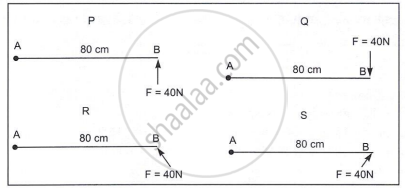
P and S have opposite moments.
The magnitude of the moment of force is maximum in R.
The magnitude of the moment of force is maximum in P and Q.
The moment of force in R is negative.
In the diagrams below four cones are depicted, such with a height of 12 cm. The position of the centre of gravity is indicated by dots located at 9 cm, 8 cm, 4 cm and 3 cm from the apex of each cone. Which of these cones is completely solid?
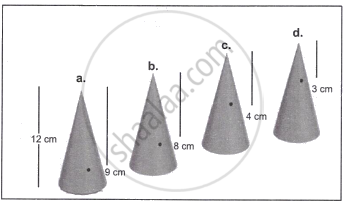
9 cm
8 cm
4 cm
3 cm
Anu and Amy purchased ice creams in plastic balls and cones, respectively, during their outing at the science fair. After consuming their ice creams, Anu stated that regardless of whether they were filled with ice cream or empty, the centre of gravity of the objects would remain unchanged. Do you agree with Anu? Why?
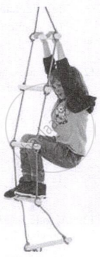
The picture below shows a boy climbing a rope ladder hanging from the branch of a tree. The boy in the picture finds it difficult to climb the ladder as it turns about the axis where he is holding. The instructor tells the boy to stretch the body with the hands stretched up and make the body parallel to the ladder and climb.
- Which force caused the ladder to turn?
- How does keeping the body parallel to the ladder make climbing easier?
Regenerative braking involves harnessing the energy that is typically lost when a car decelerates and brakes and instead using it to recharge the car's batteries. Unlike traditional braking systems that simply dissipate energy, regenerative braking allows some of that energy to be recycled.
- What is the energy conversion process that results in the wastage of energy in a normal car during braking?
- How does regenerative braking differ from normal braking in terms of energy conversion?
Soumya took two right circular cones of the same vertical height. One of the two cones is a solid one, while the other is hollow from inside. By measuring the cross-sectional areas of the cones and from the knowledge of symmetry, by using suitable formulas, he found the positions of the centre of gravity of both cones. He found that the difference is about 1.5 cm. What is the vertical height of the two cones?
Will the centre of gravity of a hollow sphere filled half with mercury and half with oil be identical to that of an empty hollow sphere? Give reasons for your answer.
Study the diagram and answer the questions that follow.
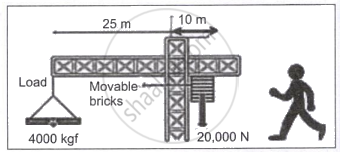
- In the diagram, is the worker attempting to raise or lower the load?
- Justify your answer to (a) with the necessary calculation.
In a gold atom (atomic number 79), an electron revolves around the nucleus in a circular orbit. There is a strong electrostatic force between the positively charged nucleus and the negatively charged electron. Though the total positive charge possessed by the nucleus is much higher than the negative charge of the electron, there is no displacement of the electron in the direction of the force.
- Name the force responsible for the movement of the electron around the nucleus in its own orbit.
- In the absence of such force, what would happen to the movement of the electron?
A metre rod is half made of copper and half made of iron. If the mass of the copper part is 900 g and the mass of iron is 800 g, then calculate the position at which the rod can remain in equilibrium.
Bandish and Parag, on a trek to Sandakpu, halted at a tea house in Tumbling. The picture shows the entrance door of the tea house. They saw the tumbrel filled with water hanging from top rigid support passing through the door. On enquiring about the tumbrel, the owner of the tea house, he said that it acts as a pullback (door closure) after opening and releasing the door.
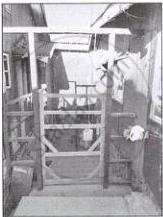
- Explain how the tumbrel helps to close the door on its own.
- Name the principle involved.
Pavel took an earthen pot which was filled with water up to its brim. The earthen pot was conical in shape and kept with its apex in downward direction.
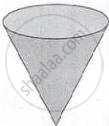
- If the vertical height of the earthen pot is 12 cm, where does its centre of gravity lie?
- Pavel poured out all the water from the pot. How will its centre of gravity shift – towards the open end or towards its apex?
- Pavel wanted to grow a plant in the given pot. So, he filled it completely again with some soil. What will be the new position of its centre of gravity?
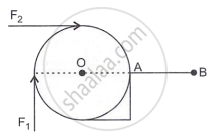
A roller with a diameter of 0.2 m is raised over a pavement AB by applying forces F1 and F2 as shown in the diagram.
If the magnitude of both forces is 20 N, then compare the magnitudes of the torques produced by the two forces.
Solutions for 1: Forces: Turning Forces and Uniform Circular Motion
Goyal Brothers Prakashan solutions for A New Approach to ICSE Physics [English] Class 10 chapter 1 - Forces: Turning Forces and Uniform Circular Motion
Shaalaa.com has the CISCE Mathematics A New Approach to ICSE Physics [English] Class 10 CISCE solutions in a manner that help students grasp basic concepts better and faster. The detailed, step-by-step solutions will help you understand the concepts better and clarify any confusion. Goyal Brothers Prakashan solutions for Mathematics A New Approach to ICSE Physics [English] Class 10 CISCE 1 (Forces: Turning Forces and Uniform Circular Motion) include all questions with answers and detailed explanations. This will clear students' doubts about questions and improve their application skills while preparing for board exams.
Further, we at Shaalaa.com provide such solutions so students can prepare for written exams. Goyal Brothers Prakashan textbook solutions can be a core help for self-study and provide excellent self-help guidance for students.
Concepts covered in A New Approach to ICSE Physics [English] Class 10 chapter 1 Forces: Turning Forces and Uniform Circular Motion are Force, Translational and Rotational Motions, Couple, Moment (Turning Effect) of a Force or Torque, Equilibrium of Bodies, Principle of Moments, Centre of Gravity, Uniform Circular Motion (UCM), Centripetal Force, Centrifugal Forces, Static Equilibrium, Dynamic Equilibrium.
Using Goyal Brothers Prakashan A New Approach to ICSE Physics [English] Class 10 solutions Forces: Turning Forces and Uniform Circular Motion exercise by students is an easy way to prepare for the exams, as they involve solutions arranged chapter-wise and also page-wise. The questions involved in Goyal Brothers Prakashan Solutions are essential questions that can be asked in the final exam. Maximum CISCE A New Approach to ICSE Physics [English] Class 10 students prefer Goyal Brothers Prakashan Textbook Solutions to score more in exams.
Get the free view of Chapter 1, Forces: Turning Forces and Uniform Circular Motion A New Approach to ICSE Physics [English] Class 10 additional questions for Mathematics A New Approach to ICSE Physics [English] Class 10 CISCE, and you can use Shaalaa.com to keep it handy for your exam preparation.
