Advertisements
Advertisements
प्रश्न
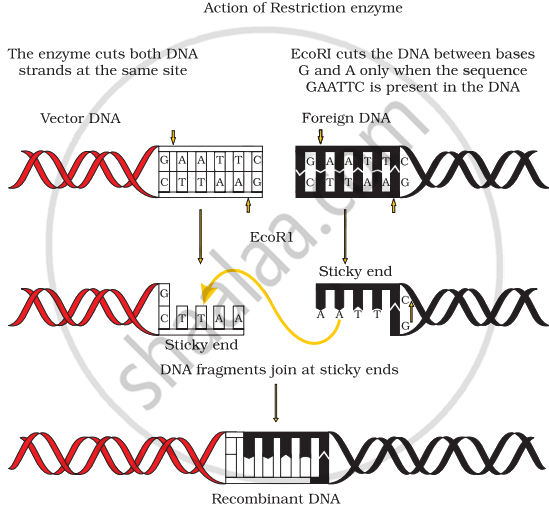
Make a chart (with diagrammatic representation) showing a restriction enzyme, the substrate DNA on which it acts, the site at which it cuts DNA and the product it produces.
Advertisements
उत्तर
APPEARS IN
संबंधित प्रश्न
How are 'sticky ends' formed on a DNA strand? Why are they so called?
Why is the enzyme cellulase needed for isolating genetic material from plant cells and not form the animal cells?
Suggest a technique to a researcher who needs to separate fragments of DNA.
Explain briefly:
Restriction enzymes and DNA
How does restriction endonuclease function?
Answer the following question.
Write the use of restriction endonuclease in the formation of recombinant DNA.
The total number of nucleotide sequences of DNA that code for a hormone is 1530. The proportion of different bases in the sequence is found to be Adenine = 34%, Guanine = 19%, Cytosine = 23%, Thymine = 19%.
Applying Chargaff’s rule, what conclusion can be drawn?
There is a restriction endonudease called as EcoRI. What does co part in it stands for?
DNA strands on a gel stained with ethidium bromide when viewed under UV radiation, appear as ______
A specific recognition sequence identified by endonucleases to make cuts at specific positions within the DNA is ______
'Restriction' in Restriction enzyme refers to ______.
Which of the following bacteria is not a source of restriction endonuclease?
Restriction enzymes that are used in the construction of recombinant DNA are endonucleases which cut the DNA at ‘specific-recognition sequence’. What would be the disadvantage if they do not cut the DNA at specific-recognition sequence?
A mixture of fragmented DNA was electrophoresed in an agarose gel. After staining the gel with ethidium bromide, no DNA bands were observed. What could be the reason?
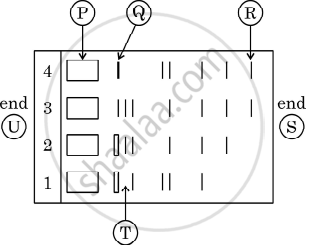
Given below is the stepwise schematic representation of the process of electrophoresis. Identify the 'alphabets' representing
- Anode end
- smallest/lightest DNA strand in the matrix
- Agarose gel
What is elution?
Given below is the restriction site of a restriction endonuclease Pst-I and the cleavage sites on a DNA molecule.
\[\ce{5' C - T - G - C - A \overset{\downarrow}{-}{G 3'}}\]
\[\ce{3' G\underset{\uparrow}{-} A - C - G - T - C 5'}\]
Choose the option that gives the correct resultant fragments by the action of the enzyme Pst-I.
How are DNA fragments visualised once they are separated by gel electrophoresis?
Identify the activity of endonuclease and exonuclease in the given image.
Hind II always cuts DNA molecules at a particular point called recognition sequence and it consists of ______.
What is the precise definition of a palindromic sequence in DNA?
Which of the following was the very first restriction endonuclease to be isolated and characterized?
How do exonucleases differ fundamentally from endonucleases in their enzymatic site of action?
In the standard nomenclature convention for restriction endonucleases, what do the second and third letters signify?
Why is it mandatory to cut both the vector DNA and the foreign source DNA with the exact same restriction enzyme when constructing recombinant DNA?
What is the origin of agarose, the matrix most commonly used in gel electrophoresis?
How are separated DNA bands visualized following agarose gel electrophoresis?
