Advertisements
Advertisements
प्रश्न
How does restriction endonuclease function?
Advertisements
उत्तर
Each restriction endonuclease finds its specific palindromic nucleotide sequences in the DNA and cuts the DNA at these specific sites. It does so by binding to the DNA at these sites and cutting both the strands at specific points in their sugar-phosphate backbones.
APPEARS IN
संबंधित प्रश्न
Collect 5 examples of palindromic DNA sequences. Better try to create a palindromic sequence by following base-pair rules.
Answer the following question.
Explain the significance of palindromic nucleotide sequence in the formation of recombinant DNA.
The total number of nucleotide sequences of DNA that code for a hormone is 1530. The proportion of different bases in the sequence is found to be Adenine = 34%, Guanine = 19%, Cytosine = 23%, Thymine = 19%.
Applying Chargaff’s rule, what conclusion can be drawn?
'Restriction' in restriction enzyme refers to
DNA fragments separate according to size through?
Would you choose an exonuclease while producing a recombinant DNA molecule?
How does one visualise DNA on an agarose gel?
Carefully observe the given picture. A mixture of DNA with fragments ranging from 200 base pairs to 2500 base pairs was electrophoresed on agarose gel with the following arrangement.
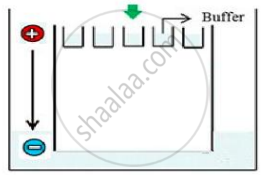
(a) What result will be obtained on staining with ethidium bromide? Explain with reason.
(b) The above setup was modified and a band with 250 base pairs was obtained at X.
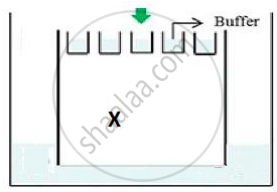
What change(s) were made to the previous design to obtain a band at X? Why did the band appear at position X?
Given below is the restriction site of a restriction endonuclease Pst-I and the cleavage sites on a DNA molecule.
\[\ce{5' C - T - G - C - A \overset{\downarrow}{-}{G 3'}}\]
\[\ce{3' G\underset{\uparrow}{-} A - C - G - T - C 5'}\]
Choose the option that gives the correct resultant fragments by the action of the enzyme Pst-I.
Why is it mandatory to cut both the vector DNA and the foreign source DNA with the exact same restriction enzyme when constructing recombinant DNA?
