Advertisements
Advertisements
प्रश्न
'EcoRI' has played a very significant role in rDNA technology.
- Explain the convention for naming EcoRI.
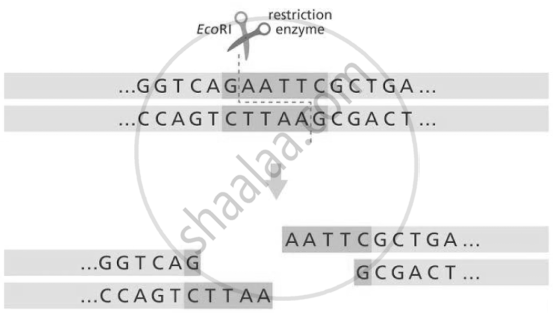
- Write the recognition site and the cleavage sites of this restriction endonuclease.
Advertisements
उत्तर
(I) Restriction endonucleases are named as follows:
1st alphabet represents the genus of the organism from which the enzyme is isolated.
2nd and 3rd alphabet represent the species of the organism.
4th alphabet represents the strain.
The Roman number represents the order of isolation or discovery of the enzyme.
EcoRI comes from the Escherichia coli RYB strain.
In EcoRI, 'E' comes from the genus 'Escherichia' and 'co' comes from the species name 'Coli'.
The letter 'R' is derived from the name of the strain RYB.
Roman numbers following the names indicate the order in which the enzymes were isolated from that strain of bacteria.
(II) The recognition sequence where EcoRI cleaves the DNA molecule is G/AATTC. Such sequences have a complementary sequence, CTTAA/G, which is known as a palindromic sequence.
APPEARS IN
संबंधित प्रश्न
Mention the difference in the mode of action of exonuclease and endonuclease.
How does restriction endonuclease function?
Answer the following question.
Write the use of restriction endonuclease in the formation of recombinant DNA.
There is a restriction endonudease called as EcoRI. What does co part in it stands for?
Which of the following enzymes catalyse the removal of nucleotides from the ends of DNA?
The role of DNA ligase in the construction of a recombinant DNA molecule is ______.
CTTAAG
GAATTC
- What are such sequences called? Name the enzyme used that recognizes such nucleotide sequences.
- What is their significance in biotechnology?
Which of the following was the very first restriction endonuclease to be isolated and characterized?
Which of the following represents the specific palindromic recognition sequence cleaved by the restriction endonuclease EcoRI?
How are separated DNA bands visualized following agarose gel electrophoresis?
