Advertisements
Advertisements
प्रश्न
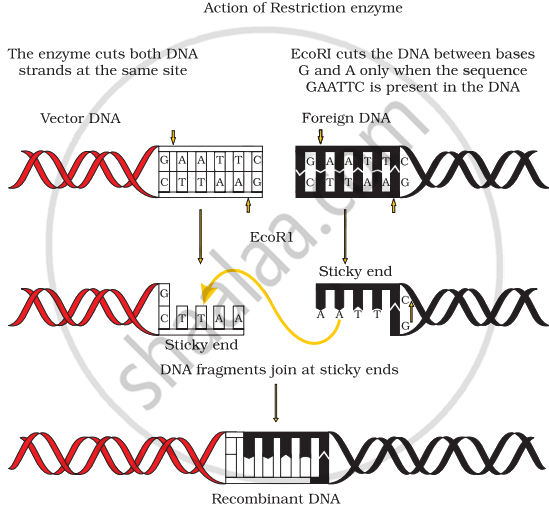
Make a chart (with diagrammatic representation) showing a restriction enzyme, the substrate DNA on which it acts, the site at which it cuts DNA and the product it produces.
Advertisements
उत्तर
APPEARS IN
संबंधित प्रश्न
Explain with the help of a suitable example the naming of a restriction endonuclease.
How are 'sticky ends' formed on a DNA strand? Why are they so called?
Why is the enzyme cellulase needed for isolating genetic material from plant cells and not form the animal cells?
Mention the difference in the mode of action of exonuclease and endonuclease.
Suggest a technique to a researcher who needs to separate fragments of DNA.
Name the enzymes that are used for the isolation of DNA from bacterial and fungal cells for recombinant DNA technology.
Answer the following question.
Write the use of restriction endonuclease in the formation of recombinant DNA.
Which of the following radioisotope is not suitable for DNA labeling based studies?
Restriction enzymes ______.
A specific recognition sequence identified by endonucleases to make cuts at specific positions within the DNA is ______
Which of the following enzymes catalyse the removal of nucleotides from the ends of DNA?
Which of the given statements is correct in the context of visualizing DNA molecules separated by agarose gel electrophoresis?
'Restriction' in Restriction enzyme refers to ______.
While isolating DNA from bacteria, which of the following enzymes is not required?
Which of the following bacteria is not a source of restriction endonuclease?
Which of the following statements does not hold true for restriction enzyme?
A plasmid DNA and a linear DNA (both are of the same size) have one site for a restriction endonuclease. When cut and separated on agarose gel electrophoresis, plasmid shows one DNA band while linear DNA shows two fragments. Explain.
Carefully observe the given picture. A mixture of DNA with fragments ranging from 200 base pairs to 2500 base pairs was electrophoresed on agarose gel with the following arrangement.
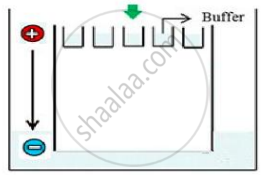
(a) What result will be obtained on staining with ethidium bromide? Explain with reason.
(b) The above setup was modified and a band with 250 base pairs was obtained at X.
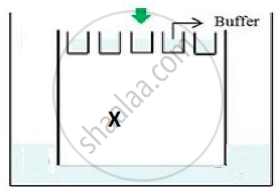
What change(s) were made to the previous design to obtain a band at X? Why did the band appear at position X?
State the principle involved in separation of DNA fragments using gel electrophoresis.
How are DNA fragments visualised once they are separated by gel electrophoresis?
Hind II always cuts DNA molecules at a particular point called recognition sequence and it consists of ______.
Which of the following was the very first restriction endonuclease to be isolated and characterized?
How do exonucleases differ fundamentally from endonucleases in their enzymatic site of action?
In the restriction endonuclease EcoRI, what do the letter 'R' and the Roman numeral 'I' represent?
Why is it mandatory to cut both the vector DNA and the foreign source DNA with the exact same restriction enzyme when constructing recombinant DNA?
During agarose gel electrophoresis, why do DNA fragments migrate toward the anode (positive electrode)?
What is the process called when desired, separated DNA bands are physically cut out from the agarose gel and extracted from the gel piece?
