Advertisements
Advertisements
प्रश्न
Which of the given statements is correct in the context of visualizing DNA molecules separated by agarose gel electrophoresis?
विकल्प
DNA can be seen in visible light
DNA can be seen without staining in visible light
Ethidium bromide stained DNA can be seen in visible light
Ethidium bromide stained DNA can be seen under exposure to UV light
Advertisements
उत्तर
Ethidium bromide stained DNA can be seen under exposure to UV light
Explanation:
DNA molecules separated by agarose gel electrophoresis are not visible in normal visible light and require staining. Ethidium bromide binds to DNA and fluoresces under UV light, allowing visualization of DNA bands as bright orange coloured bands. This method is widely used in laboratories for DNA analysis after gel electrophoresis.
APPEARS IN
संबंधित प्रश्न
How are 'sticky ends' formed on a DNA strand? Why are they so called?
Suggest a technique to a researcher who needs to separate fragments of DNA.
Name and describe the technique that helps in separating the DNA fragments formed by the use of restriction endonuclease
Make a chart (with diagrammatic representation) showing a restriction enzyme, the substrate DNA on which it acts, the site at which it cuts DNA and the product it produces.
Collect 5 examples of palindromic DNA sequences. Better try to create a palindromic sequence by following base-pair rules.
Distinguish between exonuclease and endonuclease.
How does restriction endonuclease function?
Explain the roles of the following with the help of an example each in recombinant DNA technology :
Restriction Enzymes
Answer the following question.
Write the use of restriction endonuclease in the formation of recombinant DNA.
The DNA fragment separated on an agarose gel can be visualized by staining with ______.
A mixture containing DNA fragments a, b, c and d, with molecular weights of a + b = c, a > b and d > c was subject to agarose get electrophoresis. This position of these fragments from cathode to anode to anode sides of the gel would be ______.
Molecular scissors, which cut DNA at specific site is ______.
A specific recognition sequence identified by endonucleases to make cuts at specific positions within the DNA is ______
In agarose gel electrophoresis, DNA molecules are separated on the basis of their ______.
Which of the following bacteria is not a source of restriction endonuclease?
Restriction enzymes should not have more than one site of action in the cloning site of a vector. Comment.
Restriction enzymes that are used in the construction of recombinant DNA are endonucleases which cut the DNA at ‘specific-recognition sequence’. What would be the disadvantage if they do not cut the DNA at specific-recognition sequence?
How does one visualise DNA on an agarose gel?
Given below is the stepwise schematic representation of the process of electrophoresis. Identify the 'alphabets' representing
- Anode end
- smallest/lightest DNA strand in the matrix
- Agarose gel
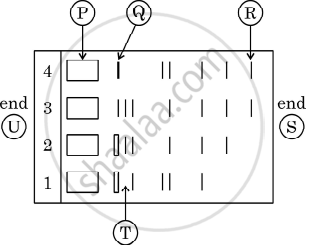
What is elution?
State the importance of elution in this process.
Given below is the restriction site of a restriction endonuclease Pst-I and the cleavage sites on a DNA molecule.
\[\ce{5' C - T - G - C - A \overset{\downarrow}{-}{G 3'}}\]
\[\ce{3' G\underset{\uparrow}{-} A - C - G - T - C 5'}\]
Choose the option that gives the correct resultant fragments by the action of the enzyme Pst-I.
Identify the activity of endonuclease and exonuclease in the given image.
Hind II always cuts DNA molecules at a particular point called recognition sequence and it consists of ______.
In the restriction endonuclease EcoRI, what do the letter 'R' and the Roman numeral 'I' represent?
Which of the following represents the specific palindromic recognition sequence cleaved by the restriction endonuclease EcoRI?
