Advertisements
Advertisements
प्रश्न
Do eukaryotic cells have restriction endonucleases? Justify your answer.
Advertisements
उत्तर
Yes, restriction endonucleases are found in eukaryotic cells. Restriction endonuclease acts by examining the length of the DNA sequence. When it finds its specific recognition sequence, it binds to the DNA and cuts both strands of the double helix at specific points in the sugar-phosphate backbones. Each restriction endonuclease recognises specific palindromic nucleotide sequences in DNA.
संबंधित प्रश्न
Name and describe the technique that helps in separating the DNA fragments formed by the use of restriction endonuclease
Make a chart (with diagrammatic representation) showing a restriction enzyme, the substrate DNA on which it acts, the site at which it cuts DNA and the product it produces.
How does restriction endonuclease function?
Explain the roles of the following with the help of an example each in recombinant DNA technology :
Restriction Enzymes
Answer the following question.
Write the use of restriction endonuclease in the formation of recombinant DNA.
There is a restriction endonudease called as EcoRI. What does co part in it stands for?
Molecular scissors, which cut DNA at specific site is ______.
'Restriction' in restriction enzyme refers to
'Restriction' in Restriction enzyme refers to ______.
Which of the following statements does not hold true for restriction enzyme?
Would you choose an exonuclease while producing a recombinant DNA molecule?
Restriction enzymes that are used in the construction of recombinant DNA are endonucleases which cut the DNA at ‘specific-recognition sequence’. What would be the disadvantage if they do not cut the DNA at specific-recognition sequence?
A mixture of fragmented DNA was electrophoresed in an agarose gel. After staining the gel with ethidium bromide, no DNA bands were observed. What could be the reason?
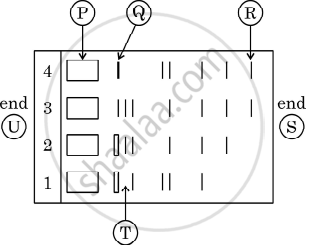
Given below is the stepwise schematic representation of the process of electrophoresis. Identify the 'alphabets' representing
- Anode end
- smallest/lightest DNA strand in the matrix
- Agarose gel
'EcoRI' has played a very significant role in rDNA technology.
- Explain the convention for naming EcoRI.
- Write the recognition site and the cleavage sites of this restriction endonuclease.
How are DNA fragments visualised once they are separated by gel electrophoresis?
