Advertisements
Advertisements
Question
Do eukaryotic cells have restriction endonucleases? Justify your answer.
Advertisements
Solution
Yes, restriction endonucleases are found in eukaryotic cells. Restriction endonuclease acts by examining the length of the DNA sequence. When it finds its specific recognition sequence, it binds to the DNA and cuts both strands of the double helix at specific points in the sugar-phosphate backbones. Each restriction endonuclease recognises specific palindromic nucleotide sequences in DNA.
RELATED QUESTIONS
Suggest a technique to a researcher who needs to separate fragments of DNA.
How does a restriction nuclease function? Explain
Explain briefly:
Restriction enzymes and DNA
Distinguish between exonuclease and endonuclease.
Answer the following question.
Explain the significance of palindromic nucleotide sequence in the formation of recombinant DNA.
Give a reason why :
Single cloning site is preferred in a vector.
DNA fragments separate according to size through?
A specific recognition sequence identified by endonucleases to make cuts at specific positions within the DNA is ______
The role of DNA ligase in the construction of a recombinant DNA molecule is ______.
Which of the following statements does not hold true for restriction enzyme?
Would you choose an exonuclease while producing a recombinant DNA molecule?
Restriction enzymes that are used in the construction of recombinant DNA are endonucleases which cut the DNA at ‘specific-recognition sequence’. What would be the disadvantage if they do not cut the DNA at specific-recognition sequence?
A plasmid DNA and a linear DNA (both are of the same size) have one site for a restriction endonuclease. When cut and separated on agarose gel electrophoresis, plasmid shows one DNA band while linear DNA shows two fragments. Explain.
Carefully observe the given picture. A mixture of DNA with fragments ranging from 200 base pairs to 2500 base pairs was electrophoresed on agarose gel with the following arrangement.
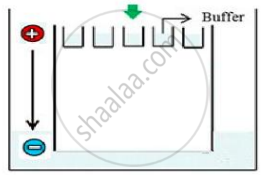
(a) What result will be obtained on staining with ethidium bromide? Explain with reason.
(b) The above setup was modified and a band with 250 base pairs was obtained at X.
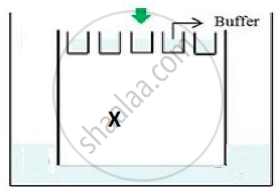
What change(s) were made to the previous design to obtain a band at X? Why did the band appear at position X?
State the importance of elution in this process.
Given below is the restriction site of a restriction endonuclease Pst-I and the cleavage sites on a DNA molecule.
\[\ce{5' C - T - G - C - A \overset{\downarrow}{-}{G 3'}}\]
\[\ce{3' G\underset{\uparrow}{-} A - C - G - T - C 5'}\]
Choose the option that gives the correct resultant fragments by the action of the enzyme Pst-I.
What are the protruding and hanging stretches of DNA produced by these restriction enzymes called? Describe their role in the formation of rDNA.
State the principle involved in separation of DNA fragments using gel electrophoresis.
How are DNA fragments visualised once they are separated by gel electrophoresis?
Identify the activity of endonuclease and exonuclease in the given image.
