Advertisements
Advertisements
Questions
Distinguish between exonuclease and endonuclease.
Differentiate between exonuclease and endonuclease.
Discuss with your teacher and find out how to distinguish between exonuclease and endonuclease.
Advertisements
Solution
| Sr. No. | Exonuclease | Endonuclease |
| 1. | It is a type of restriction enzyme that removes the nucleotide from the 5' or 3' ends of the DNA molecule. | It is a type of restriction enzyme that makes a cut within the DNA at a specific site to generate sticky ends. |
| 2. | They separated DNA base pairs at their terminal ends.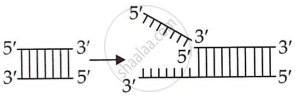 |
They separate DNA at any location other than the terminal ends.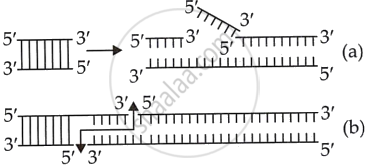 |
| 3. | They work on single strands of DNA or gaps in double-stranded DNA. | They cut one or both strands of double-stranded DNA. |
APPEARS IN
RELATED QUESTIONS
Explain with the help of a suitable example the naming of a restriction endonuclease.
Name the enzymes that are used for the isolation of DNA from bacterial and fungal cells for recombinant DNA technology.
Collect 5 examples of palindromic DNA sequences. Better try to create a palindromic sequence by following base-pair rules.
Explain briefly:
Restriction enzymes and DNA
How does restriction endonuclease function?
Explain the roles of the following with the help of an example each in recombinant DNA technology :
Restriction Enzymes
There is a restriction endonudease called as EcoRI. What does co part in it stands for?
Which of the given statements is correct in the context of visualizing DNA molecules separated by agarose gel electrophoresis?
'Restriction' in Restriction enzyme refers to ______.
While isolating DNA from bacteria, which of the following enzymes is not required?
The role of DNA ligase in the construction of a recombinant DNA molecule is ______.
Which of the following bacteria is not a source of restriction endonuclease?
A plasmid DNA and a linear DNA (both are of the same size) have one site for a restriction endonuclease. When cut and separated on agarose gel electrophoresis, plasmid shows one DNA band while linear DNA shows two fragments. Explain.
Carefully observe the given picture. A mixture of DNA with fragments ranging from 200 base pairs to 2500 base pairs was electrophoresed on agarose gel with the following arrangement.
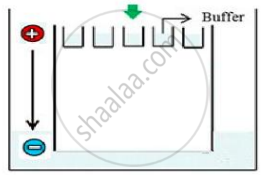
(a) What result will be obtained on staining with ethidium bromide? Explain with reason.
(b) The above setup was modified and a band with 250 base pairs was obtained at X.
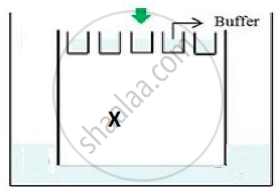
What change(s) were made to the previous design to obtain a band at X? Why did the band appear at position X?
Given below is the stepwise schematic representation of the process of electrophoresis. Identify the 'alphabets' representing
- Anode end
- smallest/lightest DNA strand in the matrix
- Agarose gel
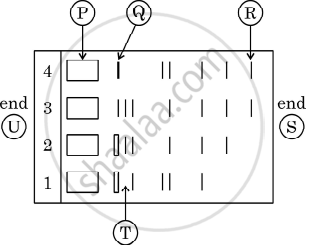
What is elution?
State the importance of elution in this process.
'EcoRI' has played a very significant role in rDNA technology.
- Explain the convention for naming EcoRI.
- Write the recognition site and the cleavage sites of this restriction endonuclease.
What are the protruding and hanging stretches of DNA produced by these restriction enzymes called? Describe their role in the formation of rDNA.
How are DNA fragments visualised once they are separated by gel electrophoresis?
Hind II always cuts DNA molecules at a particular point called recognition sequence and it consists of ______.
Which of the following was the very first restriction endonuclease to be isolated and characterized?
What is the origin of agarose, the matrix most commonly used in gel electrophoresis?
How are separated DNA bands visualized following agarose gel electrophoresis?
What is the process called when desired, separated DNA bands are physically cut out from the agarose gel and extracted from the gel piece?
