Advertisements
Advertisements
Question
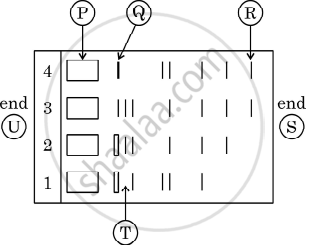
Given below is the stepwise schematic representation of the process of electrophoresis. Identify the 'alphabets' representing
- Anode end
- smallest/lightest DNA strand in the matrix
- Agarose gel
Advertisements
Solution
- Anode = S
- Smallest/lightest DNA Strand = R
- Agarose gel = T
APPEARS IN
RELATED QUESTIONS
Suggest a technique to a researcher who needs to separate fragments of DNA.
Make a chart (with diagrammatic representation) showing a restriction enzyme, the substrate DNA on which it acts, the site at which it cuts DNA and the product it produces.
Distinguish between exonuclease and endonuclease.
The total number of nucleotide sequences of DNA that code for a hormone is 1530. The proportion of different bases in the sequence is found to be Adenine = 34%, Guanine = 19%, Cytosine = 23%, Thymine = 19%.
Applying Chargaff’s rule, what conclusion can be drawn?
Which of the following enzymes catalyse the removal of nucleotides from the ends of DNA?
In agarose gel electrophoresis, DNA molecules are separated on the basis of their ______.
Would you choose an exonuclease while producing a recombinant DNA molecule?
Given below is the restriction site of a restriction endonuclease Pst-I and the cleavage sites on a DNA molecule.
\[\ce{5' C - T - G - C - A \overset{\downarrow}{-}{G 3'}}\]
\[\ce{3' G\underset{\uparrow}{-} A - C - G - T - C 5'}\]
Choose the option that gives the correct resultant fragments by the action of the enzyme Pst-I.
State the principle involved in separation of DNA fragments using gel electrophoresis.
How are DNA fragments visualised once they are separated by gel electrophoresis?
