Advertisements
Advertisements
Question
In agarose gel electrophoresis, DNA molecules are separated on the basis of their ______.
Options
Charge only
Size only
Charge to size ratio
All of the above
Advertisements
Solution
In agarose gel electrophoresis, DNA molecules are separated on the basis of their size only.
Explanation:
The gel acts as a molecular sieve, where smaller DNA fragments migrate faster through the pores of the agarose matrix compared to larger ones. Although DNA molecules are negatively charged and move toward the positive electrode due to their charge, the separation principle hinges predominantly on size differences, not charge alone or charge-to-size ratio.
APPEARS IN
RELATED QUESTIONS
Explain with the help of a suitable example the naming of a restriction endonuclease.
Why is the enzyme cellulase needed for isolating genetic material from plant cells and not form the animal cells?
Explain the roles of the following with the help of an example each in recombinant DNA technology :
Restriction Enzymes
The total number of nucleotide sequences of DNA that code for a hormone is 1530. The proportion of different bases in the sequence is found to be Adenine = 34%, Guanine = 19%, Cytosine = 23%, Thymine = 19%.
Applying Chargaff’s rule, what conclusion can be drawn?
The DNA fragment separated on an agarose gel can be visualized by staining with ______.
A mixture containing DNA fragments a, b, c and d, with molecular weights of a + b = c, a > b and d > c was subject to agarose get electrophoresis. This position of these fragments from cathode to anode to anode sides of the gel would be ______.
There is a restriction endonudease called as EcoRI. What does co part in it stands for?
'Restriction' in restriction enzyme refers to
Which of the following bacteria is not a source of restriction endonuclease?
Restriction enzymes that are used in the construction of recombinant DNA are endonucleases which cut the DNA at ‘specific-recognition sequence’. What would be the disadvantage if they do not cut the DNA at specific-recognition sequence?
A plasmid DNA and a linear DNA (both are of the same size) have one site for a restriction endonuclease. When cut and separated on agarose gel electrophoresis, plasmid shows one DNA band while linear DNA shows two fragments. Explain.
Carefully observe the given picture. A mixture of DNA with fragments ranging from 200 base pairs to 2500 base pairs was electrophoresed on agarose gel with the following arrangement.
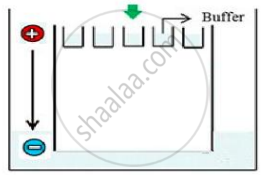
(a) What result will be obtained on staining with ethidium bromide? Explain with reason.
(b) The above setup was modified and a band with 250 base pairs was obtained at X.
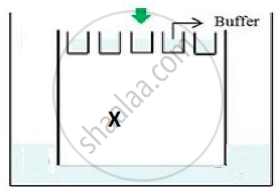
What change(s) were made to the previous design to obtain a band at X? Why did the band appear at position X?
'EcoRI' has played a very significant role in rDNA technology.
- Explain the convention for naming EcoRI.
- Write the recognition site and the cleavage sites of this restriction endonuclease.
Identify the activity of endonuclease and exonuclease in the given image.
Hind II always cuts DNA molecules at a particular point called recognition sequence and it consists of ______.
How do exonucleases differ fundamentally from endonucleases in their enzymatic site of action?
Why is it mandatory to cut both the vector DNA and the foreign source DNA with the exact same restriction enzyme when constructing recombinant DNA?
According to the sieving effect of an agarose gel matrix, which DNA fragments move the farthest and fastest from the loading wells?
What is the process called when desired, separated DNA bands are physically cut out from the agarose gel and extracted from the gel piece?
