Advertisements
Advertisements
Question
Name and describe the technique that helps in separating the DNA fragments formed by the use of restriction endonuclease
Advertisements
Solution
Gel electrophoresis is a technique of separating DNA fragments formed by the action of restriction endonucleases.
The fragments of DNA are placed in a typical agarose gel under an electric field. The DNA fragments move towards the anode as these fragments are negatively charged molecules. The DNA fragments separate according to their size through the sieving effect provided by the agarose gel. The smaller the fragment size, the farther it moves. The separated DNA fragments are stained with ethidium bromide followed by exposure to ultraviolet radiation. The DNA fragments are seen as orangecoloured and are cut out from the agarose gel and extracted from the gel piece. This step is called elution.

APPEARS IN
RELATED QUESTIONS
Name the enzymes that are used for the isolation of DNA from bacterial and fungal cells for recombinant DNA technology.
Make a chart (with diagrammatic representation) showing a restriction enzyme, the substrate DNA on which it acts, the site at which it cuts DNA and the product it produces.
Answer the following question.
Explain the significance of palindromic nucleotide sequence in the formation of recombinant DNA.
'Restriction' in restriction enzyme refers to
Which of the given statements is correct in the context of visualizing DNA molecules separated by agarose gel electrophoresis?
In agarose gel electrophoresis, DNA molecules are separated on the basis of their ______.
Restriction enzymes that are used in the construction of recombinant DNA are endonucleases which cut the DNA at ‘specific-recognition sequence’. What would be the disadvantage if they do not cut the DNA at specific-recognition sequence?
Carefully observe the given picture. A mixture of DNA with fragments ranging from 200 base pairs to 2500 base pairs was electrophoresed on agarose gel with the following arrangement.
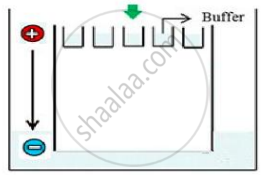
(a) What result will be obtained on staining with ethidium bromide? Explain with reason.
(b) The above setup was modified and a band with 250 base pairs was obtained at X.
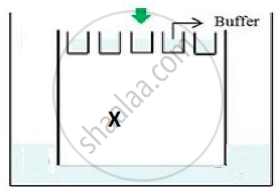
What change(s) were made to the previous design to obtain a band at X? Why did the band appear at position X?
Identify the activity of endonuclease and exonuclease in the given image.
In the restriction endonuclease EcoRI, what do the letter 'R' and the Roman numeral 'I' represent?
