Advertisements
Advertisements
Question
What does H in’ ‘d’ and ‘III’ refer to in the enzyme Hind III?
Advertisements
Solution
H’ from name of genus Haemophilus, ‘d’ from name of strain Rd. TIT indicates the order in which the enzyme was isolated from the Rd strain of bacteria.
APPEARS IN
RELATED QUESTIONS
Explain with the help of a suitable example the naming of a restriction endonuclease.
Name and describe the technique that helps in separating the DNA fragments formed by the use of restriction endonuclease
Distinguish between exonuclease and endonuclease.
Give a reason why :
Single cloning site is preferred in a vector.
There is a restriction endonudease called as EcoRI. What does co part in it stands for?
DNA fragments separate according to size through?
DNA strands on a gel stained with ethidium bromide when viewed under UV radiation, appear as ______
Which of the given statements is correct in the context of visualizing DNA molecules separated by agarose gel electrophoresis?
'Restriction' in Restriction enzyme refers to ______.
Would you choose an exonuclease while producing a recombinant DNA molecule?
CTTAAG
GAATTC
- What are such sequences called? Name the enzyme used that recognizes such nucleotide sequences.
- What is their significance in biotechnology?
Carefully observe the given picture. A mixture of DNA with fragments ranging from 200 base pairs to 2500 base pairs was electrophoresed on agarose gel with the following arrangement.
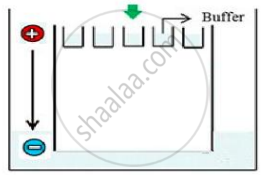
(a) What result will be obtained on staining with ethidium bromide? Explain with reason.
(b) The above setup was modified and a band with 250 base pairs was obtained at X.
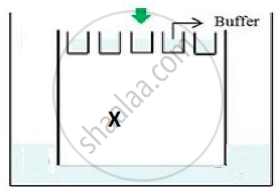
What change(s) were made to the previous design to obtain a band at X? Why did the band appear at position X?
Identify the activity of endonuclease and exonuclease in the given image.
Hind II always cuts DNA molecules at a particular point called recognition sequence and it consists of ______.
What is the precise definition of a palindromic sequence in DNA?
Which of the following was the very first restriction endonuclease to be isolated and characterized?
During agarose gel electrophoresis, why do DNA fragments migrate toward the anode (positive electrode)?
Why are Type II restriction endonucleases the primary class of restriction enzymes used in genetic manipulation?
