Advertisements
Advertisements
प्रश्न
Distinguish between exonuclease and endonuclease.
Differentiate between exonuclease and endonuclease.
Discuss with your teacher and find out how to distinguish between exonuclease and endonuclease.
Advertisements
उत्तर
| Sr. No. | Exonuclease | Endonuclease |
| 1. | It is a type of restriction enzyme that removes the nucleotide from the 5' or 3' ends of the DNA molecule. | It is a type of restriction enzyme that makes a cut within the DNA at a specific site to generate sticky ends. |
| 2. | They separated DNA base pairs at their terminal ends.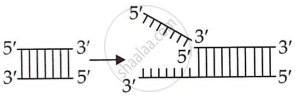 |
They separate DNA at any location other than the terminal ends.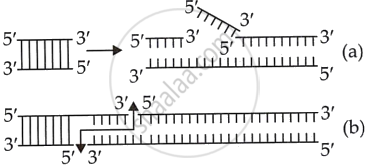 |
| 3. | They work on single strands of DNA or gaps in double-stranded DNA. | They cut one or both strands of double-stranded DNA. |
APPEARS IN
संबंधित प्रश्न
Explain with the help of a suitable example the naming of a restriction endonuclease.
How does a restriction nuclease function? Explain
Make a chart (with diagrammatic representation) showing a restriction enzyme, the substrate DNA on which it acts, the site at which it cuts DNA and the product it produces.
Collect 5 examples of palindromic DNA sequences. Better try to create a palindromic sequence by following base-pair rules.
Explain briefly:
Restriction enzymes and DNA
Answer the following question.
Write the use of restriction endonuclease in the formation of recombinant DNA.
The total number of nucleotide sequences of DNA that code for a hormone is 1530. The proportion of different bases in the sequence is found to be Adenine = 34%, Guanine = 19%, Cytosine = 23%, Thymine = 19%.
Applying Chargaff’s rule, what conclusion can be drawn?
A mixture containing DNA fragments a, b, c and d, with molecular weights of a + b = c, a > b and d > c was subject to agarose get electrophoresis. This position of these fragments from cathode to anode to anode sides of the gel would be ______.
Which of the following radioisotope is not suitable for DNA labeling based studies?
There is a restriction endonudease called as EcoRI. What does co part in it stands for?
'Restriction' in restriction enzyme refers to
DNA fragments separate according to size through?
Which of the given statements is correct in the context of visualizing DNA molecules separated by agarose gel electrophoresis?
While isolating DNA from bacteria, which of the following enzymes is not required?
Which of the following bacteria is not a source of restriction endonuclease?
What does H in’ ‘d’ and ‘III’ refer to in the enzyme Hind III?
Restriction enzymes should not have more than one site of action in the cloning site of a vector. Comment.
A plasmid DNA and a linear DNA (both are of the same size) have one site for a restriction endonuclease. When cut and separated on agarose gel electrophoresis, plasmid shows one DNA band while linear DNA shows two fragments. Explain.
A mixture of fragmented DNA was electrophoresed in an agarose gel. After staining the gel with ethidium bromide, no DNA bands were observed. What could be the reason?
What is elution?
State the principle involved in separation of DNA fragments using gel electrophoresis.
Identify the activity of endonuclease and exonuclease in the given image.
In the standard nomenclature convention for restriction endonucleases, what do the second and third letters signify?
Why is it mandatory to cut both the vector DNA and the foreign source DNA with the exact same restriction enzyme when constructing recombinant DNA?
During agarose gel electrophoresis, why do DNA fragments migrate toward the anode (positive electrode)?
According to the sieving effect of an agarose gel matrix, which DNA fragments move the farthest and fastest from the loading wells?
How are separated DNA bands visualized following agarose gel electrophoresis?
