Advertisements
Advertisements
Question
How does a restriction nuclease function? Explain
Advertisements
Solution
Restriction endonuclease functions by recognising its specific sequence. It binds to the DNA and cuts each to the two strands of the double helix at specific points in their sugar phosphate backbones. These enzymes cut the strand of DNA between the same two bases on the opposite strands leaving a single-stranded portion at their ends. These overhanging stretches are called sticky ends on each strand. The enzyme DNA ligase functions depending on the stickiness of these ends. For example, the restriction endonuclease EcoRI found in the colon bacteria E. coli recognises the base sequence GAATTC in the DNA duplex and cuts its strands between G and A.

APPEARS IN
RELATED QUESTIONS
Mention the difference in the mode of action of exonuclease and endonuclease.
Collect 5 examples of palindromic DNA sequences. Better try to create a palindromic sequence by following base-pair rules.
Explain briefly:
Restriction enzymes and DNA
How does restriction endonuclease function?
DNA fragments separate according to size through?
Carefully observe the given picture. A mixture of DNA with fragments ranging from 200 base pairs to 2500 base pairs was electrophoresed on agarose gel with the following arrangement.
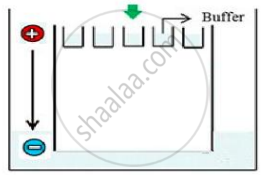
(a) What result will be obtained on staining with ethidium bromide? Explain with reason.
(b) The above setup was modified and a band with 250 base pairs was obtained at X.
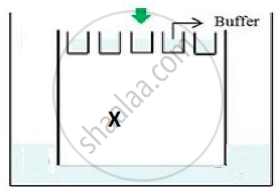
What change(s) were made to the previous design to obtain a band at X? Why did the band appear at position X?
'EcoRI' has played a very significant role in rDNA technology.
- Explain the convention for naming EcoRI.
- Write the recognition site and the cleavage sites of this restriction endonuclease.
Identify the activity of endonuclease and exonuclease in the given image.
Hind II always cuts DNA molecules at a particular point called recognition sequence and it consists of ______.
In the standard nomenclature convention for restriction endonucleases, what do the second and third letters signify?
