Advertisements
Advertisements
प्रश्न
Do eukaryotic cells have restriction endonucleases? Justify your answer.
Advertisements
उत्तर
Yes, restriction endonucleases are found in eukaryotic cells. Restriction endonuclease acts by examining the length of the DNA sequence. When it finds its specific recognition sequence, it binds to the DNA and cuts both strands of the double helix at specific points in the sugar-phosphate backbones. Each restriction endonuclease recognises specific palindromic nucleotide sequences in DNA.
संबंधित प्रश्न
How are 'sticky ends' formed on a DNA strand? Why are they so called?
Why is the enzyme cellulase needed for isolating genetic material from plant cells and not form the animal cells?
Name and describe the technique that helps in separating the DNA fragments formed by the use of restriction endonuclease
Explain briefly:
Restriction enzymes and DNA
Answer the following question.
Write the use of restriction endonuclease in the formation of recombinant DNA.
Give a reason why :
Single cloning site is preferred in a vector.
The DNA fragment separated on an agarose gel can be visualized by staining with ______.
A mixture containing DNA fragments a, b, c and d, with molecular weights of a + b = c, a > b and d > c was subject to agarose get electrophoresis. This position of these fragments from cathode to anode to anode sides of the gel would be ______.
Restriction enzymes ______.
Molecular scissors, which cut DNA at specific site is ______.
DNA strands on a gel stained with ethidium bromide when viewed under UV radiation, appear as ______
In agarose gel electrophoresis, DNA molecules are separated on the basis of their ______.
While isolating DNA from bacteria, which of the following enzymes is not required?
Restriction enzymes should not have more than one site of action in the cloning site of a vector. Comment.
CTTAAG
GAATTC
- What are such sequences called? Name the enzyme used that recognizes such nucleotide sequences.
- What is their significance in biotechnology?
Given below is the stepwise schematic representation of the process of electrophoresis. Identify the 'alphabets' representing
- Anode end
- smallest/lightest DNA strand in the matrix
- Agarose gel
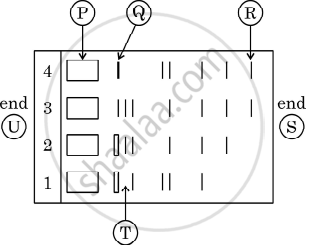
What is elution?
'EcoRI' has played a very significant role in rDNA technology.
- Explain the convention for naming EcoRI.
- Write the recognition site and the cleavage sites of this restriction endonuclease.
How are DNA fragments visualised once they are separated by gel electrophoresis?
