Advertisements
Advertisements
प्रश्न
From what you have learnt, can you tell whether enzymes are bigger or DNA is bigger in molecular size? How did you know?
Advertisements
उत्तर
Both DNA (deoxyribonucleic acid) and enzymes are macromolecules. DNA is a polymer of deoxyribonucleotides, and enzymes are proteins; hence, these are polymers of amino acids. But DNA is larger in molecular size than proteins because protein synthesis is regulated by small segments of DNA, called genes, and a single DNA molecule can encode many proteins.
APPEARS IN
संबंधित प्रश्न
Suggest and describe a technique to obtain multiple copies of a gene of interest in vitro.
Besides better aeration and mixing properties, what other advantages do stirred tank bioreactors have over shake flasks?
Can you recall meiosis and indicate at what stage recombinant DNA is made?
Explain briefly:
PCR
State the importance of using a bioreactor.
Describe the process of amplification of the “gene of interest” using the PCR technique.
______ plays an important role in blood clotting.
PCR and restriction fragment length polymorphism are the methods for ______.
PCR proceeds mthree distinct steps governed by temperature, they are in order of ______.
Blood stains are found at the site of a murder. It DNA profiling technique is to be used for identifying the criminals, which of the following is ideal for use?
In addition to the Taq polymerase enzyme, which other thermostable DNA polymerases have been isolated to be used in PCR?
During the purification process for recombinant DNA technology, the addition of chilled ethanol precipitates out ______.
During the process of gene amplification using PCR, if a very high temperature is not maintained in the beginning, then which of the following steps of PCR will be affected first?
Rising of dough is due to ______.
An antibiotic resistance gene in a vector usually helps in the selection of ______.
Significance of 'heat shock' method in bacterial transformation is to facilitate ______.
A bacterial cell was transformed with a recombinant DNA molecule that was generated using a human gene. However, the transformed cells did not produce the desired protein. Reasons could be ______.
Which of the following should be chosen for best yield if one were to produce a recombinant protein in large amounts?
Read the paragraph given below and answer and questions that follow:
| Enzyme Taq polymerase, is extracted from a eubacterial microorganism Thermus aquaticus from Yellowstone National Park in Montana, USA and isolated by Chien et al. (1976). Taq polymerase successfully replaced the DNA polymerase from E.coli that was being used in PCR earlier and this shift revolutionised the PCR technique. |
- Taq polymerase after its discovery replaced E.coli DNA polymerase in PCR technique. Explain giving reasons why was the need felt for the change?
- What is a primer and its importance in PCR?
- Write the importance of PCR as a diagnostic tool.
Assertion (A): Synthetic oligonucleotide polymers are used during Annealing in a PCR.
Reason (R): The primers bind to the double stranded DNA at their complementary regions.
Write the scientific name of the source organism of the thermostable DNA polymerase used in PCR.
Bioreactors are the containment vehicles of any biotechnology-based production process. For large scale production and for economic reasons the final success of biotechnological process depends on the efficiency of the bioreactor.
Answer the following questions w.r.t. the given paragraph:
- List the operational guidelines that must be adhered to so as to achieve optimisation of the bioreactor system. Enlist any four.
- Mention the phase of the growth we refer to in the statement "Optimisation of growth and metabolic activity of the cells".
- Is the biological product formed in the bioreactor suitable for the intended use immediate? Give reason in support of your answer.
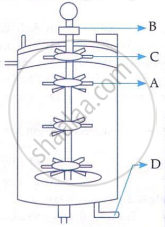
Identify the part of a bio-reactor which is used as a foam braker from the given figure.
What is the primary definition of recombinant DNA technology?
Which enzyme is specifically used to break open fungal cells during the isolation of genetic material?
How are bacterial cells typically made competent to facilitate the uptake of recombinant DNA during transformation?
