Advertisements
Advertisements
Question
From what you have learnt, can you tell whether enzymes are bigger or DNA is bigger in molecular size? How did you know?
Advertisements
Solution
Both DNA (deoxyribonucleic acid) and enzymes are macromolecules. DNA is a polymer of deoxyribonucleotides, and enzymes are proteins; hence, these are polymers of amino acids. But DNA is larger in molecular size than proteins because protein synthesis is regulated by small segments of DNA, called genes, and a single DNA molecule can encode many proteins.
APPEARS IN
RELATED QUESTIONS
Name two commonly used bioreactors.
Draw a labelled sketch of sparged-stirred-tank bioreactor. Write its application.
Describe briefly the following:
Bioreactors
Prepare a flow chart in formation of recombinant DNA by the action of restriction endonuclease enzyme EcoRI.
DNA fragments generated by the restriction endonuclease in a chemical reaction can be separated by ______.
A single strand of nucleic acid tagged with a radioactive molecule is called ______.
The first step in recombinant DNA technology is
In PCR, primers are used for ______.
Rising of dough is due to ______.
Which of the following contributed in popularising the PCR (polymerase chain reactions) technique?
An antibiotic resistance gene in a vector usually helps in the selection of ______.
Which of the following steps are catalysed by Taq DNA polymerase in a PCR reaction?
While doing a PCR, ‘denaturation’ step is missed. What will be its effect on the process?
Do biomolecules (DNA, protein) exhibit biological activity in anhydrous conditions?
Read the following paragraph and answer the questions that follow:
| Biotechnology revolves around the "gene of interest", with an objective to open various avenues for human welfare in health, medicine, pharma, agriculture etc. using different techniques, tools and processes. One of the breakthroughs of biotechnology in medicine is the gene therapy. |
- Name the human disease for which the gene therapy was used for the first time.
- Explain the steps of gene therapy carried to cure the disease using the lymphocytes of the patient. Why is this therapy not a permanent cure of the disease?
- Write the possible permanent cure of the disease by the gene therapy that is in progress.
Bioreactors are the containment vehicles of any biotechnology-based production process. For large scale production and for economic reasons the final success of biotechnological process depends on the efficiency of the bioreactor.
Answer the following questions w.r.t. the given paragraph:
- List the operational guidelines that must be adhered to so as to achieve optimisation of the bioreactor system. Enlist any four.
- Mention the phase of the growth we refer to in the statement "Optimisation of growth and metabolic activity of the cells".
- Is the biological product formed in the bioreactor suitable for the intended use immediate? Give reason in support of your answer.
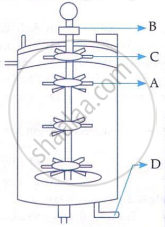
Identify the part of a bio-reactor which is used as a foam braker from the given figure.
What is the primary definition of recombinant DNA technology?
Which enzymes act as 'molecular scissors' to cut purified DNA precisely at specific target sites?
What is the process of cutting out and recovering a separated DNA band from an agarose gel called?
In the provided agarose gel electrophoresis image, what is represented in lane 1 compared to lanes 2 through 4?
Which enzyme is responsible for joining the desired gene to a carrier vector DNA to form recombinant DNA?
How are bacterial cells typically made competent to facilitate the uptake of recombinant DNA during transformation?
Which of the following are direct methods used for introducing recombinant DNA into host cells besides chemical transformation?
