Advertisements
Advertisements
Question
An antibiotic resistance gene in a vector usually helps in the selection of ______.
Options
Competent bacterial cells
Transformed bacterial cells
Recombinant bacterial cells
None of the above
Advertisements
Solution
An antibiotic resistance gene in a vector usually helps in the selection of transformed bacterial cells.
APPEARS IN
RELATED QUESTIONS
Suggest and describe a technique to obtain multiple copies of a gene of interest in vitro.
Can you recall meiosis and indicate at what stage recombinant DNA is made?
Describe briefly the following:
Bioreactors
State the importance of using a bioreactor.
Describe the process of amplification of the “gene of interest” using the PCR technique.
Which of the following term used for defining a viral genome incorporated into host DNA?
PCR and restriction fragment length polymorphism are the methods for ______.
The first step in recombinant DNA technology is
During the purification process for recombinant DNA technology, the addition of chilled ethanol precipitates out ______.
During the process of gene amplification using PCR, if a very high temperature is not maintained in the beginning, then which of the following steps of PCR will be affected first?
Rising of dough is due to ______.
Which of the following steps are catalysed by Taq DNA polymerase in a PCR reaction?
A bacterial cell was transformed with a recombinant DNA molecule that was generated using a human gene. However, the transformed cells did not produce the desired protein. Reasons could be ______.
Identify and explain steps ‘A’, ‘B’ and ‘C’ in the PCR diagram given below.

Read the paragraph given below and answer and questions that follow:
| Enzyme Taq polymerase, is extracted from a eubacterial microorganism Thermus aquaticus from Yellowstone National Park in Montana, USA and isolated by Chien et al. (1976). Taq polymerase successfully replaced the DNA polymerase from E.coli that was being used in PCR earlier and this shift revolutionised the PCR technique. |
- Taq polymerase after its discovery replaced E.coli DNA polymerase in PCR technique. Explain giving reasons why was the need felt for the change?
- What is a primer and its importance in PCR?
- Write the importance of PCR as a diagnostic tool.
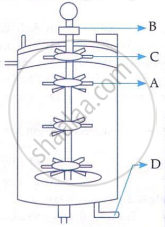
Identify the part of a bio-reactor which is used as a foam braker from the given figure.
Which enzyme is specifically used to break open fungal cells during the isolation of genetic material?
Which enzymes act as 'molecular scissors' to cut purified DNA precisely at specific target sites?
In the provided agarose gel electrophoresis image, what is represented in lane 1 compared to lanes 2 through 4?
Which series of operations is collectively referred to as 'downstream processing'?
