Advertisements
Advertisements
Question
A bacterial cell was transformed with a recombinant DNA molecule that was generated using a human gene. However, the transformed cells did not produce the desired protein. Reasons could be ______.
Options
Human gene may have intron which bacteria cannot process
Amino acid codons for humans and bacteria are different
Human protein is formed but degraded by bacteria
All of the above
Advertisements
Solution
A bacterial cell was transformed with a recombinant DNA molecule that was generated using a human gene. However, the transformed cells did not produce the desired protein. Reasons could be human gene may have intron which bacteria cannot process.
APPEARS IN
RELATED QUESTIONS
Name two commonly used bioreactors.
Can you recall meiosis and indicate at what stage recombinant DNA is made?
Which of the following term used for defining a viral genome incorporated into host DNA?
PCR and restriction fragment length polymorphism are the methods for ______.
Blood stains are found at the site of a murder. It DNA profiling technique is to be used for identifying the criminals, which of the following is ideal for use?
In addition to the Taq polymerase enzyme, which other thermostable DNA polymerases have been isolated to be used in PCR?
In PCR, primers are used for ______.
Rising of dough is due to ______.
Which of the following contributed in popularising the PCR (polymerase chain reactions) technique?
Do biomolecules (DNA, protein) exhibit biological activity in anhydrous conditions?
Read the following paragraph and answer the questions that follow:
| Biotechnology revolves around the "gene of interest", with an objective to open various avenues for human welfare in health, medicine, pharma, agriculture etc. using different techniques, tools and processes. One of the breakthroughs of biotechnology in medicine is the gene therapy. |
- Name the human disease for which the gene therapy was used for the first time.
- Explain the steps of gene therapy carried to cure the disease using the lymphocytes of the patient. Why is this therapy not a permanent cure of the disease?
- Write the possible permanent cure of the disease by the gene therapy that is in progress.
Assertion (A): Synthetic oligonucleotide polymers are used during Annealing in a PCR.
Reason (R): The primers bind to the double stranded DNA at their complementary regions.
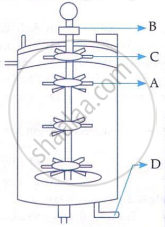
Identify the part of a bio-reactor which is used as a foam braker from the given figure.
Given below are two statements:
Statement I: The DNA fragments extracted from gel electrophoresis can be used in construction of recombinant DNA.
Statement II: Smaller size DNA fragments are observed near anode while larger fragments are found near the wells in an agarose gel.
In the light of the above statements, choose the most appropriate answer from the options given below:
Main steps in the formation of Recombinant DNA are given below. Arrange these steps in a correct sequence.
- Insertion of recombinant DNA into the host cell.
- Cutting of DNA at specific location by restriction enzyme.
- Isolation of desired DNA fragment.
- Amplification of gene of interest using PCR.
Choose the correct answer from the options given below:
What is the primary definition of recombinant DNA technology?
Which enzyme is specifically used to break open fungal cells during the isolation of genetic material?
In agarose gel electrophoresis, why do DNA fragments move toward the positive electrode?
What is the process of cutting out and recovering a separated DNA band from an agarose gel called?
