Advertisements
Advertisements
Question
Describe briefly the following:
Bioreactors
Advertisements
Solution
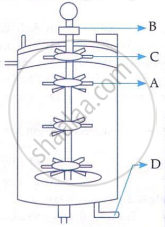
Bioreactors can be thought of as vessels in which raw materials are biologically converted into specific products, individual enzymes, etc., using microbial plant, animal, or human cells. A bioreactor provides the optimal conditions for achieving the desired product by providing optimum growth conditions (temperature, pH, substrate, salts, vitamins, oxygen). The most commonly used bioreactor is the stirring type. Stirred-tank reactors are usually cylindrical or have a curved base. This helps mix the material inside the reactor. Stirrers not only mix the material inside the reactor but also ensure the availability of oxygen everywhere in the reactor. Every bioreactor has an agitator system. It also has an oxygen delivery system, foam control system, temperature control system, and pH control device. The reaction is controlled by a system and sampling, which allows small volumes of the cultured product to be periodically removed.
APPEARS IN
RELATED QUESTIONS
Name two commonly used bioreactors.
Can you list 10 recombinant proteins which are used in medical practice? Find out where they are used as therapeutics (use the internet).
Besides better aeration and mixing properties, what other advantages do stirred tank bioreactors have over shake flasks?
Can you recall meiosis and indicate at what stage recombinant DNA is made?
Explain briefly:
Chitinase
State the importance of using a bioreactor.
Describe the process of amplification of the “gene of interest” using the PCR technique.
In a pathological lab, a series of steps were undertaken for finding the gene of interest. Describe the steps, or make a flow chart showing the process of amplification of this gene of interest.
Which of the following term used for defining a viral genome incorporated into host DNA?
DNA fragments generated by the restriction endonuclease in a chemical reaction can be separated by ______.
PCR and restriction fragment length polymorphism are the methods for ______.
A single strand of nucleic acid tagged with a radioactive molecule is called ______.
Gene Amplification using primers can be done by ______.
During the purification process for recombinant DNA technology, the addition of chilled ethanol precipitates out ______.
Significance of 'heat shock' method in bacterial transformation is to facilitate ______.
Which of the following should be chosen for best yield if one were to produce a recombinant protein in large amounts?
Write the scientific name of the source organism of the thermostable DNA polymerase used in PCR.
Identify the part of a bio-reactor which is used as a foam braker from the given figure.
Given below are two statements:
Statement I: The DNA fragments extracted from gel electrophoresis can be used in construction of recombinant DNA.
Statement II: Smaller size DNA fragments are observed near anode while larger fragments are found near the wells in an agarose gel.
In the light of the above statements, choose the most appropriate answer from the options given below:
Upon exposure to UV radiation, DNA stained with ethidium bromide will show ______.
What is the primary definition of recombinant DNA technology?
Which enzyme is specifically used to break open fungal cells during the isolation of genetic material?
Which enzymes act as 'molecular scissors' to cut purified DNA precisely at specific target sites?
How are bacterial cells typically made competent to facilitate the uptake of recombinant DNA during transformation?
Which series of operations is collectively referred to as 'downstream processing'?
