Advertisements
Advertisements
प्रश्न
Describe briefly the following:
Bioreactors
Advertisements
उत्तर
Bioreactors can be thought of as vessels in which raw materials are biologically converted into specific products, individual enzymes, etc., using microbial plant, animal, or human cells. A bioreactor provides the optimal conditions for achieving the desired product by providing optimum growth conditions (temperature, pH, substrate, salts, vitamins, oxygen). The most commonly used bioreactor is the stirring type. Stirred-tank reactors are usually cylindrical or have a curved base. This helps mix the material inside the reactor. Stirrers not only mix the material inside the reactor but also ensure the availability of oxygen everywhere in the reactor. Every bioreactor has an agitator system. It also has an oxygen delivery system, foam control system, temperature control system, and pH control device. The reaction is controlled by a system and sampling, which allows small volumes of the cultured product to be periodically removed.
APPEARS IN
संबंधित प्रश्न
Name two commonly used bioreactors.
Draw a labelled sketch of sparged-stirred-tank bioreactor. Write its application.
Describe briefly the following:
Downstream processing
State the importance of using a bioreactor.
______ plays an important role in blood clotting.
PCR proceeds mthree distinct steps governed by temperature, they are in order of ______.
Blood stains are found at the site of a murder. It DNA profiling technique is to be used for identifying the criminals, which of the following is ideal for use?
In PCR, primers are used for ______.
Rising of dough is due to ______.
Which of the following steps are catalysed by Taq DNA polymerase in a PCR reaction?
Which of the following should be chosen for best yield if one were to produce a recombinant protein in large amounts?
How is copy number of the plasmid vector related to yield of recombinant protein?
While doing a PCR, ‘denaturation’ step is missed. What will be its effect on the process?
Do biomolecules (DNA, protein) exhibit biological activity in anhydrous conditions?
Read the paragraph given below and answer and questions that follow:
| Enzyme Taq polymerase, is extracted from a eubacterial microorganism Thermus aquaticus from Yellowstone National Park in Montana, USA and isolated by Chien et al. (1976). Taq polymerase successfully replaced the DNA polymerase from E.coli that was being used in PCR earlier and this shift revolutionised the PCR technique. |
- Taq polymerase after its discovery replaced E.coli DNA polymerase in PCR technique. Explain giving reasons why was the need felt for the change?
- What is a primer and its importance in PCR?
- Write the importance of PCR as a diagnostic tool.
Write the scientific name of the source organism of the thermostable DNA polymerase used in PCR.
State the advantage of using Thermostable DNA polymerase.
Bioreactors are the containment vehicles of any biotechnology-based production process. For large scale production and for economic reasons the final success of biotechnological process depends on the efficiency of the bioreactor.
Answer the following questions w.r.t. the given paragraph:
- List the operational guidelines that must be adhered to so as to achieve optimisation of the bioreactor system. Enlist any four.
- Mention the phase of the growth we refer to in the statement "Optimisation of growth and metabolic activity of the cells".
- Is the biological product formed in the bioreactor suitable for the intended use immediate? Give reason in support of your answer.
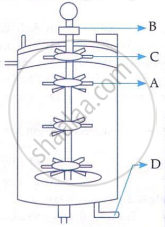
Identify the part of a bio-reactor which is used as a foam braker from the given figure.
Upon exposure to UV radiation, DNA stained with ethidium bromide will show ______.
What is the primary definition of recombinant DNA technology?
Which enzymes act as 'molecular scissors' to cut purified DNA precisely at specific target sites?
What is the process of cutting out and recovering a separated DNA band from an agarose gel called?
How are bacterial cells typically made competent to facilitate the uptake of recombinant DNA during transformation?
Which series of operations is collectively referred to as 'downstream processing'?
