Advertisements
Online Mock Tests
Chapters
▶ 2: Periodic Classication of Element
3: Chemical reactions and equations
4: Effects of electric current
5: Heat
6: Refraction of light
7: Lenses
8: Metallugy
9: Carbon compounds
10: Space Missions
![SCERT Maharashtra solutions for Science and Technology Part 1 [English] Standard 10 Maharashtra State Board chapter 2 - Periodic Classication of Element - Shaalaa.com](/images/science-and-technology-part-1-english-standard-10-maharashtra-state-board_6:5f2b1b2038084cf381bfa42c826a928c.jpg "SCERT Maharashtra solutions for Science and Technology Part 1 [English] Standard 10 Maharashtra State Board chapter 2 - Periodic Classication of Element")
Advertisements
Solutions for Chapter 2: Periodic Classication of Element
Below listed, you can find solutions for Chapter 2 of Maharashtra State Board SCERT Maharashtra for Science and Technology Part 1 [English] Standard 10 Maharashtra State Board.
SCERT Maharashtra solutions for Science and Technology Part 1 [English] Standard 10 Maharashtra State Board 2 Periodic Classication of Element Choose the correct option. [Pages 2 - 4]
Dobereiner laid down the ______ rule.
periodic
modern periodic
triad
octaves
Newlands’ Law of Octaves is applicable up to ______.
oxygen
calcium
cobalt
potassium
X and Y are two elements having similar properties which obey Newlands’s Law of Octaves. The minimum and maximum number of elements in between X and Y respectively are ______.
6 and 8
7 and 15
8 and 14
6 and 13
At the time of Mendeleev ______ elements were known.
56
65
63
118
In Mendeleev’s periodic table eka- silicon was later named as ______.
scandium
gallium
germanium
thorium
In Modern Periodic Table the number of columns and periods are respectively ______ and ______.
16, 7
6, 16
18, 7
18, 6
______ is the outermost shell for elements of period 2.
K
L
M
N
The groups 1 and 2 constitute the ______ block.
s
p
d
d
Which pair of atomic numbers represents elements in the same group?
11, 19
6, 12
4, 16
8, 17
Which among the following elements would lose an electron easily?
Mg
Na
Al
Cl
Which among the following is the largest element?
Na
Mg
K
Ca
Arrange the following elements in order of their decreasing metallic character.
Na, Si, Cl, Mg, Al
Cl > Si > Al > Mg > Na
Na > Mg > Al > Si > Cl
Na > Al > Mg > Cl > Si
Al > Na > Si > Ca > Mg
Which one of the following does not increase while moving down the group of the periodic table?
Atomic radius
Metallic character
Valency
Number of shells
On moving from left to right in a periodic table, the size of the atom ______.
increases
decreases
decreases first and then increases
does not change
Which of the following statements about the Modern periodic table is correct?
18 horizontal rows are known as Periods.
7 vertical columns are known as Periods.
18 vertical columns are known as groups.
7 horizontal rows are known as groups.
The d-block elements are called as ______ elements.
transition
metalloid
normal
inner transition
The size of an atom is indicated by its ______.
atomic number
radius
number of shells
atomic mass
_______ is the distance between the nucleus of the atom and its outermost shell.
Atomic radius
Atomic diameter
atomic mass
atomic size
Atomic radius is expressed in the unit ______.
nanometer
picometer
micrometer
millimeter
The tendency of an element to form cation is the ______ character of that element.
non metallic
basic
metallic
acidic
______ is in liquid form in the halogen family.
Fluorine
Chlorine
Bromine
Iodine
While going from top to bottom in a group the atomic radius ______.
increases
decreases
remains same
No change occurs
The tendency of an element to form anion is the ______ character of that element.
nonmetallic
basic
metallic
acidic
The elements from the zero group are called ______.
alkali metals
alkaline earth metals
halogen
noble gases
SCERT Maharashtra solutions for Science and Technology Part 1 [English] Standard 10 Maharashtra State Board 2 Periodic Classication of Element Find the correlation. [Page 10]
Find the correlation:
Eka boron : Scandium : : Eka Aluminum : ______
Find the correlation:
Mendeleev’s periodic table : atomic mass : : Modern periodic table : _______
Find the correlation:
Group 1 and 2 : s block : : group 13 and 18 : ______
Find the correlation:
Group 13 to 18 : p block : : ______ : d block
Find the correlation:
Two elements in the same position : demerit of Newland's octaves : : place for Isotopes : ______
Find the correlation:
Beryllium : alkaline earth metal : : sodium: ______
Find the correlation:
Cl : halogen group : : Ar : _______
Find the correlation:
Iodine : solid : : bromine : _______
SCERT Maharashtra solutions for Science and Technology Part 1 [English] Standard 10 Maharashtra State Board 2 Periodic Classication of Element Find odd one out. [Page 12]
Find the odd one out and give its explanation.
F
K
Cl
I
Find the odd one out and give its explanation.
Lithium
Sodium
Magnesium
Potassium
Find the odd one out and give its explanation.
Beryllium
Helium
Neon
Argon
Find the odd one out and give its explanation.
Gallium
Scandium
Germanium
Calcium
Find the odd one out and give its explanation.
Boron
Arsenic
Germanium
Gallium
Find the odd one out and give its explanation.
Dobereiner
Newland
Mendeleev
Moseley
Find the odd one out and give its explanation.
Fluorine
Boron
Bromine
Chlorine
Find the odd one out and give its explanation.
Carbon
Calcium
Oxygen
Neon
Find the odd one out and give its explanation.
Potassium
Magnesium
Calcium
Beryllium
Find the odd one out and give its explanation.
Beryllium
Magnesium
Carbon
Oxygen
SCERT Maharashtra solutions for Science and Technology Part 1 [English] Standard 10 Maharashtra State Board 2 Periodic Classication of Element Answer in one sentence. [Page 13]
Answer the following question in one sentence.
Elements A and B follow Newland’s octaves rule. How many elements are there in between A and B?
Answer the following question in one sentence.
Write the characteristic of Dobereiner’s triads?
Answer the following question in one sentence.
To which element does Newland’s octave rule apply?
Answer the following question in one sentence.
Write the molecular formula of the oxide of any one of the elements in Mendeleev’s periodic table.
Answer the following question in one sentence.
Write the name of the noble gas having 2 electrons in its valence shell.
Answer the following question in one sentence.
Write the name of an element having electronic configuration 2,8,2.
Answer the following question in one sentence.
Which two elements show an ambiguity regarding their sequence in Mendeleev’s periodic table?
Answer the following question in one sentence.
The elements beryllium, magnesium and calcium are in group 2. What will be their valency?
Answer the following question in one sentence.
The modern periodic table is divided into which blocks?
Answer the following question in one sentence.
What determines the chemical reactivity of elements?
SCERT Maharashtra solutions for Science and Technology Part 1 [English] Standard 10 Maharashtra State Board 2 Periodic Classication of Element Match the columns [Page 15]
Match the columns.
| Column A | Column B |
| 1) Eka-aluminium | a) Scandium |
| 2) Eka-Silicon | b) Gallium |
| 3) Eka-boron | c) Germanium |
| d) Beryllium |
Match the columns.
| Column A | Column B |
| 1) Triads | a) Mendeleev |
| 2) Octave | b) Dobereiner |
| 3) Atomic number | c) Thomson |
| 4) Atomic mass number | d) Moseley |
| e) Newland |
Match the columns.
| Column A | Column B |
| 1) s -block | a) Lanthanides and actinides |
| 2) p -block | b) Group 3 to 12 |
| 3) d -block | c) Group 1, 2 |
| 4) f -block | d) Group 13 to 18 |
| e) Zero group |
Match the columns.
| Column A Electronic configuration |
Column B Valency |
| 1) 2, 2 | a) 1 |
| 2) 2, 8, 1 | b) 2 |
| 3) 2, 5 | c) 3 |
| d) 5 |
Match the columns.
| Column A | Column B |
| 1) Alkaline earth metals | a) Group 18 |
| 2) Alkali metals | b) Group 17 |
| 3) Halogen | c) Group 2 |
| 4) Noble gas | d) Group 1 |
| e) Group 14 |
SCERT Maharashtra solutions for Science and Technology Part 1 [English] Standard 10 Maharashtra State Board 2 Periodic Classication of Element Complete the incomplete sentence [Page 18]
According to Newland’s octave rule, chlorine shows similarity with fluorine. Because chlorine is ______.
According to Mendeleev’s periodic law properties of elements are ______.
The number of electrons in the outermost shell of an atom determines the ______.
Electropositivity means ______.
According to Dobereiner’s triads rule, three elements in an increasing order of atomic mass shows ______.
SCERT Maharashtra solutions for Science and Technology Part 1 [English] Standard 10 Maharashtra State Board 2 Periodic Classication of Element Write the name [Page 18]
Write the name.
The atom having the biggest atomic size from period 2.
Write the name.
The atom having the smallest atomic radius from zero group.
Write the name.
The family of group 1 elements.
Write the name and symbol of the element from the description.
The most reactive nonmetal.
Write the name.
The element having stable electron configuration from the third period.
Write the name.
A halogen from period 4.
Write the name.
The family of elements having zero valency.
Write the name.
Two elements having two orbits.
Write the name and symbol of the element from the description.
The most electronegative atom.
Write the name.
Highest electropositive element
Write the name.
The atom having smallest atomic radius from group 1.
Write the name.
The group of elements having electronic configuration 2, 2.
SCERT Maharashtra solutions for Science and Technology Part 1 [English] Standard 10 Maharashtra State Board 2 Periodic Classication of Element Right or Wrong sentence [Pages 19 - 20]
Right or wrong sentence.
The similarity between the properties of the first and eighth elements is called the octave rule.
Right
Wrong
Right or wrong sentence.
In Dobreiner’s triads, three elements appear to be arranged in ascending order of their atomic number.
Right
Wrong
Right or wrong sentence.
While designing the periodic table, Mendeleev considered the chemical and physical properties of the elements.
Right
Wrong
Right or wrong sentence.
The modern periodic table has 1 to 7 periods.
Right
Wrong
Right or wrong sentence.
The modern periodic table shows the molecular masses of the elements in each frame.
Right
Wrong
Right or wrong sentence.
P-segment is composed of groups 1 and 2.
Right or wrong sentence.
To the left of the zig-zag line in the periodic table are the metal elements.
Right
Wrong
Right or wrong sentence.
The compound of the elements in group 2 is 1.
Right or wrong sentence.
Nanometer unit is used to measure atomic radius.
Right
Wrong
Right or wrong sentence.
Moving from left to right, the size of the atom decreases.
Right
Wrong
Right or wrong sentence.
All the elements in the halogen family are gases.
Right
Wrong
Right or wrong sentence.
The elements lithium and beryllium are in the same period because their valencies are similar.
Right
Wrong
Right or wrong sentence.
Beryllium and calcium are alkaline soil metals.
Right or wrong sentence.
The K and L shells of the elements Na and Mg contain electrons.
Right
Wrong
Right or wrong sentence.
The number of shields decreases as the calculation goes down from top to bottom.
Right
Wrong
Right or wrong sentence.
The metal properties of the element decrease as the spiral moves from left to right.
Right or wrong sentence.
The size of an atom depends on the number of compound electrons.
Right or wrong sentence.
Silicon is a metallic element.
Right
Wrong
Right or wrong sentence.
The properties of the metal increase as it goes down in the calculation.
Right or wrong sentence.
Electrical negativity is the metallic property of an element.
SCERT Maharashtra solutions for Science and Technology Part 1 [English] Standard 10 Maharashtra State Board 2 Periodic Classication of Element Write an Explanation [Page 22]
Write an explanation.
Group
Write an explanation.
Period
Write an explanation.
Atomic radius
Write an explanation.
Electropositivity
Write an explanation.
Electronegativity
SCERT Maharashtra solutions for Science and Technology Part 1 [English] Standard 10 Maharashtra State Board 2 Periodic Classication of Element Write scientific reasons [Page 23]
Write a scientific reason.
Mendeleev kept vacant places in the periodic table.
Write a scientific reason.
There was ambiguity about the correct position of hydrogen in Mendeleev’s periodic table.
Write a scientific reason.
Boron and oxygen elements are placed in the second period in periodic table.
Write a scientific reason.
There was no definitive place for isotope in Mendeleev’s periodic table.
Write a scientific reason.
Lithium and sodium are included in the same group in the periodic table.
Write scientific reason.
In same period, boron and oxygen elements have different atomic size.
Write scientific reason.
The metallic character of elements increases while going down the groups.
Write a scientific reason.
The non-metallic character increases while going from left to right in a period.
Write a scientific reason.
In a group, the size of the atom increases as it goes down from the top.
Write a scientific reason.
In group 2, beryllium and calcium elements, calcium is more electropositive element than beryllium.
Write a scientific reason.
Elements belonging to the same group have the same valency.
SCERT Maharashtra solutions for Science and Technology Part 1 [English] Standard 10 Maharashtra State Board 2 Periodic Classication of Element Solve the following Questions [Pages 26 - 27]
State Dobereiner’s Law of Triads.
State Newland’s Law of Octaves.
State Mendeleev’s Periodic Law.
State the modern periodic law.
Complete the following flow chart.
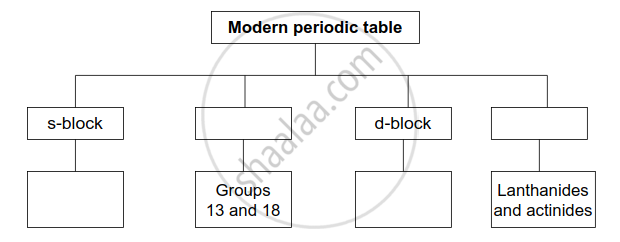
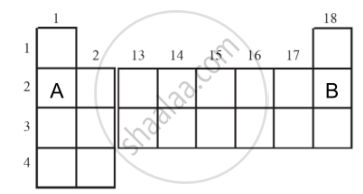
In the modern periodic table, the positions of 1 to 20 elements are shown here. Identify the elements A and B. Write their atomic number.
Some elements and their atomic radii are given here. Arrange them in decreasing order of their atomic radii. Identify which of the above elements is the biggest atom and which is smallest?
| Element | K | Na | Rb | Cs | Li |
| Atomic radius (pm) | 231 | 186 | 244 | 262 | 151 |
Complete the following chart.
| Shell | n | 2n2 | Electron holding capacity |
| K | 2 × 12 | 2 | |
| L | 2 | 8 | |
| 3 | 2 × 32 | 18 | |
| N | 4 | 2 × 42 |
Find the period in which these elements can be placed.
4Be, 17Cl, 2He, 13Al
Electronic configuration of element A is 2,8,1. Answer the following questions based on this information.
- What is the atomic number of element A?
- Find the group to which this element belongs.
Classify the following elements into Metals and Nonmetals.
S, Mg, Al, P, N, Na.
SCERT Maharashtra solutions for Science and Technology Part 1 [English] Standard 10 Maharashtra State Board 2 Periodic Classication of Element Distinguish between [Page 30]
Distinguish between:
Group - Period
Distinguish between:
s-block - p-block
Distinguish between:
Group 17 - Group 18
Distinguish between:
Mendeleev’s periodic table - Modern periodic table
SCERT Maharashtra solutions for Science and Technology Part 1 [English] Standard 10 Maharashtra State Board 2 Periodic Classication of Element Answer the Following [Pages 33 - 35]
State Mendeleev’s Periodic Law.
On which basis Mendeleev organised periodic law?
What were the limitations of Dobereiner’s classification?
Describe the merits of Mendeleev’s periodic table?
What are the demerits of Mendeleev’s periodic table?
Write name of elements, symbol, atomic number, electronic configuration of second period in modern periodic table?
Write information about the given atomic numbers in the table.
| Atomic Number | Electronic configuration | Group | Period | Element |
| 10 | ||||
| 20 | ||||
| 7 |
An X element with atomic number 11 and Y element with atomic number 13 belongs to the third period in the modern periodic table. With this information, give the answers of the below questions.
- Which element has more metallic character from these two elements?
- What is the valency of each X and Y elements?
- Atom size of Y element is smaller than atom size of X element? Explain?
Identify periods of elements and blocks of elements from given electronic configuration.
- 2, 8, 2
- 2, 8, 7
- 2, 1
Position of A, B and C three elements is given in the table from the modern periodic table. Answer the following questions.
| Periods | Group 2 | Group 17 |
| 2 | ----- | A |
| 3 | B | ----- |
| 4 | ----- | C |
- What is an element metal or nonmetal?
- Which is the outermost orbit of element B?
- Identify C element and it's physical state.
3, 1, 2 electrons are in valence shells of X, Y, Z elements resp. From this information, write the name of the groups it belongs to and its valency.
Write the properties of groups.
Write the properties of periods.
Write the electron configuration and determine the valency of the beryllium -atomic number 4 and oxygen - atomic number 8.
SCERT Maharashtra solutions for Science and Technology Part 1 [English] Standard 10 Maharashtra State Board 2 Periodic Classication of Element Answer the following questions [Pages 49 - 50]
Observe the given chart and answer the questions given below.
| Element | A | B | C | D |
| Electronic configuration | 2, 1 | 2, 8 | 2, 8, 1 | 2, 8, 8 |
- Which elements are in the same row?
- Which elements have the same column?
- Which elements are in the 18th column?
- Which element is more reactive among A and C?
- Which of the following elements A or B will form compounds?
XY compound is formed by X (Atomic number 11) and Y (Atomic number 17), then answer the questions given below.
- Determine the position of the element X and Y periodic table.
- Which type of elements X and Y are metals, nonmetals or metalloids?
- From which block the elements X and Y are?
- Determine the electronic configuration and valency of these elements.
Observe the periodic table given below and write the answers of the questions.
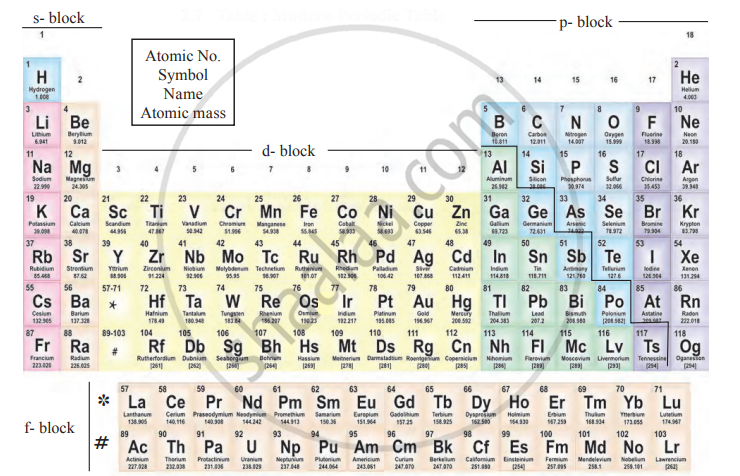
- Write the name and valencies of the elements in 3rd row.
- Classify the elements in this row as metal, nonmetal and metalloids.
- Which block does nonmetals belong to?
- Write name of any two metalloid elements.
Make a chart which shows the name of the element, valency, atomic number, electronic configuration in the 2nd row of the modern periodic table and arrange these elements in ascending order of atomic mass.
What physical and chemical properties of elements did Mendeleev consider in compiling the periodic table?
What challenges did Mendeleev face in following periodic law?
Explain structure of modern periodic table in short.
An element has its electron configuration as 2, 8, 2. Now answer the following question.
What is the atomic number of this element?
An element has its electron configuration as 2, 8, 2. Now answer the following question.
What is the group of this element?
An element has its electron configuration as 2, 8, 2. Now answer the following question.
To which period does this element belong?
An element has its electron configuration as 2, 8, 2. Now answer the following question.
Which of the following elements would this element resemble?
(Atomic numbers are given in the brackets)
N(7), Be(4), Ar(18), Cl(17)
Solutions for 2: Periodic Classication of Element
SCERT Maharashtra solutions for Science and Technology Part 1 [English] Standard 10 Maharashtra State Board chapter 2 - Periodic Classication of Element
Shaalaa.com has the Maharashtra State Board Mathematics Science and Technology Part 1 [English] Standard 10 Maharashtra State Board Maharashtra State Board solutions in a manner that help students grasp basic concepts better and faster. The detailed, step-by-step solutions will help you understand the concepts better and clarify any confusion. SCERT Maharashtra solutions for Mathematics Science and Technology Part 1 [English] Standard 10 Maharashtra State Board Maharashtra State Board 2 (Periodic Classication of Element) include all questions with answers and detailed explanations. This will clear students' doubts about questions and improve their application skills while preparing for board exams.
Further, we at Shaalaa.com provide such solutions so students can prepare for written exams. SCERT Maharashtra textbook solutions can be a core help for self-study and provide excellent self-help guidance for students.
Concepts covered in Science and Technology Part 1 [English] Standard 10 Maharashtra State Board chapter 2 Periodic Classication of Element are Structure of the Modern Periodic Table, Modern Periodic Table and Electronic Configuration of Elements, The Modern Periodic Table, Dobereiner’s Triads, Newland's Law of Octaves, Mendeleev’s Periodic Table, Insights into Mendeleev’s Periodic Table, Modern Periodic Law, Classification of Elements, Periodic Trends in the Modern Periodic Table, Groups and Electronic Configuration, Atomic Size, Metallic and Non-metallic Characters, Gradation in Halogen Family, Periods and Electronic Configuration.
Using SCERT Maharashtra Science and Technology Part 1 [English] Standard 10 Maharashtra State Board solutions Periodic Classication of Element exercise by students is an easy way to prepare for the exams, as they involve solutions arranged chapter-wise and also page-wise. The questions involved in SCERT Maharashtra Solutions are essential questions that can be asked in the final exam. Maximum Maharashtra State Board Science and Technology Part 1 [English] Standard 10 Maharashtra State Board students prefer SCERT Maharashtra Textbook Solutions to score more in exams.
Get the free view of Chapter 2, Periodic Classication of Element Science and Technology Part 1 [English] Standard 10 Maharashtra State Board additional questions for Mathematics Science and Technology Part 1 [English] Standard 10 Maharashtra State Board Maharashtra State Board, and you can use Shaalaa.com to keep it handy for your exam preparation.
