Advertisements
Advertisements
Question
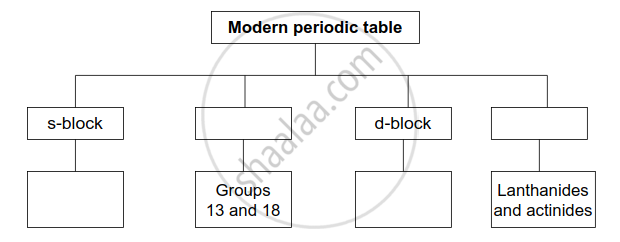
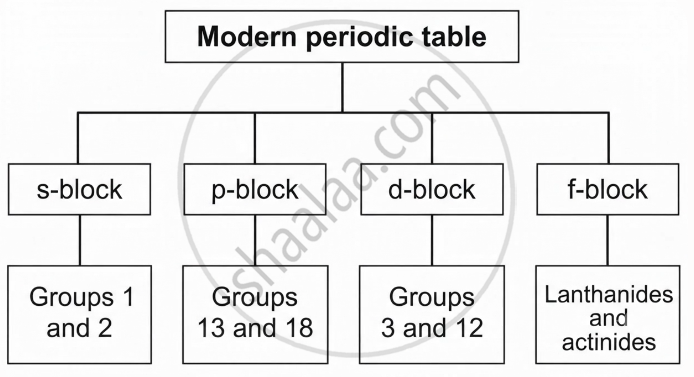
Complete the following flow chart.
Advertisements
Solution
APPEARS IN
RELATED QUESTIONS
Fill in the blank:
The modern periodic table consists of ……………. periods.
In the Modern Periodic Table, calcium (atomic number 20) is surrounded by elements with atomic numbers 12, 19, 21, and 38. Which of these have physical and chemical properties resembling calcium?
Compare and contrast the arrangement of elements in Mendeleev’s periodic Table and the Modern Periodic Table.
How does the tendency of elements to gain electrons change as we move from left to right in a period? State the reason of this change.
Fill in the following blank with suitable word:
The basis for modern periodic table is ...............
Fill in the following blank with suitable word:
Group 17 elements are known as ...............
Fill in the following blank with suitable word:
Group 18 elements are called ...............
What is the name of those elements which divide metals and non-metals in the periodic table?
The atomic numbers of four elements P, Q, R and S are 6, 8, 14 and 16 respectively. Out of these, the element known as metalloid is:
(a) P
(b) Q
(c) R
(d) S
Which element has the electronic configuration 2, 8, 2?
How would the tendency to lose electrons change as we go from left to right across a period of the periodic table?
What is the major characteristic of the first elements in the periods of the periodic table? What is the general name of such elements?
What are the advantages of the periodic table?
Give the group number of following elements present in periodic table
Name two elements in halogens.
Name two elements in Inert gas.
Answer the following in respect of element `31/15 P`
Give its electronic configuration
The electronic configuration of an element T is 2, 8, 8, 1.
- What is the group number of T?
- What is the period number of T?
- How many valence electrons are there in an atom of T?
- What is the valency of T?
- Is it a metal or a non-metal?
What is the number of elements in the 3rd period, of the modern periodic table?
Give the symbol and valency of the following element and radical.
Magnesium
Give the symbol and valency of the following element and radical.
Nitrogen [Nitride]
Give the symbol and valency of the following element and radical.
Sulphite
Give the chemical formula of sodium sulphite
The d-block elements are called as ______ elements.
Answer the following question in one sentence.
The modern periodic table is divided into which blocks?
Write a scientific reason.
There was ambiguity about the correct position of hydrogen in Mendeleev’s periodic table.
Distinguish between:
Group 17 - Group 18
What are groups and periods in the modern periodic table?
State any five features of modern periodic table.
______ and ______ are called inner transition elements.
Choose an element from period 3 of modern periodic table that matches the description given below in instance. Give a reason for your choice.
It has same valency as Lithium.
A part of modern periodic table is given below. On its basis, answer the following questions:
| Group No. → | 1 | 2 | 13 | 14 | 15 | 16 | 17 | 18 |
| Period ↓ | ||||||||
| 2 | A | B | ||||||
| 3 | E | D | F | C |
Write the molecular formula of the compound formed by the combination:
E and B
Define groups of modern periodic table.
State the group and period, of the element having three shells with three electrons in valence shell.
Name the metalloids in the first twenty elements.
Name the following metal:
A metal present in period 3, group 1 of the periodic table.
An element has 2 electrons in its N shell.
Is it a metal or a non-metal?
