Advertisements
Advertisements
प्रश्न
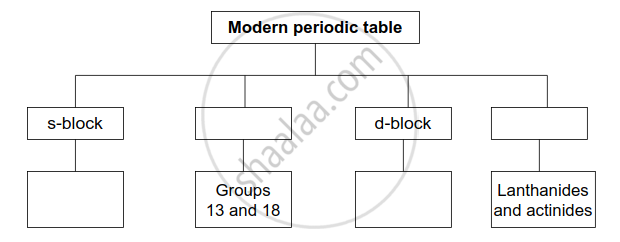
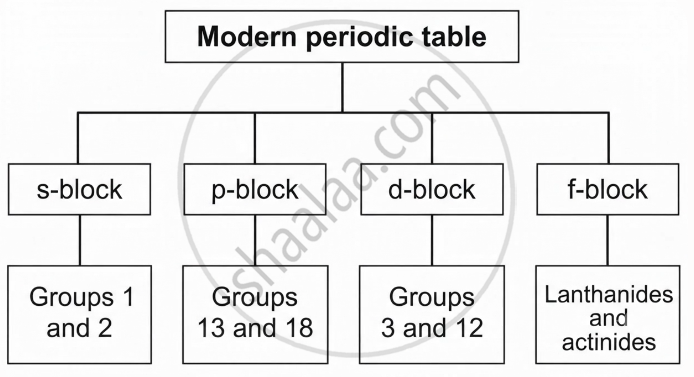
Complete the following flow chart.
Advertisements
उत्तर
APPEARS IN
संबंधित प्रश्न
Compare and contrast the arrangement of elements in Mendeleev’s periodic Table and the Modern Periodic Table.
Fill in the following blank with suitable word:
The horizontal rows in a periodic table are called ...............
Give two example of group 1 elements.
On which side of the periodic table will you find metals?
How does the chemical reactivity of alkali metals vary on going in group 1 of the periodic table?
Explain why all the elements of a group have similar chemical properties.
On the basis of electronic configuration, how will you identify chemically similar elements?
What happens to the number of valence electrons in the atoms of elements as we go down in a group of the periodic table?
What is the number of elements is 1st period the modern periodic table?
Which of the following are the correct characteristics of isotopes of an element?
(i) same atomic mass
(ii) same atomic number
(iii) same physical properties
(iv) same chemical properties
(a) (i), (ii) and (iv)
(b) (ii), (iii) and (iv)
(c) (ii) and (iii)
(d) (ii) and (iv)
An element X belongs to 3rd period and group 2 of the periodic table. State:
(a) number of valence electrons
(b) valency
(c) metal or non-metal
(d) name of the element
Give the group number of following elements present in periodic table
Name two elements in Alkaline earth metals.
Name two elements in each case: Lanthanides
Name the type of elements which have two outermost shell incomplete.
Name the type of elements which have one electron short of octet.
Write the number of protons, neutrons and electronic configuration of \[\ce{_19^39K, _15^31P}\]. Also state their position in periodic table.
State the modern periodic law.
Two elements P and Q belong to the same period of the modern periodic table and are in group 1 and group 2, respectively. Compare the following characteristics in the tabular form.
- Number of electrons in their atoms
- Their tendency to lose electrons
- Their metallic characters
- Formation of their oxides
- Formulae of their chlorides
Give the symbol and valency of the following element and radical.
Magnesium
Give the chemical formula of sodium sulphite
Give the chemical formula of magnesium nitrate
How were elements arranged in the long form of the periodic table or the Modern Periodic Table?
Find the odd one out and give its explanation.
______ forms the basis of the modern periodic table.
The inert gas which lies in the third period is ______
The elements A, B, C, D and E have atomic number 9, 11, 17, 12 and 13 respectively. Which pair of elements belong to the same group?
The three elements A, B and C with similar properties have atomic masses X, Y and Z respectively. The mass of Y is approximately equal to the average mass of X and Z. What is such an arrangement of elements called as? Give one example of such a set of elements.
If an element X is placed in group 14, what will be the formula and the nature of bonding of its chloride?
The maximum number of electrons that can be accommodated in s, p,d, and f subshells are ______.
Spot the error:
There are 5 periods and 17 groups in the modern periodic table.
A part of modern periodic table is given below. On its basis, answer the following questions:
| Group No. → | 1 | 2 | 13 | 14 | 15 | 16 | 17 | 18 |
| Period ↓ | ||||||||
| 2 | A | B | ||||||
| 3 | E | D | F | C |
Write the molecular formula of the compound formed by the combination:
E and B
A part of modern periodic table is given below. On its basis, answer the following questions:
| Group No. → | 1 | 2 | 13 | 14 | 15 | 16 | 17 | 18 |
| Period ↓ | ||||||||
| 2 | A | B | ||||||
| 3 | E | D | F | C |
Which of the element is a Noble gas?
Give the criteria on the basis of which elements are placed (i) in a group and (ii) in a period in the modern periodic table. The atomic number of an element is 16. According to the criteria, in which group and period it should be placed?
Name the non-metals in the first twenty elements.
Name the following metal:
A metal present in period 3, group 1 of the periodic table.
Match the atomic number with the following:
A rare gas.
