Advertisements
Advertisements
प्रश्न
Write a short note.
Position of isotopes in the Mendeleev’s and the modern periodic table.
Advertisements
उत्तर
Isotopes: Isotopes are the atoms having the same atomic number but different atomic masses.
Therefore, according to Mendeleev’s classification, these should be placed at different places depending upon their atomic masses.
For example, hydrogen isotopes with atomic masses 1,2 and 3 should be placed at three places. However, isotopes have not been given separate places in the periodic table because of their similar properties. So this was a drawback of Mendeleev's periodic table as he could not explain the position of isotopes.
The modern periodic table is based upon the arrangement of the elements on the basis of their atomic number. So, all the isotopes of hydrogen should be placed at the same place depending upon their atomic number.
APPEARS IN
संबंधित प्रश्न
How many periods and groups are there in the long form of periodic table?
How were the positions of isotopes of an element decided in the modern periodic table?
What is the major characteristic of the first elements in the periods of the periodic table? What is the general name of such elements?
How do the atomic radii of elements change as we go from left to right in a period of the periodic table?
Explain why all the elements of a period have different chemical properties.
State how the valency of elements varies in a group of the periodic table?
Explain why, the first period of the periodic table has only two elements whereas second period has eight elements
An element X belongs to 3rd period and group 2 of the periodic table. State:
(a) number of valence electrons
(b) valency
(c) metal or non-metal
(d) name of the element
How many groups and periods does the modern periodic table have?
Name two elements in Alkaline earth metals.
What do you understand by typical elements?
Name the type of elements which have outermost shell incomplete.
The electronic configuration of an element T is 2, 8, 8, 1.
What is the period number of T?
Write a short note.
Structure of the modern periodic table.
What would be the correct order if Zn, Fe, Al and Cu are arranged in increasing order of reactivity?
What is the number of elements in the 1st period?
The horizontal rows in a periodic table are called _____.
Define the atomic size.
Give the symbol and valency of the following element and radical.
Magnesium
Give the symbol and valency of the following element and radical.
Bisulphite
Give the symbol and valency of the following element and radical.
Sulphate
What are the elements.
Compare Modern Periodic Law with Mendeleev's Periodic Law.
Answer the following question in one sentence.
The modern periodic table is divided into which blocks?
In the modern periodic table, the positions of 1 to 20 elements are shown here. Identify the elements A and B. Write their atomic number.
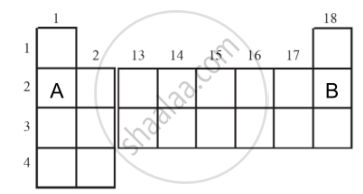
Distinguish between:
s-block - p-block
An X element with atomic number 11 and Y element with atomic number 13 belongs to the third period in the modern periodic table. With this information, give the answers of the below questions.
- Which element has more metallic character from these two elements?
- What is the valency of each X and Y elements?
- Atom size of Y element is smaller than atom size of X element? Explain?
Elements in the modern periodic table are arranged in ______groups and______ periods.
Noble gases belong to______ group of the periodic table.
The element which has the least tendency to lose electrons is ______
Choose an element from period 3 of modern periodic table that matches the description given below in instance. Give a reason for your choice.
It has variable valency and is a member of the Oxygen family (group 16).
______ group elements are called alkaline earth metals.
An element has the atomic number 12.
- Write the electric configuration.
- To which group and period does it belong.
A part of modern periodic table is given below. On its basis, answer the following questions:
| Group No. → | 1 | 2 | 13 | 14 | 15 | 16 | 17 | 18 |
| Period ↓ | ||||||||
| 2 | A | B | ||||||
| 3 | E | D | F | C |
Which of the element is a Noble gas?
- Write the electronic configuration of element X, given by its symbol as under: \[\ce{^40_20 X}\]
- Determine its position in the modem periodic table.
- What is the nature of its oxide?
- Name one other element of its group.
1H2 is an isotope of hydrogen. In the modern Periodic Table it will ______.
