Advertisements
Advertisements
प्रश्न
Define periods of modern periodic table.
Advertisements
उत्तर
The horizontal rows are called periods. The table consists of 7 periods, numbered from 1 to 7 from top to bottom.
APPEARS IN
संबंधित प्रश्न
Nitrogen (atomic number 7) and phosphorus (atomic number 15) belong to group 15 of the Periodic Table. Write the electronic configuration of these two elements. Which of these will be more electronegative? Why?
Write the merits of the modern periodic table over Mendeleev’s Periodic table
Fill in the following blank with suitable word:
The basis for modern periodic table is ...............
How many periods and groups are there in the long form of periodic table?
How were the positions of isotopes of an element decided in the modern periodic table?
Consider the following elements:
Na, Ca, Al, K, Mg, Li
Which of these elements belong to the same group of the periodic table?
How would the tendency to gain electrons change on moving from left to right in a period of the periodic table?
What is a period in a periodic table?
What are the advantages of the periodic table?
Which of the following are the correct characteristics of isotopes of an element?
(i) same atomic mass
(ii) same atomic number
(iii) same physical properties
(iv) same chemical properties
(a) (i), (ii) and (iv)
(b) (ii), (iii) and (iv)
(c) (ii) and (iii)
(d) (ii) and (iv)
Give the group number of following elements present in periodic table
Correct the statement.
Copper and zinc are representative elements.
Name two elements in halogens.
Name the type of elements which have outermost shell complete.
Name the type of elements which have two electrons in the outermost orbit.
Answer the following in respect of element `31/15 P `
To which group and period does it belong?
The electronic configuration of an element T is 2, 8, 8, 1.
- What is the group number of T?
- What is the period number of T?
- How many valence electrons are there in an atom of T?
- What is the valency of T?
- Is it a metal or a non-metal?
Name an alkali metal in period 3 and halogen in period 2.
What is the number of elements in the 1st period?
What is the number of elements in the 3rd period, of the modern periodic table?
How does number of (i) valence electrons (ii) valency; vary on moving from left to right in the second period of a periodic table?
Name an element of group 18 which can form compounds.
Give the symbol and valency of the following element and radical.
Magnesium
Give the symbol and valency of the following element and radical.
Sulphur [Sulphide]
Give the symbol and valency of the following element and radical.
Ammonium
How were elements arranged in the long form of the periodic table or the Modern Periodic Table?
The groups 1 and 2 constitute the ______ block.
Find the odd one out and give its explanation.
Find the odd one out and give its explanation.
Right or wrong sentence.
The modern periodic table shows the molecular masses of the elements in each frame.
Complete the following flow chart.
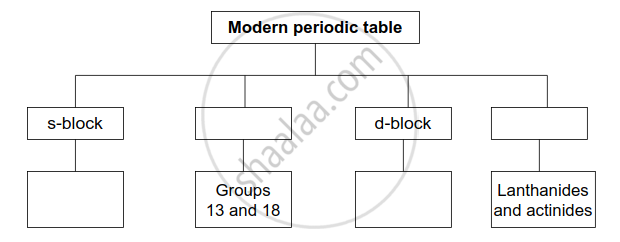
In the modern periodic table, elements are arranged according to their ______
The elements A, B, C, D and E have atomic number 9, 11, 17, 12 and 13 respectively. Which pair of elements belong to the same group?
Compare the radii of two species X and Y. Give reasons for your answer.
- X has 12 protons and 12 electrons
- Y has 12 protons and 10 electrons
______ group elements are called alkaline earth metals.
An element belonging to 3d series of modern periodic table has spin magnetic moment = 5.92 B.M. in +3 oxidation state. The atomic number of elements are ______.
Name the following metal:
A metal present in period 3, group 1 of the periodic table.
An element has 2 electrons in its N shell.
Is it a metal or a non-metal?
