Advertisements
Advertisements
प्रश्न
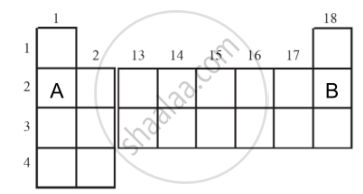
In the modern periodic table, the positions of 1 to 20 elements are shown here. Identify the elements A and B. Write their atomic number.
Advertisements
उत्तर
- Element A is lithium (Li).
Element B is neon (Ne). - Atomic number of element A is 3.
Atomic number of element B is 10.
APPEARS IN
संबंधित प्रश्न
Compare and contrast the arrangement of elements in Mendeleev’s periodic Table and the Modern Periodic Table.
What is periodicity in properties of elements with reference to the Modern Periodic Table?
Fill in the following blank with suitable word:
The basis for modern periodic table is ...............
How were the positions of cobalt and nickel resolved in the modern periodic table?
Is it possible to have an element having atomic number 1.5 placed between hydrogen and helium?
Name the scientist who prepared modern periodic table.
Consider the following elements:
Ca, Cl, Na, I, Li, Ba, Sr, K, Br
Separate these elements into three groups (families) of similar properties. State one property in each case on the basis of which you have made your choice.
How does the chemical reactivity of alkali metals vary on going in group 1 of the periodic table?
On the basis of electronic configuration, how will you identify the first element of a period?
What happens to the number of valence electrons in the atoms of elements as we go down in a group of the periodic table?
(b) What is the number of elements is 3rd period, the modern periodic table?
In the modern Periodic Table, why does cobalt with higher atomic mass of 58.93 appear before nickel having lower atomic mass of 58.71?
The following diagram shows a part of the periodic table in which the elements are arranged according to their atomic numbers. (The letters given here not the chemical symbols of the elements):
| a 3 |
b 4 |
c 5 |
d 6 |
e 7 |
f 8 |
g 9 |
h 10 |
|
| i 11 |
j 12 |
k 13 |
l 14 |
m 15 |
n 16 |
o 17 |
p 18 |
(i) Which element has a bigger atom, a or f?
(ii) Which element has a higher valency, k or o?
(iii) Which element is more metallic i or k?
(iv) Which element is more non-metallic, d or g?
(v) Select a latter which represents a metal of valency 2.
(vi) Select a letter which represents a non-metal of valency 2.
An element X belongs to 3rd period and group 2 of the periodic table. State:
(a) number of valence electrons
(b) valency
(c) metal or non-metal
(d) name of the element
What are horizontal rows and vertical columns in a periodic table known as?
Name two elements in Inert gas.
Name the type of elements which have one electron short of octet.
Name the type of elements which have two electrons in the outermost orbit.
Answer the following in respect of element `31/15 P `
To which group and period does it belong?
Arrange the elements of second and third periods in increasing order of their atomic size.
Third Period.
What is the main characteristic of the last element in each period of the periodic table?
State the modern periodic law for the classification of elements. How many (i) groups and (ii) periods are there in the modern periodic table?
What is meant in the periodic table by a period?
What is the number of elements in the 3rd period, of the modern periodic table?
Name an element of group 18 which can form compounds.
Give the symbol and valency of the following element and radical.
Aluminium
Give the symbol and valency of the following element and radical.
Hydroxide
Give the chemical formula of ammonium sulphate
State the number of elements in Period 3 of the Periodic Table.
The d-block elements are called as ______ elements.
An X element with atomic number 11 and Y element with atomic number 13 belongs to the third period in the modern periodic table. With this information, give the answers of the below questions.
- Which element has more metallic character from these two elements?
- What is the valency of each X and Y elements?
- Atom size of Y element is smaller than atom size of X element? Explain?
State any five features of modern periodic table.
Which of the given elements A, B, C, D and E with atomic number 2, 3, 7, 10 and 30 respectively belong to the same period?
The element with atomic number 14 is hard and forms acidic oxide and a covalent halide. To which of the following categories does the element belong?
“Hydrogen occupies a unique position in Modern Periodic Table”. Justify the statement.
Spot the error:
The elements of group 13 are called the carbon family.
- Write the electronic configuration of element X, given by its symbol as under: \[\ce{^40_20 X}\]
- Determine its position in the modem periodic table.
- What is the nature of its oxide?
- Name one other element of its group.
Define groups of modern periodic table.
