Advertisements
Advertisements
Question
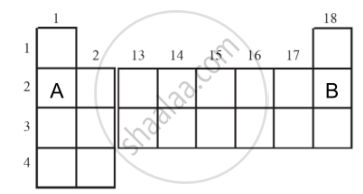
In the modern periodic table, the positions of 1 to 20 elements are shown here. Identify the elements A and B. Write their atomic number.
Advertisements
Solution
- Element A is lithium (Li).
Element B is neon (Ne). - Atomic number of element A is 3.
Atomic number of element B is 10.
APPEARS IN
RELATED QUESTIONS
The position of three elements A, B and C in the Periodic Table are shown below –
|
Group 16
|
Group 17
|
|
−
|
−
|
|
−
|
A
|
|
−
|
−
|
|
B
|
C
|
(a) State whether A is a metal or non-metal.
(b) State whether C is more reactive or less reactive than A.
(c) Will C be larger or smaller in size than B?
(d) Which type of ion, cation or anion, will be formed by element A?
How does the tendency of elements to gain electrons change as we move from left to right in a period? State the reason of this change.
Fill in the following blank with suitable word:
The horizontal rows in a periodic table are called ...............
Fill in the following blank with suitable word:
Group 1 elements are called ...............
What is meant by a group, in a periodic table?
Give two example of group 1 elements.
What is the significance of atomic number in the modern classification of elements? Explain with the help of an example.
How were the positions of cobalt and nickel resolved in the modern periodic table?
What is the name of those elements which divide metals and non-metals in the periodic table?
What are the merits of the modern periodic table of elements?
What are the periods in a periodic table? Give two characteristics of each.
Name the type of elements which have outermost shell incomplete.
Name the type of elements which have two electrons in the outermost orbit.
Fill in the blank:
The horizontal rows in the periodic table are called _____________.
An element barium has the atomic number 56. Look up its position in the periodic table and answer the following question.
Is it larger or smaller than caesium (Cs)?
Write a short note.
Position of isotopes in the Mendeleev’s and the modern periodic table.
How many periods and groups are there in the modern periodic table?
What is the number of elements in the 1st period?
What is the number of elements in the 3rd period, of the modern periodic table?
Name an element of group 18 which can form compounds.
Answer the following question.
How it can be proved that the basic structure of the Modern Periodic Table is based on the electronic configuration of atoms of different elements?
Give the symbol and valency of the following element and radical.
Sulphur [Sulphide]
Give the symbol and valency of the following element and radical.
Sulphite
Give the chemical formula of sodium nitrate
Give the chemical formula of sodium bicarbonate
Give the chemical formula of sodium sulphite
State the number of elements in Period 3 of the Periodic Table.
Find the correlation:
Mendeleev’s periodic table : atomic mass : : Modern periodic table : _______
Noble gases belong to______ group of the periodic table.
How does the property vary in periods and in groups?
The element with atomic number 14 is hard and forms acidic oxide and a covalent halide. To which of the following categories does the element belong?
Which of the following statements about the Modern Periodic Table is correct:
The three elements A, B and C with similar properties have atomic masses X, Y and Z respectively. The mass of Y is approximately equal to the average mass of X and Z. What is such an arrangement of elements called as? Give one example of such a set of elements.
Choose an element from period 3 of modern periodic table that matches the description given below in instance. Give a reason for your choice.
It has a similar structure to diamond.
A part of modern periodic table is given below. On its basis, answer the following questions:
| Group No. → | 1 | 2 | 13 | 14 | 15 | 16 | 17 | 18 |
| Period ↓ | ||||||||
| 2 | A | B | ||||||
| 3 | E | D | F | C |
Write the molecular formula of the compound formed by the combination:
E and B
Define periods of modern periodic table.
Answer the following in respect of element \[\ce{_16^32S}\].
- Give its electronic configuration.
- To which group and period does it belon?
- What is its valency?
- Is it a metal or a non-metal?
- Is it a reducing agent or an oxidising agent?
- Give its formula with hydrogen.
Match the atomic number with the following:
An element of group 2.
