Advertisements
Advertisements
प्रश्न
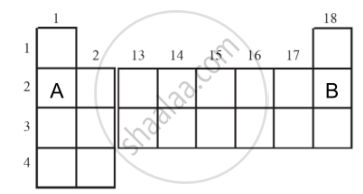
In the modern periodic table, the positions of 1 to 20 elements are shown here. Identify the elements A and B. Write their atomic number.
Advertisements
उत्तर
- Element A is lithium (Li).
Element B is neon (Ne). - Atomic number of element A is 3.
Atomic number of element B is 10.
APPEARS IN
संबंधित प्रश्न
What is periodicity in properties of elements with reference to the Modern Periodic Table?
Fill in the following blank with suitable word:
The horizontal rows in a periodic table are called ...............
Give two example of group 17 elements.
How were the positions of isotopes of an element decided in the modern periodic table?
Would you place the two isotopes of chlorine, CI-35 and CI-37 in different slots because of their different atomic masses or in the same slot because their chemical properties are the same? Justify your answer.
The three elements having chemical symbols of Si, B and Ge are:
(a) all metals
(b) all non-metals
(c) all metalloids
(d) Si is metalloid, B is metal and Ge is non-metal
The atomic numbers of four elements P, Q, R and S are 6, 8, 14 and 16 respectively. Out of these, the element known as metalloid is:
(a) P
(b) Q
(c) R
(d) S
The modern periodic table was prepared by ______.
Consider the following elements:
Na, Ca, Al, K, Mg, Li
Which of these elements belong to the same group of the periodic table?
How does the chemical reactivity of the halogens vary on going in group 17 of the periodic table?
What is a period in a periodic table?
From the standpoint of atomic structure, what determines which element will be the first and which the last in a period the periodic table?
The atomic numbers of the three elements X, Y and Z are 2, 6 and 10 respectively.
(i) Which two elements belong to the same group?
(ii) Which two elements belong to the same period?
Give reasons for your choice.
The elements A, B, C and D belong to groups 1, 2, 14 and 17 respectively of the periodic table. Which of the following pairs of elements would produce a covalent bond?
(i) A and D
(ii) C and D
(iii) A and B
(iv) B and C
(v) A and C
Name two elements in each case:
Actinides
Name the type of elements which have outermost shell incomplete.
Answer the following in respect of element `31/15 P `
To which group and period does it belong?
Arrange the elements of second and third periods in increasing order of their atomic size.
Third Period.
Write the number of protons, neutrons and electronic configuration of \[\ce{_19^39K, _15^31P}\]. Also state their position in periodic table.
The electronic configuration of an element T is 2, 8, 8, 1.
- What is the group number of T?
- What is the period number of T?
- How many valence electrons are there in an atom of T?
- What is the valency of T?
- Is it a metal or a non-metal?
State the main aim of classifying elements. Which is the more fundamental property of elements that is used in the development of Modern Periodic Table? Name and state the law based on this fundamental property. On which side of the periodic table one can find metals, non-metals and metalloids?
Give the symbol and valency of the following element and radical.
Sodium
State what is meant by the term chemical formula.
Give the chemical formula of ammonium sulphate
Give the chemical formula of calcium phosphate
State the number of elements in Period 2 of the Periodic Table.
How were elements arranged in the long form of the periodic table or the Modern Periodic Table?
The groups 1 and 2 constitute the ______ block.
Find the correlation:
Group 1 and 2 : s block : : group 13 and 18 : ______
______ is the longest period in the periodical table.
Element ‘X’ forms a chloride with the formula XCl2, which is solid with a high melting point. X would most likely be in the same group of the periodic table as: ______
On moving from left to right in a period in the periodic table, the size of the atom ______
The amount of energy released when one or more electrons is added to the neutral atom is ______
Which of the given elements A, B, C, D and E with atomic number 2, 3, 7, 10 and 30 respectively belong to the same period?
An element which is an essential constituent of all organic compounds belongs to
Arrange the following elements in the increasing order of their metallic character
| Mg, | Ca, | K, | Ge, | Ga |
An element belonging to 3d series of modern periodic table has spin magnetic moment = 5.92 B.M. in +3 oxidation state. The atomic number of elements are ______.
Select the appropriate options and complete the following paragraph:
(metals, non-metals, metalloids, four, seven, s-block, p-block, d-block, f-block).
On the basis of electronic configuration, elements in the modern periodic table are classified Into ______ blocks. Groups 1 and 2 elements are included in ______ and all these elements are metals. (except Hydrogen). Group 13 to 18 elements are included in ______. This block contains metals, non-metals and metalloids. Group 3 to 12 elements are included in ______ and all the elements are ______ elements shown at the bottom of the periodic table i.e. Lanthanides and Actinides constitute ______ and all these elements are metals.
Name the metalloids in the first twenty elements.
