Advertisements
Advertisements
Question
Some elements and their atomic radii are given here. Arrange them in decreasing order of their atomic radii. Identify which of the above elements is the biggest atom and which is smallest?
| Element | K | Na | Rb | Cs | Li |
| Atomic radius (pm) | 231 | 186 | 244 | 262 | 151 |
Advertisements
Solution
- Decreasing order of atomic radii: Cs > Rb > K > Na > Li
- Cesium (Cs) has the biggest atom and lithium (Li) has the smallest atom.
APPEARS IN
RELATED QUESTIONS
Arrange the following as per the instruction given in the brackets:
Na, K, Li (Increasing atomic size)
Answer the following in respect of element `31/15 P `
Is it a reducing agent or oxidizing agent?
Give the trends in atomic size on moving down the group.
Which is greater in size an atom or a cation?
Which is greater in size an atom or an anion?
What happens to the atomic size of elements on moving from left to right in a period?
Supply the missing word from those in the brackets:
If an element has seven electrons in its outermost shell then it is likely to have the ______ (largest/ smallest) atomic size among all the elements in the same period.
The size of an atom is indicated by its ______.
Right or wrong sentence.
Moving from left to right, the size of the atom decreases.
The electronic configuration of metal A is 2, 8, 18, 1.
The metal A when exposed to air and moisture forms B a green layered compound. A with con. H2 SO4 forms C and D along with water. D is a gaseous compound. Find A, B, C, and D.
Which of the following is the correct order of atomic size?
Which among the following elements has the largest atomic radii?
Elements have been arranged in the following sequence on the basis of their increasing atomic masses.
| F, | Na, | Mg, | Al, | Si, | P, | S, | Cl, | Ar, | K |
- Pick two sets of elements which have similar properties.
- The given sequence represents which law of classification of elements?
Arrange the following elements in increasing order of their atomic radii.
- Li, Be, F, N
- Cl, At, Br I
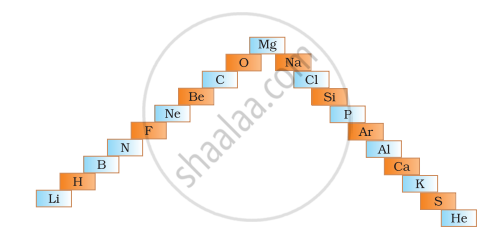
- In below ladder symbols of elements are jumbled up. Rearrange these symbols of elements in the increasing order of their atomic number in the Periodic Table.
- Arrange them in the order of their group also.
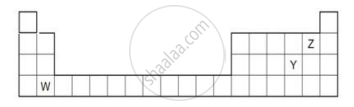
The diagram below shows part of the periodic table.
- Which elements would react together to form covalent compounds?
- Between the two elements W and Z, which will have a bigger atomic radius? Why?
Arrange the following as per instruction given in the bracket.
Mg, Cl, Na, S, Si (decreasing order of atomic size)
Arrange the following in order of increasing radii:
Cl−, Cl
Explain your choice.
