Advertisements
Advertisements
Question
To the left of the zig-zag line in the periodic table are the metal elements.
Options
Right
Wrong
Advertisements
Solution
To the left of the zig-zag line in the periodic table are the metal elements- Right
APPEARS IN
RELATED QUESTIONS
In the Modern Periodic Table, calcium (atomic number 20) is surrounded by elements with atomic numbers 12, 19, 21, and 38. Which of these have physical and chemical properties resembling calcium?
Write the names given to the vertical columns and horizontal rows in the Modern Periodic Table. How does the metallic character of elements vary on moving down a vertical column? How does the size of atomic radius vary on moving left to right in a horizontal row? Give reason in support of your answer in the above two cases.
How many rows and columns are there in the modern periodic table?
How does the tendency of elements to gain electrons change as we move from left to right in a period? State the reason of this change.
How many periods and groups are there in the long form of periodic table?
Consider the following elements:
Na, Ca, Al, K, Mg, Li
Which of these elements belong to the same group of the periodic table?
How would the tendency to lose electrons change as we go from left to right across a period of the periodic table?
Explain why All the elements of a group have similar chemical properties.
On the basis of electronic configuration, how will you identify the first element of a period?
Helium and neon are unreactive gases. What, if anything, do their atoms have in common?
From the standpoint of atomic structure, what determines which element will be the first and which the last in a period the periodic table?
Which of the following are the correct characteristics of isotopes of an element?
(i) same atomic mass
(ii) same atomic number
(iii) same physical properties
(iv) same chemical properties
(a) (i), (ii) and (iv)
(b) (ii), (iii) and (iv)
(c) (ii) and (iii)
(d) (ii) and (iv)
The elements A, B, C and D belong to groups 1, 2, 14 and 17 respectively of the periodic table. Which of the following pairs of elements would produce a covalent bond?
(i) A and D
(ii) C and D
(iii) A and B
(iv) B and C
(v) A and C
How many groups and periods does the modern periodic table have?
Correct the statement.
Copper and zinc are representative elements.
State its position in the periodic table?
Arrange the elements of second and third periods in increasing order of their atomic size.
Third Period.
An element barium has atomic number 56. Look up its position in the periodic table and answer the following question.
What will be the formula of its phosphate?
State the main aim of classifying elements. Which is the more fundamental property of elements that is used in the development of Modern Periodic Table? Name and state the law based on this fundamental property. On which side of the periodic table one can find metals, non-metals and metalloids?
What would be the correct order if Zn, Fe, Al and Cu are arranged in increasing order of reactivity?
Give the symbol and valency of the following element and radical.
Bicarbonate
Give the chemical formula of sodium bicarbonate
State what the group number in the Modern Periodic Table signifies. Give a reason why elements in the same group, have similar valency and similar chemical properties.
State the number of elements in Period 2 of the Periodic Table.
What are the periods in a periodic table?
The modern periodic table is divided into which blocks?
Write an Explanation.
Period
Complete the following flow chart.
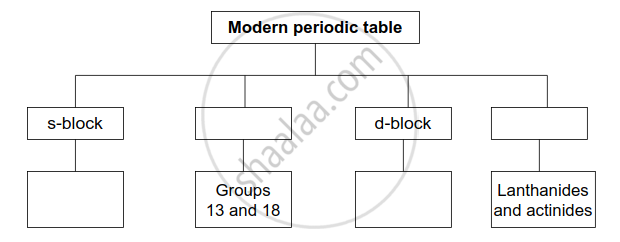
What are groups and periods in the modern periodic table?
In the modern periodic table, elements are arranged according to their ______
The inert gas which lies in the third period is ______
Which of the following statements about the Modern Periodic Table is correct:
The elements A, B, C, D and E have atomic number 9, 11, 17, 12 and 13 respectively. Which pair of elements belong to the same group?
Which of the following elements would lose an electron easily?
Which of the following elements does not lose an electron easily?
Which of the following elements will form an acidic oxide?
Group 16 elements are collectively called as ______.
Select the appropriate options and complete the following paragraph:
(metals, non-metals, metalloids, four, seven, s-block, p-block, d-block, f-block).
On the basis of electronic configuration, elements in the modern periodic table are classified Into ______ blocks. Groups 1 and 2 elements are included in ______ and all these elements are metals. (except Hydrogen). Group 13 to 18 elements are included in ______. This block contains metals, non-metals and metalloids. Group 3 to 12 elements are included in ______ and all the elements are ______ elements shown at the bottom of the periodic table i.e. Lanthanides and Actinides constitute ______ and all these elements are metals.
Name the non-metals in the first twenty elements.
An element has 2 electrons in its N shell.
Is it a metal or a non-metal?
