Advertisements
Advertisements
Question
Explain structure of modern periodic table in short.
Advertisements
Solution
- The modern periodic table consists of seven horizontal rows called the periods and eighteen vertical columns called the groups.
- The arrangement of the periods and groups forms boxes, with each box corresponding to the position of an element.
- Atomic numbers are serially indicated in the upper part of these boxes.
- In addition to these seven rows, the lanthanide and actinide series are shown separately at the bottom of the periodic table. The first row is the lanthanide series, and the second row is the actinide series.
- There are 118 boxes in the periodic table, including the two series. vi. The entire periodic table is divided into four blocks: s-block, p-block, d-block and f-block.
-
- s-block: contains group 1 and 2 elements
- p-block: contains groups 13 to 18 elements
- d-block: contains groups 3 to 12 elements (transition elements)
- f-block: contains the lanthanide and actinide series
- A zig-zag line is drawn in the p-block of the periodic table. Metals lie on the left side while nonmetals lie on the right side of this line. Metalloids lie along the border of this line.
APPEARS IN
RELATED QUESTIONS
What is the significance of atomic number in the modern classification of elements? Explain with the help of an example.
where should hydrogen be placed in the modern periodic table? Give reason for your answer.
Is it possible to have an element having atomic number 1.5 placed between hydrogen and helium?
Which of the following statement is correct in regard to the classification of elements?
(a) Elements in modern periodic table are arranged on the basis of increasing atomic masses.
(b) Elements in Mendeleev's periodic table are arranged on the basis of increasing atomic numbers.
(c) In modern periodic table, the element nickel of lower atomic mass is kept before the element cobalt of higher atomic mass.
(d) In modern periodic table, the isotopes of chlorine having different atomic masses are kept in the same group.
Consider the following elements:
Na, Ca, Al, K, Mg, Li
Which of these elements belong to the same group of the periodic table?
Which element has two shells, both of which are completely filled with electrons?
Give alongside is a part of the periodic table :
As we move horizontally from left to right:
| Li | Be | B | C | N | O | F | |
| Na | Mg | Al | Si | P | S | Cl |
(i) What happens to the metallic character of the elements?
(ii) What happens to the atomic size?
What is a period in a periodic table?
On the basis of electronic configuration, how will you identify chemically similar elements?
(b) What is the number of elements is 3rd period, the modern periodic table?
What are the advantages of the periodic table?
Name the metals in the first twenty elements.
Name the type of elements which have outermost shell incomplete.
Name the type of elements which have two electrons in the outermost orbit.
Answer the following in respect of element `31/15 P`
Give its electronic configuration
An element barium has the atomic number 56. Look up its position in the periodic table and answer the following question.
Is it larger or smaller than caesium (Cs)?
Name an alkali metal in period 3 and halogen in period 2.
State the main aim of classifying elements. Which is the more fundamental property of elements that is used in the development of Modern Periodic Table? Name and state the law based on this fundamental property. On which side of the periodic table one can find metals, non-metals and metalloids?
Define the atomic size.
Give the chemical formula of sodium hydroxide
Give the chemical formula of sodium sulphite
State the number of elements in Period 3 of the Periodic Table.
Find the correlation:
Group 1 and 2 : s block : : group 13 and 18 : ______
Find the correlation:
Group 13 to 18 : p block : : ______ : d block
Find the odd one out and give its explanation.
Right or wrong sentence.
The modern periodic table has 1 to 7 periods.
Complete the following flow chart.
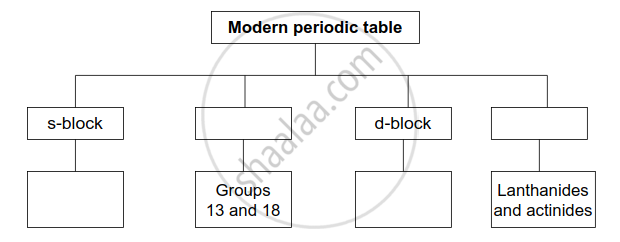
State whether true or false. If false, correct the statement.
Lanthanides and actinides are kept at the bottom of the periodic table because they resemble each other but they do not resemble with any other group elements.
The scientist who propounded the modern periodic law is ______.
The arrangement of elements in the Modern Periodic Table is based on their ______.
Which of the given elements A, B, C, D and E with atomic number 2, 3, 7, 10 and 30 respectively belong to the same period?
Where would you locate the element with electronic configuration 2,8 in the Modern Periodic Table?
An element which is an essential constituent of all organic compounds belongs to
Which one of the following elements exhibit maximum number of valence electrons?
Choose an element from period 3 of modern periodic table that matches the description given below in instance. Give a reason for your choice.
It has a similar structure to diamond.
Choose an element from period 3 of modern periodic table that matches the description given below in instance. Give a reason for your choice.
It has same valency as Lithium.
State the group and period, of the element having three shells with three electrons in valence shell.
Answer the following in respect of element \[\ce{_16^32S}\].
Give its electronic configuration.
