Advertisements
Advertisements
Question
Fill in the blank:
The modern periodic table consists of ……………. periods.
Advertisements
Solution
The modern periodic table consists of 7 periods.
APPEARS IN
RELATED QUESTIONS
Nitrogen (atomic number 7) and phosphorus (atomic number 15) belong to group 15 of the Periodic Table. Write the electronic configuration of these two elements. Which of these will be more electronegative? Why?
Fill in the following blank with suitable word:
Group 18 elements are called ...............
How does the chemical reactivity of alkali metals vary on going in group 1 of the periodic table?
Explain why all the elements of a period have different chemical properties.
What happens to the number of valence electrons in the atoms of elements as we go down in a group of the periodic table?
State the term
The tabular arrangement of elements in horizontal rows and vertical columns _________
How many groups and periods does the modern periodic table have?
Name two elements in Alkali metals.
Name the metals in the first twenty elements.
Name the type of elements which have outermost shell complete.
Name the type of elements which have one electron short of octet.
How does the electronic configuration of an atom relate to its position in the modern periodic table?
Define the atomic size.
Give the symbol and valency of the following element and radical.
Sulphur [Sulphide]
Give the symbol and valency of the following element and radical.
Ammonium
Give the chemical formula of ammonium sulphate
State the number of elements in Period 3 of the Periodic Table.
Right or wrong sentence.
The K and L shells of the elements Na and Mg contain electrons.
Complete the following flow chart.
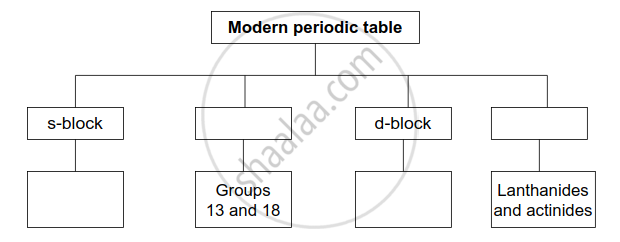
An X element with atomic number 11 and Y element with atomic number 13 belongs to the third period in the modern periodic table. With this information, give the answers of the below questions.
- Which element has more metallic character from these two elements?
- What is the valency of each X and Y elements?
- Atom size of Y element is smaller than atom size of X element? Explain?
Position of A, B and C three elements is given in the table from the modern periodic table. Answer the following questions.
| Periods | Group 2 | Group 17 |
| 2 | ----- | A |
| 3 | B | ----- |
| 4 | ----- | C |
- What is an element metal or nonmetal?
- Which is the outermost orbit of element B?
- Identify C element and it's physical state.
Elements in the modern periodic table are arranged in ______groups and______ periods.
Identify gas A in the following experiment.

The element with atomic number 14 is hard and forms acidic oxide and a covalent halide. To which of the following categories does the element belong?
The amount of energy released when one or more electrons is added to the neutral atom is ______
The longest period of the Modern Periodic Table is period.
An element which is an essential constituent of all organic compounds belongs to
Which one of the following elements exhibit maximum number of valence electrons?
The element with atomic number 14 is hard and forms acidic oxide and a covalent halide. To which of the following categories does the element belong?
Group 16 elements are collectively called as ______.
______ group elements are called alkaline earth metals.
A part of modern periodic table is given below. On its basis, answer the following questions:
| Group No. → | 1 | 2 | 13 | 14 | 15 | 16 | 17 | 18 |
| Period ↓ | ||||||||
| 2 | A | B | ||||||
| 3 | E | D | F | C |
Write the molecular formula of the compound formed by the combination:
A and F
A part of modern periodic table is given below. On its basis, answer the following questions:
| Group No. → | 1 | 2 | 13 | 14 | 15 | 16 | 17 | 18 |
| Period ↓ | ||||||||
| 2 | A | B | ||||||
| 3 | E | D | F | C |
Which of the element is a Noble gas?
An element ‘M' has 50% of the electrons filled in the 3rd shell as in the 2nd shell. The atomic number of ‘M’ is ______.
1H2 is an isotope of hydrogen. In the modern Periodic Table it will ______.
Answer the following in respect of element \[\ce{_16^32S}\].
- Give its electronic configuration.
- To which group and period does it belon?
- What is its valency?
- Is it a metal or a non-metal?
- Is it a reducing agent or an oxidising agent?
- Give its formula with hydrogen.
Match the atomic number with the following:
A rare gas.
