Advertisements
Advertisements
Question
Fill in the blank:
The formulae of chloride of metal M is MCl2. The metal M belongs to ……………. group.
Advertisements
Solution
The formula of the chloride of metal M is MCl2. Metal M belongs to the 2nd group.
APPEARS IN
RELATED QUESTIONS
The elements Be, Mg and Ca each having two electrons in their outermost shells are in periods 2, 3, and 4 respectively of the modern periodic table. Answer the following questions, giving justification in each case:-
(i) Write the group to which these elements belong.
(ii) Name the least reactive element.
(iii) Name the element having largest atomic radius.
Write the number of periods the Modern Periodic Table has. State the changes in valency and metallic character of elements as we move from left to right in a period. Also state the changes, if any, in the valency and atomic size of elements as we move down a group.
List any two properties of the elements belonging to the first group of the modern periodic table.
Write the number of vertical columns in the modern periodic table. What are these columns called?
Define the term : Atomic size
Calculate the number of gram atoms in 4.6 grams of sodium (Na = 23)
Choose the most appropriate answer of the following:
Which of the following would weigh the least?
(A) 2-gram atoms of Nitrogen.
(B) 1mole of Silver
(C) 22.4 liters of oxygen gas at 1 atmospheric pressure and 273K
(D) 6.02 x 10²³ atoms of carbon.
[Atomic masses: Ag=108, N=14, O=16, C=12]
In the following set of element, one element does not belong to the set. Select this element and state why it does not belong:
Calcium, Magnesium, Sodium, Beryllium
How does the valency of elements vary in going down a group of the periodic table?
Name the element which is in first group and third period.
Rewrite the following statement after correction, if necessary:
The metallic character of elements in a period increases gradually on moving from left to right.
How does Nature of oxides of elements change on going from left to right in a period of the periodic table?
Give examples in support of your answer.
The electronic configuration of the atom of an element X is 2, 8, 4. In modern periodic table, the element X is places in :
(a) 2nd group
(b) 4th group
(c) 14th group
(d) 8th group
Given alongside is a part of the periodic table. As we move vertically downward from Li to fr?
| Li | Be |
| Na | |
| K | |
| Rb | |
| Cs | |
| Fr | |
| rA | Ra |
What happens to the size of atoms?
The elements A, B, C, D and E have atomic numbers 9, 11, 17, 12 and 13 respectively. The pair of elements which belongs to the same group of the periodic table is:
(a) A and B
(b) B and D
(c) A and C
(d) D and E
Which of the following element would lose an electron easily?
(a) Mg
(b) Na
(c) K
(d) Ca
Correct the statements.
Elements in the same periods have equal valency.
An element X belong to 4th period and 17th group, state.
name the family to which it belong.
An element X belong to 3rd periods and group II of the periodic table state:
the valency,
An element X belong to 3rd periods and group II of the periodic table state:
name of the element,
How many groups and periods are there in the modern periodic table?
Fill in the blank
There are ______ groups and ______ periods in the modern form of periodic table.
Select the correct answer
Identify the metalloid
Name the elements in period 1.
What is the common feature of electronic configurations of the elements at the end of period 2 and period 3?
What is meant by a group in the periodic table?
The following table represents the first period of the modern periodic table. Study the table and answer the questions that follow: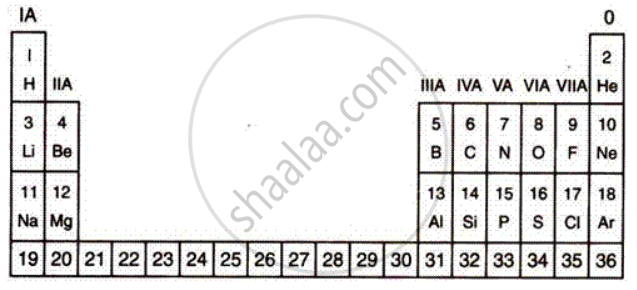
- Write the formula of the sulphate of the element with atomic number 13.
- What type of bonding will be present in the oxide of the element with atomic number 1?
- Which feature of the atomic structure accounts for the similarities in the chemical properties of the elements in group VIIA of the periodic table?
- Name the element which has the highest ionization potential.
- How many electrons are present in the valence shell of the element with atomic number 18?
- What is the name given to the energy released, when an atom in its isolated gaseous state accepts an electron to form an anion?
- What is the electronic configuration of the element in the third period which gains one electron to become an anion?
- Fill in the blanks:
The atomic size ______ as we move from left to right across the period, because the ______ increases, but the ______ remains the same.
Choose the most appropriate answer from the following list of oxides which fit the description.
A basic oxide.
Choose the most appropriate answer from the following list of oxides which fit the description.
An oxide which dissolves in water forming an acid.
Arrange the following as per instruction given in the bracket.
Li, K, Na, H ( decreasing order of their potential ionisation )
The elements of one short period of the periodic table are given below in order from left to right:
| Li | Be | B | C | O | F | Ne |
To which period do these elements belong?
The elements of one short period of the periodic table are given below in order from left to right:
| Li | Be | B | C | O | F | Ne |
One element of this period is missing. Which is the missing element and where should it be placed?
Write the electronic configuration of element 17T35.
- What is the group number of T?
- What is the period number of T?
- How many valence electrons are there in an atom of T?
- What is the valency of T?
- Is it a metal or non-metal?
- State number of protons and neutrons in T.
An element belongs to the third period and Group IIIA (13) of the periodic table. State: the name of the element.
Name and state the following with reference to the elements of the first three periods of the periodic table.
Non-metallic elements present in Period 3 of Groups 15 and 16.
Based on the group valency of element write the molecular formula of the following compound giving justification:
Halide of the elements of group thirteen
The similarities in the properties of a group of elements are because they have the same ______.
State the following:
The group which contains highly electropositive metals including sodium.
Match the option A and B with the statements (i) and (ii):
| A. metal | (i) The metal that forms two types of ion. |
| B. iron | (ii) An element with electronic configuration 2, 8, 8, 3. |
