Advertisements
Advertisements
Question
Select the correct answer from the options given below.
It is a period having elements from atomic no. 11 to 18.
Options
period – 1
period – 2
period – 3
Advertisements
Solution
period – 3
APPEARS IN
RELATED QUESTIONS
Two elements ‘A’ and ‘B’ belong to the 3rd period of Modern periodic table and are in group 2 and 13, respectively. Compare their following characteristics in tabular form:-
(a) Number of electrons in their atoms
(b) Size of their atoms
(c) Their tendencies to lose electrons
(d) The formula of their oxides
(e) Their metallic character
(f) The formula of their chlorides
Which element has twice as many electrons in its second shell as in its first shell?
Use the letters only written in the Periodic Table given below to answer the questions that Follow:
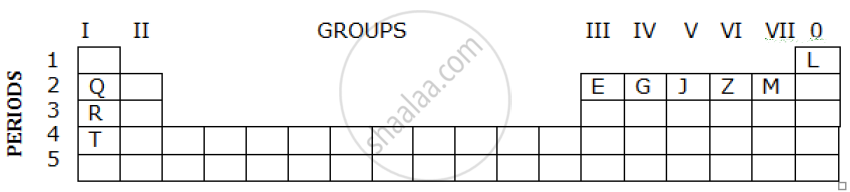
- State the number of valence electrons in atom J.
- Which element shown forms ions with a single negative charge?
- Which metallic element is more reactive than R?
- Which element has its electrons arranged in four shells?
In the following set of elements, one element does not belong to the set. Select this element and state why it does not belong:
Oxygen, Nitrogen, Carbon, Chlorine, Fluorine
Arrange the following elements in increasing order of their atomic radii:
Li, Be, F, N
Which of the following element would lose an electron easily?
(a) Mg
(b) Na
(c) K
(d) Ca
What is its atomic number?
An element X belong to 4th period and 17th group, state.
name the family to which it belong.
Why fluorine has higher E.N. than chorine?
Which of the following would weigh the least?
(Atomic masses C = 12, 0 = 16, Na = 23)
