Advertisements
Advertisements
Question
What is meant by a Group in the Periodic Table?
Advertisements
Solution
The verticle columns from top to bottom are called groups.
RELATED QUESTIONS
Two elements ‘P’ and ‘Q’ belong to the same period of the modern periodic table and are in Group 1 and Group 2, respectively. Compare their following characteristics in tabular form:-
(a) The number of electrons in their atoms
(b) The sizes of their atoms
(c) Their metallic character
(d) Their tendencies to lose electrons
(e) The formula of their oxides
(f) The formula of their chlorides
Calcium is an element with atomic number 20. Stating reason, answer each of the following questions:-
(i) Is calcium a metal or a non-metal?
(ii) Will its atomic radius be larger or smaller than that of potassium with atomic number 19?
(iii) Write the formula of its oxide.
How does Chemical reactivity of elements change on going from left to right in a period of the periodic table?
Give example in support of your answer.
Given alongside is a part of the periodic table. As we move vertically downward from Li to fr?
| Li | Be |
| Na | |
| K | |
| Rb | |
| Cs | |
| Fr | |
| rA | Ra |
What happens to the size of atoms?
Name the non-metals present in period 2 and metals in period 3.
In the following table, the positions of six elements A, B, C, D, E and F are given as they are in the Modern Periodic Table :
 |
1 | 2 | 3-12 | 13 | 14 | 15 | 16 | 17 | 18 |
| 2 | A | B | C | D | |||||
| 3 | E | F |
On the basis of the above table, answer the following questions :
(i) Name the element which forms only covalent compounds.
(ii) Name the element which is a metal with valency three.
(iii) Name the element which is a non-metal with valency three.
(iv) Out of B and C, whose atomic radius is bigger and why ?
(v) Write the common name for the family to which the elements D and F belong.
Study the extract of the Periodic Table given below and answer the questions that follow. Give the alphabet corresponding to the element in question. DO NOT repeat an element. 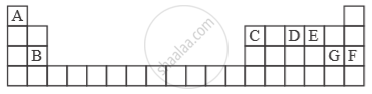
Which is an inert gas?
Parts (i) to (v) refer to changes in the properties of elements on moving from left to right across a period of the periodic table. For each property, choose the letter corresponding to the correct answer from the choices (a), (b), (c) and (d).
(i) The non metallic character of the elements:
(a) Decreases
(b) Increases
(c) Remains the same
(d) Depends on the period
(ii) The electro negativity
(a) Depends on the number of valence electrons
(b) Remains the same
(c) Decreases
(d) Increases
(iii) The ionization potential
(a) Goes up and down
(b) Decreases
(c) Increases
(d) Remains the same
(iv) The atomic size
(a) Decreases
(b) Increases
(c) Remains the same
(d) Sometimes increases and sometimes decreases
(v) The electron affinity of the elements in groups 1 to 7:
(a) Goes up and down
(b) Decreases and then increases
(c) Increases
(d) decreases
Fill in the blank and rewrite the completed statement:
________ group in the periodic table contains elements that are all gases at room temperature.
Name or state following with reference to the element of the first three periods of the periodic table.
The valency of elements in group 1 [I–A].
