Advertisements
Advertisements
Question
Answer the following question:
State the four blocks of the modern periodic table based on the electronic configuration of elements.
Advertisements
Solution
Elements in the modern periodic table are classified on the basis of their electronic configuration. They are divided into four blocks: s – block, p – block, d – block, and f – block.
APPEARS IN
RELATED QUESTIONS
Taking the example of an element of atomic number 16, explain how the electronic configuration of the atom of an element relates to its position in the modern periodic table and how valency of an element is calculated on the basis of its atomic number.
An element 'M' with electronic configuration (2, 8, 2) combines separately with (NO3)–, (SO4)2– and (PO4)3– radicals. Write the formula of the three compounds so formed. To which group and period of the Modern Periodic Table does the element 'M' belong? Will 'M' form covalent or ionic compounds? Give reason to justify your answer.
The electrons in the atoms of four elements A, B, C and D are distributed in three shells having 1, 3, 5 and 7 electrons in the outermost shell respectively. State the period in which these elements can be placed in the modern periodic table. Write the electronic configuration of the atoms of A and D and the molecular formula of the compound formed when A and D combine.
What is meant by 'group' in the modern periodic table? How do the following change on moving from top to bottom in a group?
(i) Number of valence electrons
(ii) Number of occupied shells
(iii) Size of atoms
(iv) Metallic character of element
(v) Effective nuclear charge experienced by valence electrons
How do the valency and the atomic size of the elements vary while going from left to right along a period in the modern periodic table?
Which element has twice as many electrons in its second shell as in its first shell?
The metal of Group 2 from top to bottom arc Be, Mg, Ca, Sr, and Ba.
1) Which one of these elements will form ions most readily and why?
2) State the common feature in the electronic configuration of all these elements.
What happens to the metallic character of the elements as we go down in a group of the periodic table?
Arrange the following elements in increasing order of their atomic radii:
Li, Be, F, N
An element X belongs to group 2 and another element Y belongs to group 15 of the periodic table:
(a) What is the number of valence electron in X?
(b) What is the valency of X?
(c) What is the number of valence electrons in Y?
(d) What is the valency of Y?
Explain how you have arrived at your answers.
How does the size of atoms (atomic size) generally vary in going from left to right in a period of the periodic table? Why does it vary this way?
Why do elements in the same group show similar properties but the elements in different groups show different properties?
Why does the size of the atoms progressively become smaller when we move from sodium (Na) to chlorine (Cl) in the third period of the periodic table?
Given alongside is a part of the periodic table. As we move vertically downward from Li to fr?
| Li | Be |
| Na | |
| K | |
| Rb | |
| Cs | |
| Fr | |
| rA | Ra |
What happens to the size of atoms?
Five elements A, B, C, D and E have atomic numbers of 2, 3, 7, 10 and 18 respectively. The elements which belong to the same period of the periodic table are:
(a) A, B, C
(b) B, C, D
(c) A, D, E
(d) B, D, E
Where would you locate the element with electronic configuration 2, 8 in the modern periodic table?
In each of the following pair, choose the atom having the bigger size:
Na (At. No. 11) or K (At. No. 19)
Periodicity is observed due to the similar ______.
What do you understand by orbits?
Name two elements you would expect to show chemical reactions similar to calcium. What is the basis of your choice?
F, Cl and Br are the elements each having seven valence electrons. Which of these (i) has the largest atomic radius, (ii) is most reactive? Justify your answer, stating the reason for each.
Study the extract of the Periodic Table given below and answer the questions that follow. Give the alphabet corresponding to the element in question. DO NOT repeat an element. 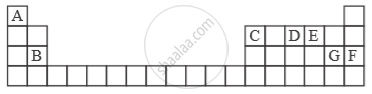
The ion of which element will migrate towards the cathode during electrolysis?
What is meant by periodicity of elements?
State whether the following statement is true or false
Similar electronic configuration is repeated after intervals of 2, 8, 8, 18 and 32.
What is meant by a group in the periodic table?
The following questions refer to the Periodic Table.
What is the common feature of the electronic configurations of the elements in group 7?
Atomic number of an element is 16. State
- the period to which it belongs
- the number of valence electrons
- whether it is a metal or non-metal
Arrange the following as per the instruction given in the bracket
He,Ar,Ne (Increasing order of the number of electron shells)
The elements of one short period of the periodic table are given below in order from left to right:
| Li | Be | B | C | O | F | Ne |
One element of this period is missing. Which is the missing element and where should it be placed?
The elements of one short period of the periodic table are given below in order from left to right:
| Li | Be | B | C | O | F | Ne |
Which one of the above elements belongs to the halogen series?
An element belongs to the third period and Group IIIA (13) of the periodic table. State: if it is a metal or non-metal?
The electronic configuration of an element is 2, 8, 4. State it:
group and period in the Modern Periodic Table.
Based on the group valency of element write the molecular formula of the following compound giving justification:
Halide of the elements of group thirteen
Name or state following with reference to the element of the first three periods of the periodic table.
The formula of the hydroxide of the element having electronic configuration 2, 8, 2.
Name or state following with reference to the element of the first three periods of the periodic table.
A non-metal in period 2 which is tetravalent.
Select the correct answer from the options given below.
Is the group number of the element whose atomic number is 4.
Chlorine in the Periodic Table is surrounded by the elements with atomic number 9, 16, 18 and 35.
Which of these have Physical and Chemical properties resembling chlorine?
