Advertisements
Advertisements
प्रश्न
Answer the following question:
State the four blocks of the modern periodic table based on the electronic configuration of elements.
Advertisements
उत्तर
Elements in the modern periodic table are classified on the basis of their electronic configuration. They are divided into four blocks: s – block, p – block, d – block, and f – block.
APPEARS IN
संबंधित प्रश्न
Which element has the electronic configuration 2, 8, 2?
In the following set of elements, one element does not belong to the set. Select this element and state why it does not belong:
Oxygen, Nitrogen, Carbon, Chlorine, Fluorine
How does the valency of elements change of moving from left to right in the third period of the periodic table?
Fill in the blank in the following statement:
On moving form right to left in the second period, the number of valency electrons ...............
How does the tendency to lose electrons change as we go down in group 1 of the periodic table? Why does it change this way?
Explain why, the properties of elements are repeated after 2, 8, 18 and 32 elements in the periodic table.
The element which has the maximum number of valence electrons is:
(a) Na
(b) P
(c) Si
(d) A
Which one of the following does not increase while moving down the group of the periodic table?
In each of the following pair, choose the atom having the bigger size:
(a) Mg (At. No.12) or Cl (At. No.17)
In each of the following pair, choose the atom having the bigger size:
Na (At. No. 11) or K (At. No. 19)
What is its atomic number?
Fill in the blank:
on moving from right to left in the second period, the number of valence electrons……….
Complete the following sentences
The similarities in the properties of a group of elements are because they have the same …………………
Chorine in the periodic table is surrounded by the elements with atomic number 9, 16, 18 and 35.
Which is more electronegative than chlorine?
In the following table, the positions of six elements A, B, C, D, E and F are given as they are in the Modern Periodic Table :
 |
1 | 2 | 3-12 | 13 | 14 | 15 | 16 | 17 | 18 |
| 2 | A | B | C | D | |||||
| 3 | E | F |
On the basis of the above table, answer the following questions :
(i) Name the element which forms only covalent compounds.
(ii) Name the element which is a metal with valency three.
(iii) Name the element which is a non-metal with valency three.
(iv) Out of B and C, whose atomic radius is bigger and why ?
(v) Write the common name for the family to which the elements D and F belong.
What will be the valency of an element of atomic number 9 (nine)?
How do you calculate the possible valency of an element from the electronic configuration of its atoms?
Atomic number of metal ‚A‛ is 11, while atomic number of metal ‚B‛ is 20. Which of them will be more reactive? Write the chemical reaction of dilute HCl with metal ‚A‛.
Arrange the following according to the instruction given in the bracket:
K, Pb, Ca, Zn (in the increasing order of the reactivity).
Select the correct answer
Most reactive character among the elements given below is found in
Copy and complete the following sentence choosing the correct word or words from those given below, at the end of the sentence:
The similarities in the properties of elements belonging to a group are because they have the same ______
The following table represents the first period of the modern periodic table. Study the table and answer the questions that follow: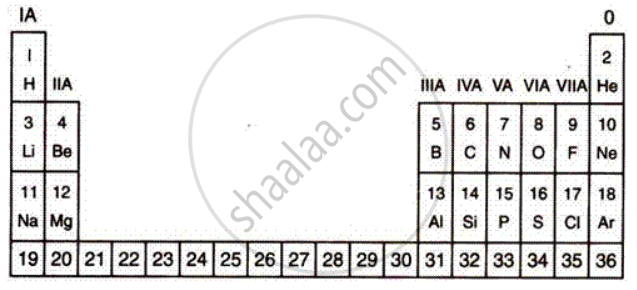
- Write the formula of the sulphate of the element with atomic number 13.
- What type of bonding will be present in the oxide of the element with atomic number 1?
- Which feature of the atomic structure accounts for the similarities in the chemical properties of the elements in group VIIA of the periodic table?
- Name the element which has the highest ionization potential.
- How many electrons are present in the valence shell of the element with atomic number 18?
- What is the name given to the energy released, when an atom in its isolated gaseous state accepts an electron to form an anion?
- What is the electronic configuration of the element in the third period which gains one electron to become an anion?
- Fill in the blanks:
The atomic size ______ as we move from left to right across the period, because the ______ increases, but the ______ remains the same.
The elements of one short period of the periodic table are given below in order from left to right:
Li Be B C O F Ne
(a) To which period do these elements belong?
(b) One element of this period is missing. Which is the missing element and where should it be placed?
(c) Place the three elements, fluorine, beryllium and nitrogen, in the order of increasing electro negativity.
(d) Which one of the above elements belongs to the halogen series?
Give the number of the group and the period of elements having three shells with three electrons in valence shell.
Choose the most appropriate answer from the following list of oxides which fit the description.
An amphoteric oxide.
Arrange the following as per instruction given in the bracket
Na, K, Cl, S, Si (increasing ionisation potential)
The position of elements A, B, C, D and E in the periodic table are shown below:
|
Group 1 |
Group 2 |
Group 17 |
Group 18 |
|
|
|
|
D |
|
|
B |
C |
|
|
A |
|
|
E |
State which is most reactive (i) metal (ii) non-metal
The position of elements A, B, C, D and E in the periodic table are shown below:
|
Group 1 |
Group 2 |
Group 17 |
Group 18 |
|
|
|
|
D |
|
|
B |
C |
|
|
A |
|
|
E |
Which type of ion will be formed by elements A, B, and C.
An element belongs to the third period and Group IIIA (13) of the periodic table. State: the number of valence electrons,
An element belongs to the third period and Group IIIA (13) of the periodic table. State: if it is a metal or non-metal?
Moving left to right in the second period, the number of valence electrons _____.
Fill in the blank and rewrite the completed statement:
________ group in the periodic table contains elements that are all gases at room temperature.
The electronic configuration of an element is 2, 8, 4. State it:
group and period in the Modern Periodic Table.
Name or state following with reference to the elements of the first three periods of the periodic table.
A metalloid in period 2 and in period 3.
Name or state following with reference to the element of the first three periods of the periodic table.
The valency of the element in period 3 having atomic number 17.
Select the correct answer from the options given below.
It is a metal in period 2 having electronic configuration 2, 1?
Select the correct answer from the options given below.
It is a period having elements from atomic no. 11 to 18.
Fill in the blanks from the words A to F given below’.
A: Decreases
B: Increases
C: Remains same
D: Increases by one
E: Electropositive
F: Electronegative
Across a period from left to right in the Modern Periodic Table.
No. of electron shells _________; No. of valence electrons __________: Electronegativity increases Character of elements changes from electropositive to ________.
Give a reason for the following:
A transition from metallic to non-metallic elements is seen on moving from left to right in a period of the periodic table.
