Advertisements
Advertisements
प्रश्न
Taking into consideration the period of the elements given below, answer the following questions:
| Elements | Atomic Radius (pm) |
| O | 66 |
| B | 88 |
| C | 77 |
| N | 74 |
| Be | 111 |
| Li | 152 |
- Arrange the above elements in decreasing order of their atomic radii.
- State the period to which the above elements belong.
- Why this arrangement of elements is similar to the above period of modern periodic table?
- Which of the above elements have the biggest and the smallest atom?
- What is the periodic trend observed in the variation of atomic radius while going from left to right within a period?
Advertisements
उत्तर
- Li > Be > B > C > N > O
- 2nd period
- Yes, this elemental arrangement resembles the era of the contemporary periodic table mentioned above. The positive charge on the nucleus grows one unit at a time as we move from left to right over a period of time, but when electrons are added to the same orbit, the pull away from the nucleus increases, reducing the size of the atom.
- Li is the biggest atom oxygen is the smallest atom
- While going from left to right within a period atomic radius decreases due to an increase in effective nuclear charge.
APPEARS IN
संबंधित प्रश्न
Calcium is an element with atomic number 20. Stating reason, answer each of the following questions:-
(i) Is calcium a metal or a non-metal?
(ii) Will its atomic radius be larger or smaller than that of potassium with atomic number 19?
(iii) Write the formula of its oxide.
Two elements ‘A’ and ‘B’ belong to the 3rd period of Modern periodic table and are in group 2 and 13, respectively. Compare their following characteristics in tabular form:-
(a) Number of electrons in their atoms
(b) Size of their atoms
(c) Their tendencies to lose electrons
(d) The formula of their oxides
(e) Their metallic character
(f) The formula of their chlorides
The elements 4Be, 12Mg and 20Ca, each having two valence electrons in their valence shells, are in periods 2, 3 and 4 respectively of the modern periodic table. Answer the following questions associated with these elements, giving reason in each case:
(a) In which group should they be?
(b) Which one of them is least reactive?
(c) Which one of them has the largest atomic size?
How many groups and periods are there in the modern periodic table?
Write the number of periods the Modern Periodic Table has. State the changes in valency and metallic character of elements as we move from left to right in a period. Also state the changes, if any, in the valency and atomic size of elements as we move down a group.
Write any one difference in the electronic configurations of group-1 and group-2 elements ?
Name the element that has two shells, both of which are completely filled with electrons.
Which element has the electronic configuration 2, 8, 2?
Calculate the mass of Calcium that will contain the same number of the atom as are present in 3.2 gm of Sulphur.
[Atomic masses: S=32, Ca=40]
In the following set of elements, one element does not belong to the set. Select this element and state why it does not belong:
Oxygen, Nitrogen, Carbon, Chlorine, Fluorine
How does the valency of elements change of moving from left to right in the third period of the periodic table?
How does the electropositive character of elements change on going down in a group of the periodic table?
What happens to the metallic character of the elements as we move from left to right in a period of the periodic table?
The electronic configuration of the atom of an element X is 2, 8, 4. In modern periodic table, the element X is places in :
(a) 2nd group
(b) 4th group
(c) 14th group
(d) 8th group
Name two properties of elements whose magnitudes change when going from top to bottom in a group of the periodic table. In what manner do they change?
Which of the following is the valence shell for the elements of second period of the modern periodic table?
(a) M shell
(b) K shell
(c) L shell
(d) N shell
Name the non-metals present in period 2 and metals in period 3.
What is modern periodic law?
State whether the following statement is true or false
On moving horizontally across a period, number of valence electrons increases from one to eight.
Explain, the statement 'In each period, the atomic radii gradually decrease with increase in atomic number'. Give one example to justify your answer.
What is the common feature of electronic configurations of the elements at the end of period 2 and period 3?
Consider the section of the periodic table given below:
| Group numbers | IA | IIA | IIIA | IVA | VA | VIA | VIIA | 0 |
| 1 | 2 | 13 | 14 | 15 | 16 | 17 | 18 | |
| Li | D | O | J | Ne | ||||
| A | Mg | E | Si | H | K | |||
| B | C | F | G | L |
Note: In this table B does not represent boron
C does not represent carbon
F does not represent fluorine
H does not represent hydrogen
K does not represent potassium
You must see the position of the element in the periodic table.
Some elements are given in their own symbol and position in the periodic table, while others are shown with a letter. With reference to the table answer the following:
- Which is the most electronegative?
- How many valence electrons are present in G?
- Write the formula of the compound between B and H.
- In the compound between F and J, what type of bond will be formed?
- Draw the electron dot structure for the compound formed between C and K.
Give the number of the group and the period of elements having three shells with three electrons in valence shell.
Use the letters only written in the Periodic Table given below to answer the questions that follow: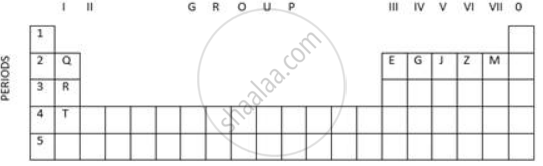
(a) State the number of valence electrons in the atom J.(b) Which element shown forms ions with a single negative charge?
(c) Which Metallic element is more reactive than R?
(d) Which element has its electrons arranged in four shells?
Arrange the following as per instruction given in the bracket.
K, Pb, Ca, Zn (increasing reactivity)
Arrange the following in order of increasing radii:
Mg2+, Mg, Mg+
Arrange the following in order of increasing radii:
N, O, P
Choose the word or phrase from the bracket which correctly complete each of the following statement:
Metals are good ................. (oxidising agents/reducing agents) because they are electron ............. (acceptors/donors).
Write the electronic configuration of element 17T35.
- What is the group number of T?
- What is the period number of T?
- How many valence electrons are there in an atom of T?
- What is the valency of T?
- Is it a metal or non-metal?
- State number of protons and neutrons in T.
Going across a period left to right, atomic size _____.
An element A has 2 electrons in its fourth shell. State:
is it a metal or non-metal
Based on the group valency of element write the molecular formula of the following compound giving justification:
Compound formed when an element A of group 2 combines with an element B of group seventeen.
The position of certain elements in the Modern Periodic Table is shown below:
| Group → Period ↓ |
1 | 2 | 3 to 12 | 13 | 14 | 15 | 16 | 17 | 18 |
| 1 | G | H | |||||||
| 2 | A | I | B | C | |||||
| 3 | D | E | F |
Using the above table answer the following questions giving reasons in each case:
- Which element will form only covalent compounds?
- Which element is a non-metal with valency 2?
- Which element is a metal with valency 2?
- Out of H, C, and F which has the largest atomic size?
- To which family does H, C, and F belong?
Write the electronic configuration of two elements A and B whose atomic numbers are 20 and 17 respectively. Write the molecular formula of the compound formed when element A reacts with element B. State whether this compound is acidic, basic or neutral. Give a reason to justify your answer.
Name the elements in the correct order of their increasing atomic numbers present in the first, second, and third short periods of the periodic table.
State which of the elements are –
- metallic
- non-metallic
- noble gases
in each of the periods 2 and 3.
Select the correct answer from the options given below.
It is a period having elements from atomic no. 11 to 18.
Select the correct answer from the options given below.
Is the group number of the element whose atomic number is 4.
Complete the table pertaining to the following elements given in Column I.
| Column I Elements | Atomic Number | Electronic Configuration | Underline the element present in that group |
| 1. Hydrogen | 1 | ______ | Be/Na/Ca |
| 2. Carbon | 6 | ______, ______ | N/P/Si |
| 3. Nitrogen | 7 | _______, ______ | C/P/S |
| 4. Oxygen | 8 | _______, ______ | N/S/Cl |
| 5. Sulphur | 16 | _____, ______, _______ | O/N/F |
| 6. Chlorine | 17 | _____, ______, ______ | I/O/S |
