Advertisements
Advertisements
प्रश्न
Name or state following with reference to the element of the first three periods of the periodic table.
A non-metal in period 2 having electronic configuration 2, 6.
Advertisements
उत्तर
O [Oxygen]
APPEARS IN
संबंधित प्रश्न
Calculate the number of gram atoms in 4.6 grams of sodium (Na = 23)
Rewrite the following statement after correction, if necessary:
The metallic character of elements in a period increases gradually on moving from left to right.
Explain why, the properties of elements are repeated after 2, 8, 18 and 32 elements in the periodic table.
Which of the following is the valence shell for the elements of second period of the modern periodic table?
(a) M shell
(b) K shell
(c) L shell
(d) N shell
Four elements P, Q, R and S belong to the third period of the Modern Periodic Table and have respectively 1, 3, 5 and 7 electrons in their outermost shells. Write the electronic configurations of Q and R and determine their valences. Write the molecular formula of the compound formed when P and S combine.
Select the correct answer
Most reactive character among the elements given below is found in
The following table represents the first period of the modern periodic table. Study the table and answer the questions that follow: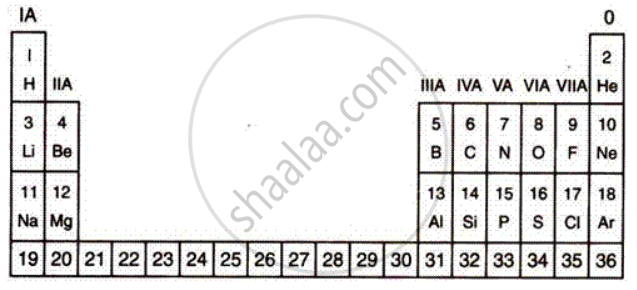
- Write the formula of the sulphate of the element with atomic number 13.
- What type of bonding will be present in the oxide of the element with atomic number 1?
- Which feature of the atomic structure accounts for the similarities in the chemical properties of the elements in group VIIA of the periodic table?
- Name the element which has the highest ionization potential.
- How many electrons are present in the valence shell of the element with atomic number 18?
- What is the name given to the energy released, when an atom in its isolated gaseous state accepts an electron to form an anion?
- What is the electronic configuration of the element in the third period which gains one electron to become an anion?
- Fill in the blanks:
The atomic size ______ as we move from left to right across the period, because the ______ increases, but the ______ remains the same.
Arrange the following as per instruction given in the bracket.
Cs, Na, Li, K, Rb (decreasing electronegativity)
Arrange the following as per instruction given in the bracket.
Li, K, Na, H ( decreasing order of their potential ionisation )
There are three elements E, F, G with atomic numbers 19, 8 and 17 respectively.
Classify the above elements as metals and non-metals.
