Advertisements
Advertisements
Question
Taking into consideration the period of the elements given below, answer the following questions:
| Elements | Atomic Radius (pm) |
| O | 66 |
| B | 88 |
| C | 77 |
| N | 74 |
| Be | 111 |
| Li | 152 |
- Arrange the above elements in decreasing order of their atomic radii.
- State the period to which the above elements belong.
- Why this arrangement of elements is similar to the above period of modern periodic table?
- Which of the above elements have the biggest and the smallest atom?
- What is the periodic trend observed in the variation of atomic radius while going from left to right within a period?
Advertisements
Solution
- Li > Be > B > C > N > O
- 2nd period
- Yes, this elemental arrangement resembles the era of the contemporary periodic table mentioned above. The positive charge on the nucleus grows one unit at a time as we move from left to right over a period of time, but when electrons are added to the same orbit, the pull away from the nucleus increases, reducing the size of the atom.
- Li is the biggest atom oxygen is the smallest atom
- While going from left to right within a period atomic radius decreases due to an increase in effective nuclear charge.
APPEARS IN
RELATED QUESTIONS
The atomic masses of three elements A, B and C having similar chemical properties are 7, 23 and 39, respectively.
- Calculate the average atomic mass of elements A and C.
- Compare the average atomic mass with atomic mass of B.
- What could the elements A, B and C be?
Name any two elements of group one and write their electronic configurations. What similarity do you observe in their electronic configurations? Write the formula of oxide of any of the aforesaid elements.
Two elements ‘A’ and ‘B’ belong to the 3rd period of Modern periodic table and are in group 2 and 13, respectively. Compare their following characteristics in tabular form:-
(a) Number of electrons in their atoms
(b) Size of their atoms
(c) Their tendencies to lose electrons
(d) The formula of their oxides
(e) Their metallic character
(f) The formula of their chlorides
Write any one difference in the electronic configurations of group-1 and group-2 elements ?
Which element has a total of two shells, with three electrons in its valence shell?
Classify the following elements into metals, non-metals and metalliods
As, C, Hg, Mg, S, Si
Use the letters only written in the Periodic Table given below to answer the questions that Follow:
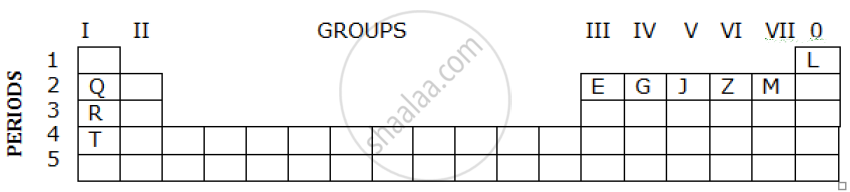
- State the number of valence electrons in atom J.
- Which element shown forms ions with a single negative charge?
- Which metallic element is more reactive than R?
- Which element has its electrons arranged in four shells?
How does the valency of elements vary in going down a group of the periodic table?
Fill in the blank in the following statement:
On going down in a group in the periodic table, the metallic character of elements ...............
How does Nature of oxides of elements change on going from left to right in a period of the periodic table?
Give examples in support of your answer.
What happens to the metallic character of the elements as we move from left to right in a period of the periodic table?
On moving from left to right in a period of the periodic table, the atomic number of elements increases. What happens to the size of atoms of elements on moving from left to right in a period?
(a) increases
(b) decreases
(c) remain the same
(d) first increases then decreases
The atomic numbers of three elements A, B and C are given below:
| Element | Atomic number |
| A | 5 |
| B | 7 |
| C | 10 |
(i) Which element belongs to group 18?
(ii) Which element belongs to group 15?
(iii) Which element belongs to group 13?
(iv) To which period/periods do these elements belong?
Periodicity is observed due to the similar ______.
Correct the statements.
Elements in the same periods have equal valency.
An element barium has atomic number 56. Look up its position in the periodic table and answer the following question.
Is it more or less reactive than calcium?
How do the following change on moving from left to right in a period of the periodic table?
Give examples in support of your answer.
atomic structure (electron arrangements) ?
Chorine in the periodic table is surrounded by the elements with atomic number 9, 16, 18 and 35.
Which is more electronegative than chlorine?
An element 'X' (Atomic number – 20) burns in the presence of oxygen to form a basic oxide.
(a) Identify the element and write its electronic configuration.
(b) State its group number and period number in the Modern Periodic Table.
(c) Write a balanced chemical equation for the reaction when this oxide is dissolved in water.
Write two reasons responsible for the late discovery of noble gases?
On the basis of electronic configuration, how will you identify the first and the last element of a period?
Fill in the blank
Oxidising property ________from fluroine to iodine because the power to accpet electron decreases.
Select the correct answer
Number of shells in potassium are
State the number of elements in period 1, period 2 and period 3 of the periodic table.
Copy and complete the following sentence choosing the correct word or words from those given below, at the end of the sentence:
The similarities in the properties of elements belonging to a group are because they have the same ______
The elements of one short period of the periodic table are given below in order from left to right:
Li Be B C O F Ne
(a) To which period do these elements belong?
(b) One element of this period is missing. Which is the missing element and where should it be placed?
(c) Place the three elements, fluorine, beryllium and nitrogen, in the order of increasing electro negativity.
(d) Which one of the above elements belongs to the halogen series?
Choose the word or phrase from the bracket which correctly complete each of the following statement:
Metals are good ................. (oxidising agents/reducing agents) because they are electron ............. (acceptors/donors).
The position of elements A, B, C, D and E in the periodic table are shown below:
|
Group 1 |
Group 2 |
Group 17 |
Group 18 |
|
|
|
|
D |
|
|
B |
C |
|
|
A |
|
|
E |
Which is larger in size (i) D or E (ii) B or C
An element belongs to the third period and Group IIIA (13) of the periodic table. State: the number of valence electrons,
(a) Fill in the blanks and rewrite the completed statements:
(i) ________ group in the periodic table contains elements that are all gases at room temperature.
(ii) Very fine particles mainly scatter ______ light.
What is the common feature of the electronic configuration of the elements at the end of Period 2 and Period 3?
Name or state following with reference to the element of the first three periods of the periodic table.
The non-metallic element present in period 3 other than sulphur and chlorine.
Name or state following with reference to the element of the first three periods of the periodic table.
The formula of the hydroxide of the element having electronic configuration 2, 8, 2.
Select the correct answer from the options given below.
It is a metal in period 2 having electronic configuration 2, 1?
Fill in the blanks from the words A to F given below.
A: Decreases
B: Increases
C: Remains same
D: Increases by one
E: Electropositive
F: Electronegative
Down a group in the Modern Periodic Table.
No. of electron shells __________; No. of valence electrons ________; Electronegativity ________ Character of elements changes from _________ to ____________.
State the following:
The group which contains highly electropositive metals including sodium.
