Advertisements
Advertisements
Question
Differentiate between Normal elements and Transition elements.
Advertisements
Solution
| Normal Elements | Transition Elements |
| Elements belonging to groups 1 and 2, and 13 to 17 are called normal elements. | Elements belonging to groups 3 to 12 are called transition elements. |
| In these elements, all the inner shells are completely filled except the outermost shells. |
In these elements, the outermost shell and next to the outermost shell (penultimate shell) are incomplete. |
APPEARS IN
RELATED QUESTIONS
The elements Be, Mg and Ca each having two electrons in their outermost shells are in periods 2, 3, and 4 respectively of the modern periodic table. Answer the following questions, giving justification in each case:-
(i) Write the group to which these elements belong.
(ii) Name the least reactive element.
(iii) Name the element having largest atomic radius.
From the following elements :
4Be; 9F; 19K; 20Ca
(i) Select the element having one electron is the outermost shell.
(ii) two elements of the same group.
Write the formula of and mention the nature of the compound formed by the union of 19K and element X(2, 8, 7).
The electrons in the atoms of four elements A, B, C and D are distributed in three shells having 1, 3, 5 and 7 electrons in the outermost shell respectively. State the period in which these elements can be placed in the modern periodic table. Write the electronic configuration of the atoms of A and D and the molecular formula of the compound formed when A and D combine.
What is meant by 'group' in the modern periodic table? How do the following change on moving from top to bottom in a group?
(i) Number of valence electrons
(ii) Number of occupied shells
(iii) Size of atoms
(iv) Metallic character of element
(v) Effective nuclear charge experienced by valence electrons
How do the valency and the atomic size of the elements vary while going from left to right along a period in the modern periodic table?
Which element has a total of two shells, with three electrons in its valence shell?
Use the letters only written in the Periodic Table given below to answer the questions that Follow:
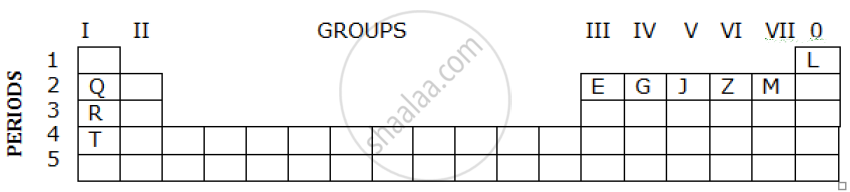
- State the number of valence electrons in atom J.
- Which element shown forms ions with a single negative charge?
- Which metallic element is more reactive than R?
- Which element has its electrons arranged in four shells?
The metal of Group 2 from top to bottom arc Be, Mg, Ca, Sr, and Ba.
1) Which one of these elements will form ions most readily and why?
2) State the common feature in the electronic configuration of all these elements.
In the following set of elements, one element does not belong to the set. Select this element and state why it does not belong:
Oxygen, Nitrogen, Carbon, Chlorine, Fluorine
Arrange the following elements in increasing order of their atomic radii:
Li, Be, F, N
Fill in the blank in the following statement:
On moving form right to left in the second period, the number of valency electrons ...............
How does the tendency to lose electrons change as we go down in group 1 of the periodic table? Why does it change this way?
Given alongside is a part of the periodic table. As we move vertically downward from Li to Fr:
| Li | Be |
| Na | |
| K | |
| Rb | |
| Cs | |
| Fr | Ra |
What happens to their metallic character?
Name two properties of elements whose magnitudes change when going from top to bottom in a group of the periodic table. In what manner do they change?
Which of the following element does not lose an electron easily?
(a) Na
(b) F
(c) Mg
(d) Al
In each of the following pair, choose the atom having the bigger size:
Na (At. No. 11) or K (At. No. 19)
Name two elements you would expect to show chemical reactions similar to calcium. What is the basis of your choice?
An element X belong to 4th period and 17th group, state.
name the family to which it belong.
An element barium has atomic number 56. Look up its position in the periodic table and answer the following question.
Is it more or less reactive than calcium?
Which element has:
twice as many electrons in its second shell as in its first shell?
Name the non-metals present in period 2 and metals in period 3.
An element 'X' (Atomic number – 20) burns in the presence of oxygen to form a basic oxide.
(a) Identify the element and write its electronic configuration.
(b) State its group number and period number in the Modern Periodic Table.
(c) Write a balanced chemical equation for the reaction when this oxide is dissolved in water.
What will be the valency of an element of atomic number 9 (nine)?
How do you calculate the possible valency of an element from the electronic configuration of its atoms?
Fill in the blank
Most electropositive elements belong to ______ group.
'In a group, the atomic radii increase with increasing period number', explain this statement and justify it with reference to group 17.
Select the correct answer
Number of shells in potassium are
Name the elements in period 1.
The following questions refer to the Periodic Table.
What is the common feature of the electronic configurations of the elements in group 7?
Give the number of the group and the period of elements having three shells with three electrons in valence shell.
Arrange the following as per instruction given in the bracket
Na, K, Cl, S, Si (increasing ionisation potential)
The elements of one short period of the periodic table are given below in order from left to right:
| Li | Be | B | C | O | F | Ne |
One element of this period is missing. Which is the missing element and where should it be placed?
Atomic numbers of elements A, B, C, D, E, F are 8, 7, 11, 12, 13 and 9 respectively. State the type of ions they form.
Fill in the blank and rewrite the completed statement:
________ group in the periodic table contains elements that are all gases at room temperature.
What is the common feature of the electronic configuration of the elements at the end of Period 2 and Period 3?
Name or state following with reference to the elements of the first three periods of the periodic table.
A metalloid in period 2 and in period 3.
Name or state following with reference to the element of the first three periods of the periodic table.
A non-metal in period 2 having electronic configuration 2, 6.
Name or state following with reference to the element of the first three periods of the periodic table.
A metal in period 3 having valency 3.
There are three elements E, F, G with atomic numbers 19, 8 and 17 respectively.
Classify the above elements as metals and non-metals.
