Advertisements
Advertisements
Question
State the property trends in general of elements on moving from left to right in a period of the periodic table.
Advertisements
Solution
Property trends of elements from left to right in a period:
- Number of electron shells remains the same.
- Valence electrons increase by one.
The transition from metallic to non-metallic character increases. - Size of atom decreases.
APPEARS IN
RELATED QUESTIONS
An element 'M' with electronic configuration (2, 8, 2) combines separately with (NO3)–, (SO4)2– and (PO4)3– radicals. Write the formula of the three compounds so formed. To which group and period of the Modern Periodic Table does the element 'M' belong? Will 'M' form covalent or ionic compounds? Give reason to justify your answer.
Fill in the blank in the following statement:
On moving form right to left in the second period, the number of valency electrons ...............
How does Chemical reactivity of elements change on going from left to right in a period of the periodic table?
Give example in support of your answer.
On the basis of electronic configuration, how will you identify the first and the last element of a period?
What is meant by a group in the periodic table?
Choose the most appropriate answer from the following list of oxides which fit the description.
An amphoteric oxide.
Use the letters only written in the Periodic Table given below to answer the questions that follow: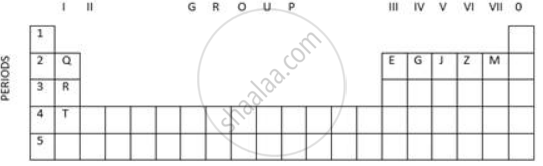
(a) State the number of valence electrons in the atom J.(b) Which element shown forms ions with a single negative charge?
(c) Which Metallic element is more reactive than R?
(d) Which element has its electrons arranged in four shells?
Based on the group valency of element write the molecular formula of the following compound giving justification:
Halide of the elements of group thirteen
Name or state following with reference to the element of the first three periods of the periodic table.
The valency of elements in group 1 [I–A].
There are three elements E, F, G with atomic numbers 19, 8 and 17 respectively.
Classify the above elements as metals and non-metals.
