Advertisements
Advertisements
प्रश्न
Answer the following question:
State the four blocks of the modern periodic table based on the electronic configuration of elements.
Advertisements
उत्तर
Elements in the modern periodic table are classified on the basis of their electronic configuration. They are divided into four blocks: s – block, p – block, d – block, and f – block.
APPEARS IN
संबंधित प्रश्न
Fill in the blank:
The formulae of chloride of metal M is MCl2. The metal M belongs to ……………. group.
The atomic numbers of three elements A, B and C are 12, 18 and 20 respectively. State, giving reason, which two elements will show similar properties.
The electrons in the atoms of four elements A, B, C and D are distributed in three shells having 1, 3, 5 and 7 electrons in the outermost shell respectively. State the period in which these elements can be placed in the modern periodic table. Write the electronic configuration of the atoms of A and D and the molecular formula of the compound formed when A and D combine.
Based on the group valency of elements state the formula lot the following giving justification for each :-
(i) Oxides of 1st group elements,
(ii) Halides of the elements of group 13, and
(iii) Compounds formed when an element of group 2 combines with, an element of group 16.
Define the term : Valency
Define the term : Atomic size
Consider two elements 'A' (Atomic number 17) and 'B' (Atomic number 19) :
(i) Write the positions of these elements in the modern periodic table giving justification.
(ii) Write the formula of the compound formed when 'A' combines with 'B.'
(iii) Draw the electron dot structure of the compound and state the nature of the bond formed between the two elements.
The following table shows the electronic configuration of the elements W, X, Y, Z:
| Element | w | x | y | z |
| Electronic configurations |
2, 8, 1 | 2, 8, 7 | 2, 5 | 1 |
Answer the following questions based on the table above:
1) What type of Bond is formed between :
a) W and X
b) Y and Z
2) What is the formula of the compound formed between :
a) X and Z
b) W and X
Choose the most appropriate answer of the following:
Which of the following would weigh the least?
(A) 2-gram atoms of Nitrogen.
(B) 1mole of Silver
(C) 22.4 liters of oxygen gas at 1 atmospheric pressure and 273K
(D) 6.02 x 10²³ atoms of carbon.
[Atomic masses: Ag=108, N=14, O=16, C=12]
Calculate the mass of Calcium that will contain the same number of the atom as are present in 3.2 gm of Sulphur.
[Atomic masses: S=32, Ca=40]
In the following set of elements, one element does not belong to the set. Select this element and state why it does not belong:
Oxygen, Nitrogen, Carbon, Chlorine, Fluorine
Arrange the following elements in increasing order of their atomic radii:
Li, Be, F, N
Arrange the following elements in the increasing order of their metallic character:
Mg, Ca, K, Ga
An element X belongs to group 2 and another element Y belongs to group 15 of the periodic table:
(a) What is the number of valence electron in X?
(b) What is the valency of X?
(c) What is the number of valence electrons in Y?
(d) What is the valency of Y?
Explain how you have arrived at your answers.
The electronic configuration of the atom of an element X is 2, 8, 4. In modern periodic table, the element X is places in :
(a) 2nd group
(b) 4th group
(c) 14th group
(d) 8th group
Which of the following element would lose an electron easily?
(a) Mg
(b) Na
(c) K
(d) Ca
The element which has the maximum number of valence electrons is:
(a) Na
(b) P
(c) Si
(d) A
How does the number of:
valence electrons and
Fill in the blank:
on moving from right to left in the second period, the number of valence electrons……….
Fill in the blank
There are ______ groups and ______ periods in the modern form of periodic table.
Fill in the blank
Most electropositive elements belong to ______ group.
State whether the following statement is true or false
Similar electronic configuration is repeated after intervals of 2, 8, 8, 18 and 32.
Explain
Size of atom changes when it loses or gain electron
Copy and complete the following sentence choosing the correct word or words from those given below, at the end of the sentence:
The similarities in the properties of elements belonging to a group are because they have the same ______
Parts (i) to (v) refer to changes in the properties of elements on moving from left to right across a period of the periodic table. For each property, choose the letter corresponding to the correct answer from the choices (a), (b), (c) and (d).
(i) The non metallic character of the elements:
(a) Decreases
(b) Increases
(c) Remains the same
(d) Depends on the period
(ii) The electro negativity
(a) Depends on the number of valence electrons
(b) Remains the same
(c) Decreases
(d) Increases
(iii) The ionization potential
(a) Goes up and down
(b) Decreases
(c) Increases
(d) Remains the same
(iv) The atomic size
(a) Decreases
(b) Increases
(c) Remains the same
(d) Sometimes increases and sometimes decreases
(v) The electron affinity of the elements in groups 1 to 7:
(a) Goes up and down
(b) Decreases and then increases
(c) Increases
(d) decreases
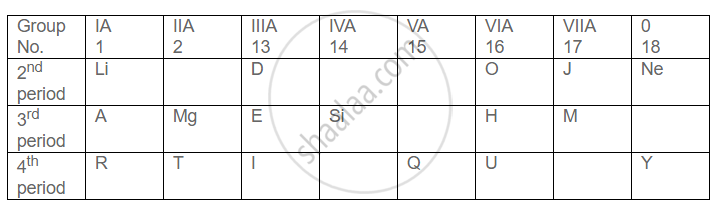
In the above table, H does not represent hydrogen.Some elements are given in their own symbol and position in the periodic table while others are shown with a letter. With refrence to the table answer the following questions.
1. Identify the most electronegative element.
2. Identify the most reactive element of Group I.
3. Identify the element from Period 3 with least atomic size.
4. How many valence electrons are present in Q?
5. Which element from group 2 would have the least ionisation energy?
6. Identify the noble gas of the fourth period.
7. In the compound between A and H, what type of bond would be formed and give its molecular formula.
Arrange the following as per the instruction given in the bracket
He,Ar,Ne (Increasing order of the number of electron shells)
The elements of one short period of the periodic table are given below in order from left to right:
| Li | Be | B | C | O | F | Ne |
Which one of the above elements belongs to the halogen series?
An element belongs to the third period and Group IIIA (13) of the periodic table. State: if it is a metal or non-metal?
State the nature of compounds formed when group 17 elements combine with (i) metals (ii) non-metals.
The electronic configuration of an element is 2, 8, 4. State it:
name and write its one physical property.
What is the common feature of the electronic configuration of the elements at the end of Period 2 and Period 3?
What is meant by a Group in the Periodic Table?
Select the correct answer from the options given below.
It is a metal in period 2 having electronic configuration 2, 1?
Select the correct answer from the options given below.
Is the group number of the element whose atomic number is 4.
Fill in the blanks from the words A to F given below’.
A: Decreases
B: Increases
C: Remains same
D: Increases by one
E: Electropositive
F: Electronegative
Across a period from left to right in the Modern Periodic Table.
No. of electron shells _________; No. of valence electrons __________: Electronegativity increases Character of elements changes from electropositive to ________.
State the following:
The group to which the element with an electronic configuration of 2, 8, 2 belongs.
